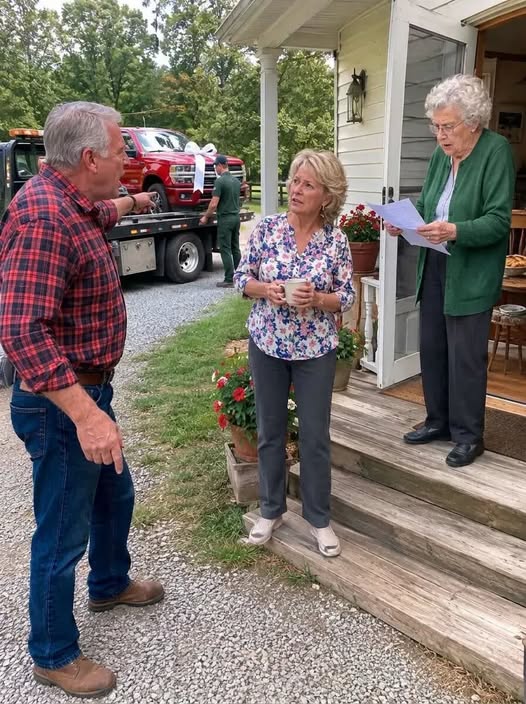
PART 6 — THE QUESTION HE DIDN’T EXPECT
A week later, Delmas came into the kitchen while I was putting away the clean dishes. He stood near the doorway for a moment, then asked whether I could drive him to the feed store. I put a plate into the cupboard and asked what he needed there. He said he had to pick up some feed. I waited for him to explain why he couldn’t take the truck, even though we both knew the answer. Finally, he said, “I don’t have a truck now.” I looked at him and replied, “I noticed.” He frowned, clearly expecting me to offer a solution. I had spent years anticipating his needs before he even asked. This time, I wanted him to understand that losing the truck was not a problem I had created. He had made the purchase, and he had made the promise to pay.
He looked irritated and asked whether I was really going to make things difficult over a truck. I told him I could drive him, but there was something he needed to do first. His eyebrows rose. I explained that he had told people at the dealership and around town that I was paying for the vehicle. Now that it had been taken away, he needed to correct that story. I wasn’t asking him to apologize to everyone or announce that he had behaved badly. I simply wanted him to tell the truth. He had purchased the truck without my permission, and I had never agreed to pay for it. He asked why he should have to explain himself. I answered that if he had been comfortable telling people I would pay, he should be comfortable telling them I hadn’t.
For a moment, he looked as though he might argue. Then he glanced toward the front door, perhaps hoping I would change my mind. I picked up my keys and waited. He finally said, “Fine.” We drove to the feed store in silence. When we entered, two men standing near the counter recognized him. One of them asked whether he had managed to get that new red truck home. Delmas stopped walking. I stood beside him, holding my keys. He looked toward the counter, then toward the floor. I didn’t interrupt or answer for him. This was his opportunity to say what had happened. He took a breath and replied, “No. I didn’t.” It was only three words, but I knew they had cost him something.
He picked up his feed and carried it out to the car. I unlocked the passenger door, and he climbed inside without looking at me. On the drive home, he didn’t say much. I could tell he was still angry, but something had changed. For once, he had been forced to acknowledge that his decisions had consequences. I didn’t feel the need to lecture him. I wasn’t interested in humiliating him or making him suffer. I simply wanted him to stop treating my money as though it were automatically his. The inheritance from Mama was not a prize for the person who could claim it first. It was something she had left to her daughter, with a clear instruction to protect it. I intended to honor that instruction.
As we drove past Ethelene’s road, I noticed the new storm door. Its clean frame caught the afternoon light, and I smiled before I could stop myself. It was a small improvement, but it represented something important. I had used my own money to do something kind for someone who had treated me with honesty. I hadn’t bought her affection, and she hadn’t demanded a reward. We had simply respected one another. Delmas noticed me looking toward the house but didn’t ask what I was smiling about. I kept driving. I wasn’t sure what the next chapter of our marriage would look like, but I knew that I wasn’t going to spend the rest of my life paying for things simply because someone expected me to.
