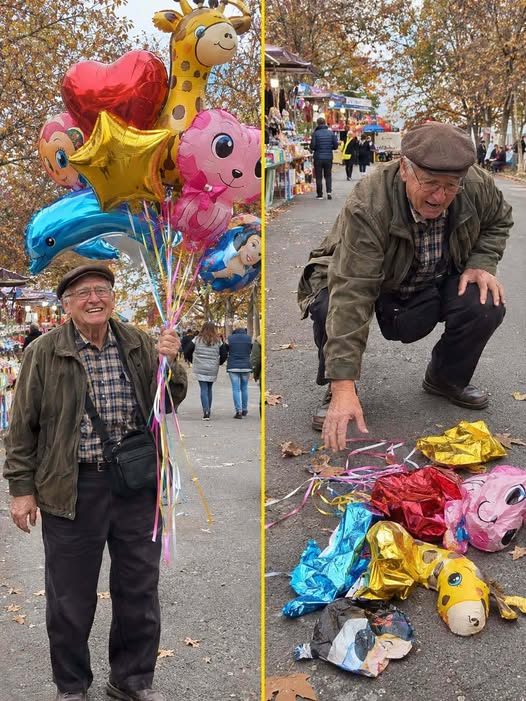
PART 1 — THE LITTLE GIRL WHO CALLED ME PAPA
My name is August Thompson, but almost everyone calls me Gus. I’m seventy-four years old, and I work nights as a custodian at Prairie View High School in Wichita, Kansas. Most people see an old man pushing a mop bucket through empty hallways, collecting trash, and wiping fingerprints from trophy cases. They don’t see the life that waits for me when I leave the school. They don’t see the little girl who runs to the door when I come home, or the purple sneakers that flash every time she stomps her feet. Her name is Sadie. She’s six years old, and she’s my granddaughter. She’s also the reason I started selling balloons every weekend. Four years ago, a car accident took my daughter Lacey, her husband Dan, and their five-year-old boy Wyatt. Sadie, who was only two at the time, was the sole survivor. I still remember the hospital waiting room, the chaplain’s quiet voice, and the doctor struggling to find words gentle enough to tell me that my family was gone.
When the nurse finally brought Sadie to me, she was wrapped in a white hospital blanket. She had a scrape on her forehead, a bandage on one arm, and her little hair sticking up in every direction. She looked at me with her mother’s brown eyes, reached out both arms, and whispered, “Papa.” I was seventy years old. My wife, Dolores, had died in 2019, and I had imagined spending my retirement quietly. I had already spent thirty-eight years welding aircraft parts at Boeing. I knew how to work with metal, how to repair a damaged joint, and how to follow a precise blueprint. But I didn’t know how to raise a two-year-old girl alone. I didn’t know how to comfort a child who woke in the night calling for a mother who would never come through the bedroom door again. Still, when Sadie reached for me, I held her close and made a promise I would spend every remaining day trying to keep: she would never have to face the world alone.
I learned everything the hard way. I watched videos at two in the morning to figure out how to braid her hair. I practiced on a doll until I could make two braids that didn’t look like tangled rope. I learned that she preferred Cheerios and refused Froot Loops, that she needed her stuffed rabbit, Mr. Buttons, before she could sleep, and that darkness frightened her. I bought a moon-shaped nightlight and left it glowing beside her bed. When she cried for her mother, I held her until her breathing slowed and her little hands relaxed. I learned how to pack school lunches, wash tiny clothes, and recognize the difference between an ordinary childhood tantrum and the deep sadness that sometimes settled over her. I was not perfect. Some mornings I was exhausted, and some nights I sat alone after she fell asleep, wondering whether I was doing enough. But every morning, Sadie woke up and called me Papa, and that gave me a reason to try again.
My pension and Social Security covered some of our expenses, but raising a child costs more than an old man expects. I applied for jobs at stores, warehouses, and hardware shops. Many employers were polite, but nobody seemed interested in hiring a seventy-year-old man. I took whatever work I could find: mowing lawns, shoveling snow, repairing fences, cleaning gutters, and doing small welding jobs for a trailer repair shop. Eventually, Prairie View High School hired me as a night custodian. The head custodian, Reggie Coleman, asked whether I could lift fifty pounds. I told him I lifted a six-year-old every night, and she wiggled. He laughed and gave me the job. It came with steady pay and health insurance. My neighbor, Mrs. Ruiz, watched Sadie while I worked. She was a retired nurse and a widow, and Sadie called her Abuela. Between the school job, my pension, and Mrs. Ruiz’s help, I thought we might finally be getting ahead.
Then Sadie became sick. At first, I thought she was simply tired from school. But she began developing bruises that she couldn’t explain, and a fever wouldn’t go away. The doctors ran tests, then more tests, and finally I heard the word no grandparent ever wants to hear: leukemia. I remember sitting in the hospital while Dr. Mehta explained the treatment, trying to understand medical words while my mind kept returning to the same question: How could this happen to another child in my family? Sadie had already lost her parents and brother. Now she was facing cancer at six years old. The treatment was expensive, and even with insurance, the bills kept growing. I looked at the little girl in the hospital bed and knew I would do anything I could to give her a chance. That was when I started selling balloons on weekends. I didn’t care if people thought a seventy-four-year-old man looked foolish standing beside a cart full of bright rubber shapes. Every balloon sold meant another few dollars toward Sadie’s treatment.
