PART 1
For forty-four years, Christmas Eve had belonged to Merritt and me. It was more than a holiday tradition or an excuse to enjoy a nice dinner away from the kitchen. It was the one evening each year when we deliberately put everything else aside and remembered why we had chosen to build a life together. No matter how difficult the months had been, no matter how many bills waited on the counter or how many responsibilities demanded our attention, we always made room for that one evening. Every December, I would take my time getting ready, choosing something pretty to wear while Merritt shaved, polished his shoes, and complained about how quickly the years seemed to pass. Then we would drive to the Branding Iron, a familiar restaurant that had become almost like a second home to us. The hostess knew our names, and the waiters knew exactly which table we preferred. It was the corner booth beneath the little brass lamp, where we could sit close together and watch the other families celebrating. We always ordered steak, shared a dessert, and talked about the Christmases when our children were little. Sometimes we laughed about the ridiculous things our daughter, Jolynn, had said as a child. Other times, we remembered the years when money was so tight that we could barely afford presents, but somehow we had always managed to make the holiday feel special. Those dinners reminded me that a marriage was not measured only by the years a couple survived together. It was also measured by the little promises they continued keeping, even when life became difficult. I believed our Christmas Eve dinner was one of those promises, something that would remain ours until we were too old to leave the house.
That was why Merritt’s announcement hurt more than I initially allowed myself to show. It happened on an ordinary afternoon in early December. I was standing in the kitchen, sorting through the grocery receipts, when he came in carrying a stack of bills. He placed them on the table, pulled out a chair, and began arranging the envelopes into neat piles. His expression was serious, and I immediately understood that he wanted to discuss money. We had been watching our expenses more carefully lately. The truck needed attention, the heating bill had increased, and several unexpected costs had arrived within the same month. I knew we were not as comfortable financially as we had been years earlier, but I had assumed we could still afford our traditional dinner. After all, it happened only once a year. Merritt looked at the figures and shook his head. “We can’t do the Branding Iron this Christmas,” he said. I stopped folding the grocery receipt in my hand. “Why not?” I asked, although I already suspected the answer. He tapped one of the bills with his finger. “The truck needs new tires. They’re getting dangerous, and I can’t keep putting it off. And ninety dollars for supper is too much to spend on you this year.” He said it casually, almost as though he were discussing the price of a loaf of bread. I looked at him, waiting for him to soften the words or explain that perhaps we could find a cheaper place. But he simply returned to studying the bills. I nodded and told him I understood. I didn’t want to turn a conversation about money into an argument. Still, something inside me sank. After forty-four years, I had never imagined that our little Christmas tradition would disappear because one evening’s dinner had suddenly become an unreasonable expense.
I tried to convince myself that I was being sentimental and that Merritt was simply being practical. We had spent decades making sacrifices for our family, and perhaps this was another season when we needed to be sensible. I reminded myself that the truck was important, especially during winter, and that new tires were not something we could ignore. Yet the way he had said “on you” continued to bother me. It made the dinner sound like an unnecessary luxury I was asking him to purchase for my own pleasure. I had never thought of it that way. We had always gone together. We had always shared the expense, the food, the memories, and the evening. It was not something I demanded from him. It was something we had built together. Later that afternoon, I went into the bedroom and opened the closet. Hanging near the back was a green dress I had purchased a few days earlier. It was simple, with a flattering waist and sleeves that made it suitable for a December evening. I had found it on sale for thirty-four dollars and had spent several minutes deciding whether I could justify buying it. Eventually, I had told myself that after years of putting everyone else first, I deserved one small gift. I imagined wearing it to the Branding Iron, perhaps with my mother’s pearl earrings and the black shoes I had kept for special occasions. Now, standing in front of the closet, I felt foolish for having allowed myself to look forward to something. I pulled the dress from its hanger and examined the price tag. Thirty-four dollars. It seemed like such a small amount compared with everything we had spent over the years. Still, I remembered Merritt’s warning about money, and I hung it back up. I even considered returning it, although the thought of walking into the store and explaining why I had changed my mind made me feel embarrassed.
During the following days, I became almost excessively careful with our household spending. I planned meals around what we already had in the cupboards, compared prices at the grocery store, and avoided buying anything that was not absolutely necessary. I found six dollars in savings by choosing different products and leaving a few items off the list. When Merritt noticed the smaller grocery bill, he nodded approvingly. “That’s better,” he said. I smiled, pretending that I felt proud rather than disappointed. I wanted him to see that I was willing to help. I wanted him to understand that I had never expected us to spend money we did not have. But a part of me wondered why saving six dollars on groceries seemed so important when our Christmas dinner had already been canceled. I thought about the little brass lamp above our booth and the way the candlelight always reflected in Merritt’s glasses. I remembered how he used to reach across the table and take my hand while we waited for dessert. There had been years when we had argued about ordinary things, years when the children needed money and work kept us busy, and years when we barely had enough energy to enjoy the holidays. Yet we had always gone. Sometimes the restaurant had been crowded, sometimes the weather had been terrible, and sometimes we had arrived so tired that we could hardly keep our eyes open. None of that had mattered. We went because it was ours. As Christmas approached, I began accepting that this year would be different. I told myself we could have a quiet dinner at home. I even thought about preparing something special, perhaps a roast with potatoes and vegetables, and setting the table with the good dishes. If Merritt wanted to save money, I would not make him feel guilty for it. I believed that was what a supportive wife was supposed to do. I had no idea that the real reason for canceling our dinner had nothing to do with the price of steak.
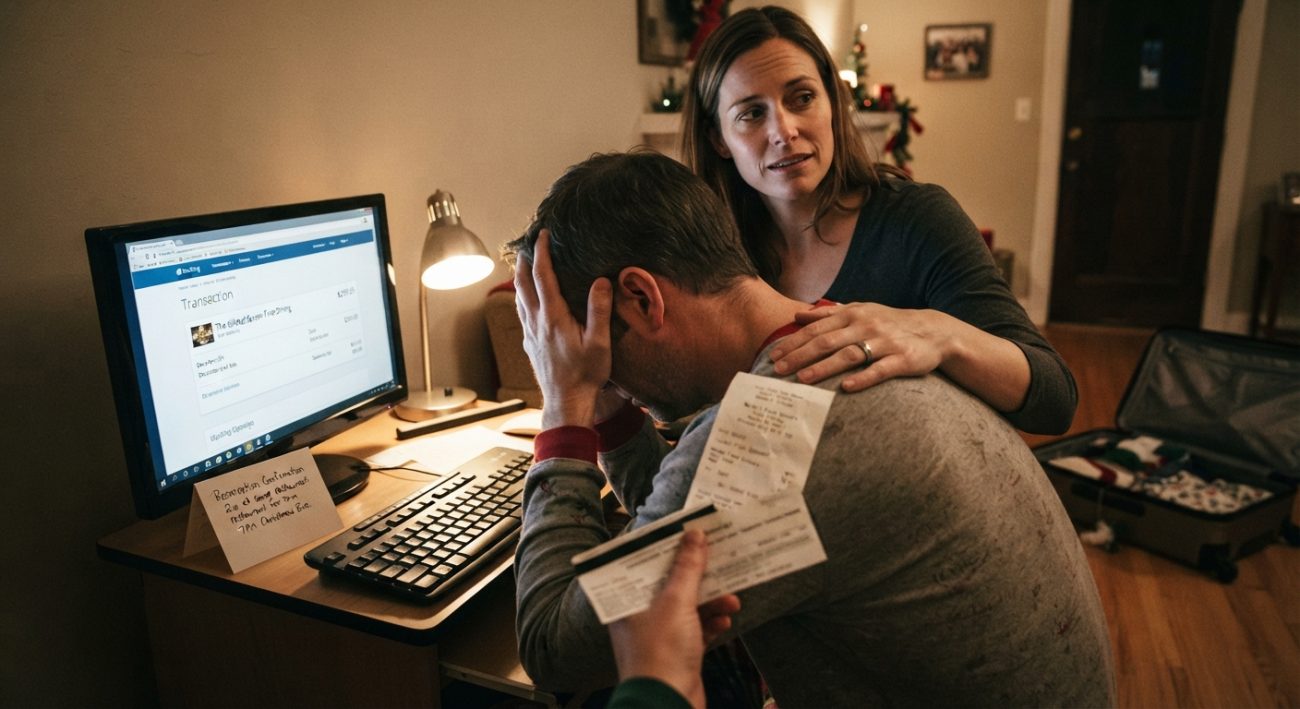
Three days before Christmas Eve, the Branding Iron called. I was in the kitchen rinsing a coffee cup when the telephone rang. I wiped my hands on a towel and answered, expecting perhaps a delivery notice or a call from Jolynn. Instead, a pleasant woman’s voice introduced herself as someone from the restaurant. She asked whether we were still keeping our Christmas Eve reservation for three. I stood completely still. At first, I thought I had misheard her. “I’m sorry,” I said. “Did you say three?” The woman checked something on her screen and confirmed that the reservation was under Merritt’s name. It was scheduled for seven o’clock on Christmas Eve, in the corner booth we had requested for decades. She added that they had made a note about the table and that a candle would be waiting when we arrived. I thanked her automatically, although my thoughts had already begun racing. When I hung up, I remained beside the kitchen counter with the telephone in my hand. The refrigerator hummed, the clock ticked above the doorway, and somewhere outside a car passed through the street. Everything looked exactly as it had a few moments earlier, but suddenly I felt as though I had stepped into a different version of my own life. Merritt had told me we could not afford dinner for two. Yet he had reserved a table for three. I tried to find an innocent explanation, but every possibility led to another question. Had he planned to surprise me? Was someone from his family joining us? Or was there a person in his life whose existence I had never been told about? I wanted to believe it was something harmless. But the lie about the truck tires had already made that difficult. For the first time in forty-four years, I began wondering whether I truly knew the man I had married.
