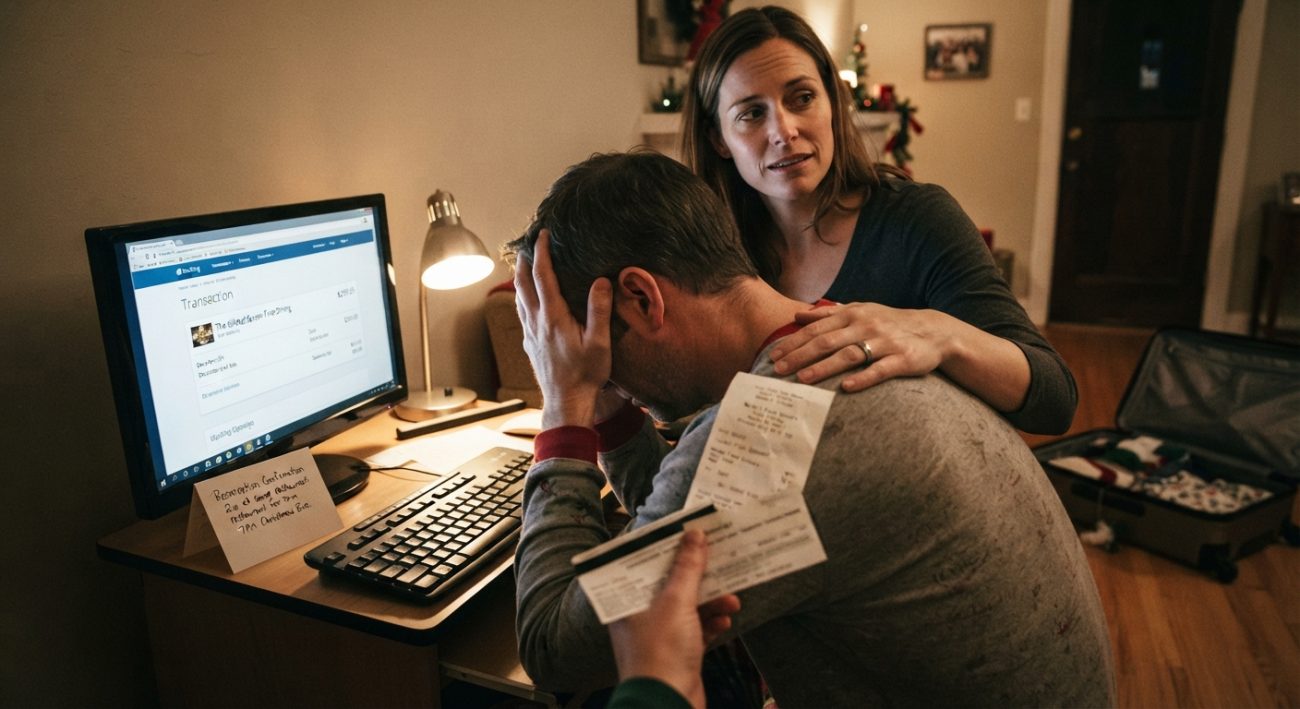
I spent the rest of that afternoon trying to behave as though nothing unusual had happened. When Merritt came into the kitchen, I was putting away the groceries. He greeted me, asked whether the mail had arrived, and opened the refrigerator to look for something to drink. I watched him carefully, searching his expression for some indication that he knew the restaurant had called. He seemed perfectly relaxed. If anything, he appeared to be in a particularly good mood. He hummed quietly while looking through the shelves, then asked whether I had seen the wrapping paper he had purchased. I told him it was in the hallway cupboard. He thanked me and went to retrieve it. A few minutes later, I heard the sound of tape being pulled from a dispenser. When I walked into the living room, he was wrapping a small present in silver paper. He had placed it on the coffee table and was carefully folding the corners. I stood in the doorway, pretending to look for something. “Who is that for?” I asked. Merritt didn’t look up immediately. “Just something for a work friend,” he replied. His answer came so quickly that I almost wondered whether he had prepared it in advance. “A work friend?” I repeated. “Yes. Someone who’s been helping me with a few things.” He pressed the final piece of tape against the paper and folded the wrapping into place. I wanted to ask what kind of help this person had provided, but I held back. Merritt had already told me we were struggling financially, and perhaps the present was something inexpensive. Still, I could not stop thinking about the three-person reservation. The little box on the coffee table suddenly seemed connected to the secret I was trying not to imagine.
That night, sleep refused to come. Merritt fell asleep beside me, breathing steadily, while I stared at the ceiling and listened to the familiar sounds of the house. The heating system clicked on and off. A branch brushed against the window. Somewhere in the distance, a dog barked. I had shared a bed with this man for more than four decades, and I knew the smallest details of his habits. I knew how he turned toward the window when he was worried, how he rubbed his forehead when he was concentrating, and how he sometimes woke in the middle of the night to check whether the doors were locked. I knew his favorite meals, the stories he repeated, and the jokes he never remembered telling. I had believed that knowing someone for that long meant there could be very few surprises left. But now I was questioning everything. I remembered our early years, when we were young and had almost nothing. I remembered the apartment where the pipes froze in winter, the first Christmas tree we bought together, and the excitement of bringing Jolynn home from the hospital. I remembered Merritt holding our daughter in his arms and promising that he would always protect her. Had he already been hiding something from me then? Had there been another woman? Another child? The possibility made my stomach tighten. I wanted to wake him and demand the truth, but I was afraid of what he might say. I also knew that confronting him without knowing anything could give him time to invent an explanation. So I remained quiet, collecting the little details that had seemed unimportant before. The phone calls he sometimes took outside. The occasional weekend errand he never explained. The sudden interest he had shown in keeping his personal messages private. None of those things proved anything, but together they formed a picture I could no longer ignore.
The next morning, Merritt behaved as though Christmas would be perfectly ordinary. He asked whether we needed anything from the store and complained about the weather forecast. I watched him butter his toast, wondering how a person could sit across from his wife and discuss groceries while secretly arranging a dinner that might change their marriage forever. I considered mentioning the phone call from the Branding Iron, but I decided against it. I wanted to see whether he would tell me himself. He did not. Instead, he spent part of the afternoon looking at his phone and smiling at something on the screen. When I entered the room, he turned it over and asked whether I had received a message from Jolynn. I said no. He nodded and returned to whatever he had been doing. That evening, I noticed he had taken the navy jacket from the closet. It was the one I had bought him for our anniversary. I remembered choosing it because the color suited him and because he had complained that his old jacket made him look older than he felt. He had been pleased with it, and I had enjoyed seeing him wear it. Now he was examining it in the mirror, brushing away a small piece of lint and checking the sleeves. I asked whether he was planning to go somewhere. “Just taking care of a few things,” he said. I looked at him for a moment. “On Christmas Eve?” He shrugged. “There’s always something to do.” His answer was ordinary, but his attention to his appearance was not. Merritt had never been a man who spent much time in front of the mirror. He usually dressed for dinner because it was our tradition, not because he needed to impress anyone. That night, however, he seemed unusually concerned with how he looked. I went to bed with the uncomfortable feeling that he was preparing for a meeting he had been anticipating for a long time.
As Christmas Eve approached, I began thinking about what I would do if the reservation turned out to mean exactly what I feared. I imagined arriving at the restaurant and finding another woman seated beside Merritt. I imagined discovering that he had been having an affair, that he had been spending money on someone else while telling me we needed to save every dollar. But the thought of another woman did not fully explain the reservation for three. If it were simply a romantic meeting, why would he need a third place setting? Perhaps the person was a relative or an old friend. Perhaps Merritt had arranged to meet someone from his past and planned to explain later. I kept returning to the same question: why had he not told me? Whatever the explanation, he had made a decision that involved our shared tradition without allowing me to participate in it. That was what hurt most. I had spent years believing we made important decisions together, even when we disagreed. If money was tight, we discussed it. If someone needed help, we considered it. If there was a family problem, we faced it as a family. Yet Merritt had quietly arranged something behind my back and had used the cost of our dinner as an excuse to keep me away. I began to feel less like a wife and more like someone who had been deliberately excluded from a part of her own life. Still, I did not know what I would say when I saw him. I rehearsed questions while washing dishes, folding laundry, and preparing meals. Each time, I imagined him denying everything. I wondered whether I would have the courage to stand in front of him and demand an honest answer.
On the morning of Christmas Eve, I made my decision. I would go to the Branding Iron. I did not know whether I would discover an affair, a hidden relative, or something even more painful. But I could not spend the evening sitting at home pretending that the call had never happened. I opened the closet and removed the green dress. The fabric felt softer than I remembered, and for a moment I thought about putting it away again. Then I looked at the price tag, which was still attached, and realized how much I had allowed Merritt’s words to influence me. I had bought the dress because I wanted to feel good about myself. I had no reason to surrender that small pleasure simply because my husband had decided not to share the truth. I removed the tag, placed it in a drawer, and laid the dress across the bed. I also took out my mother’s pearl earrings. They were not expensive, but they had been given to me many years earlier, and wearing them always made me feel connected to the woman who had taught me that dignity was something no one could take away unless we allowed it. I polished the earrings carefully, set them beside the dress, and began preparing for the evening. I would not go there to create a scene. I would go because I deserved to know why the man who had shared forty-four Christmases with me had suddenly decided that I was not entitled to the truth.
