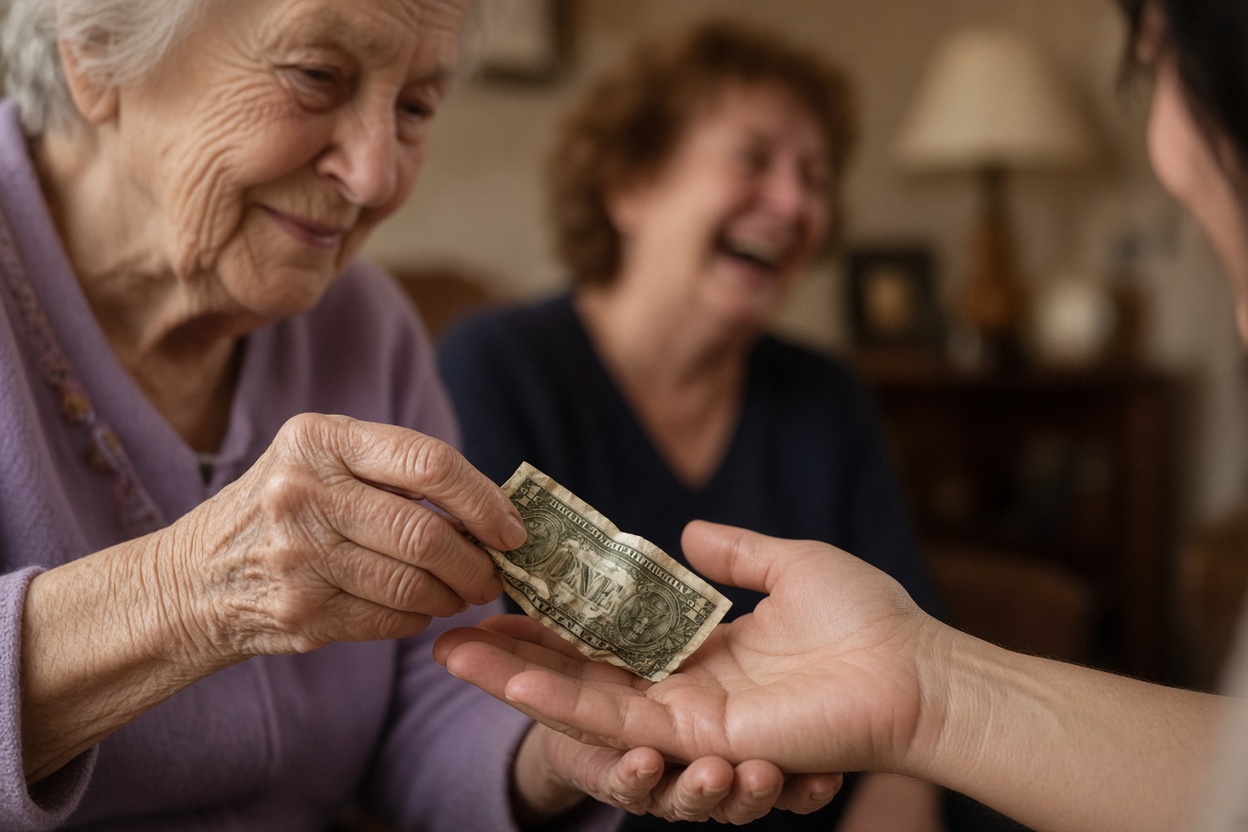
When I received my first paycheck as a second-grade teacher, I felt a kind of pride I had never experienced before. It was not the largest paycheck, and after taxes and ordinary expenses, the amount was fairly modest. But it represented something important. I had completed my degree, secured a teaching job, and begun earning a living through the career I had worked toward for years. I remembered the little girl who used to sit at Grandma’s kitchen table doing homework while she prepared dinner after a long day of cleaning houses. I remembered the school supplies she had bought with money she could barely spare and the evenings she spent listening to me practice reading aloud. I also remembered the ten-dollar bill and the account that had been growing quietly in the background. That evening, I told Grandma that I wanted to make a deposit in her name. She laughed and asked why she needed a savings account when she already had everything she required. I told her that I had a different plan. I wanted to return to Mr. Halloway’s bank and open an account specifically for her. She protested that I should save my money for my own future, but I reminded her that she had spent eighteen years doing exactly that for me. Now I wanted to give her something that belonged entirely to her.
I returned to the old stone bank the following morning. Mr. Halloway recognized me immediately and asked how Grandma was doing. I told him that she was well and that I had finally started my teaching job. He smiled broadly and said he had always believed I would make a wonderful teacher. I explained that I wanted to open a savings account under Grandma’s name. I had brought a ten-dollar bill with me, and I planned to make regular deposits. Mr. Halloway looked at the bill and smiled when he realized what I was doing. I turned it over and showed him the writing on the back: “September 26, 2026. First deposit. For Grandma’s rest. Lucy.” He read the words carefully, then looked up at me. For a moment, he did not speak. His eyes had become wet. He explained that he had watched Grandma make deposits for eighteen years, and he had always admired her determination. She had never made a big show of what she was doing. She simply arrived, handed him the money, and asked him to make sure it was safe. Sometimes she came in with coins and small notes gathered from different places. Sometimes she had to wait until she had enough for the deposit. But she always returned. He said that seeing the tradition continue in the opposite direction meant more to him than he could explain.
He helped me complete the paperwork and arranged the account so I could make regular deposits. I told him I intended to put in ten dollars every week, just as Grandma had done for me. He asked whether I was certain. I said I was. It would not always be easy, and there might be weeks when I could afford only the smallest amount. But I wanted the commitment to be consistent. I wanted Grandma to know that she could use the money whenever she wanted without feeling guilty. I planned to save enough for her to take a trip, replace anything in the house that needed repairing, and enjoy experiences she had postponed for years. I also wanted to build a reserve for medical expenses and unexpected needs. Mr. Halloway entered the first deposit and placed the confirmation slip inside a small envelope. Before handing it to me, he asked whether I wanted to write a note for Grandma. I thought about it and decided to use the same words she had used with me for so many years. I wrote that the account was safe and that she never needed to worry about taking care of everyone alone. I thanked him, placed the receipt in my bag, and walked out feeling that something important had come full circle.
When I told Grandma about the new account, she looked at me as though I had done something far too generous. She said she had never expected anything in return for raising me. I told her that I knew. That was exactly why I wanted to do it. She had never treated her sacrifices as debts I needed to repay. She had simply loved me and done whatever she could to make sure I had a chance at a better life. I wanted her to experience the same security she had spent years trying to give me. I promised that she would not have to postpone dental visits, avoid buying groceries she liked, or worry about replacing something that was broken. She listened, then reached across the table and took my hand. She said that the greatest thing I could give her was a life I was proud of. I told her I was proud of the life I had built because she had helped me build it. We sat together for a long time, remembering the years when money had been tight. She recalled the first winter after I moved in, when she had worried about the heating bill. I remembered her sewing a button onto my school uniform by the light of a small kitchen lamp. We laughed about the lunches she packed and the times she pretended she was not hungry so I would eat the last piece of chicken. She denied that she had ever done that, but I knew better.
My relationship with my mother continued growing too. We had difficult conversations, but we also began creating new memories. She came to visit Grandma more often, sometimes bringing groceries or helping with small repairs around the house. At first, Grandma seemed unsure how much responsibility to allow her to take. She had spent years being the person everyone depended on, and accepting help was not easy. But my mother kept showing up. She did not demand praise or forgiveness. She simply offered to help and respected Grandma’s decisions. One Saturday, the three of us went to a small park and sat beneath a tree while eating sandwiches. My mother told me about the first year of her recovery, when she had struggled to believe she could remain sober. She said that making the monthly deposit for my education had given her something positive to work toward. Every time she placed the money into the account, she imagined me walking across a graduation stage. She did not know whether she would ever be allowed to attend, but the picture helped her keep going. I asked whether she regretted not contacting me sooner. She said she did, but she also understood that she had caused real harm and that rebuilding trust had to happen on my terms. I appreciated her honesty. We could not change the past, but we could decide what kind of future we wanted to create.
