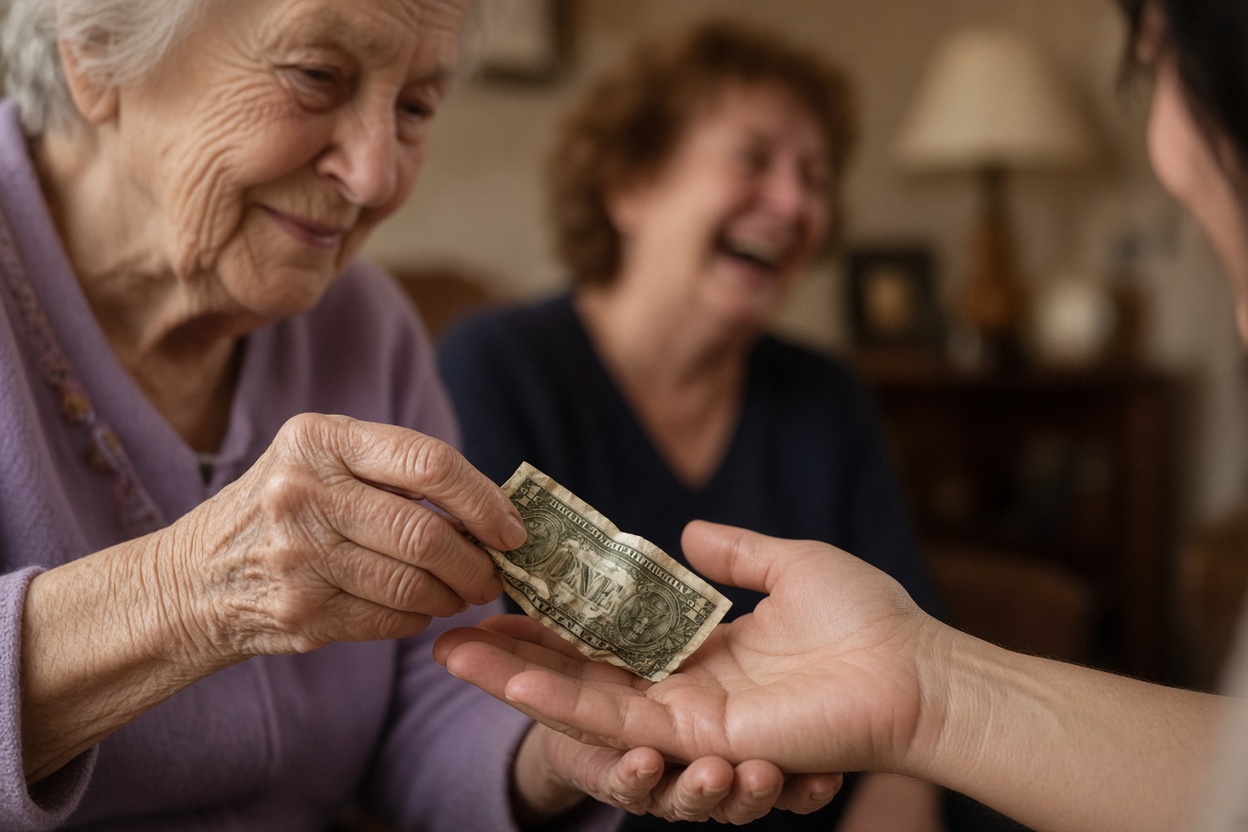
Rochelle told Grandma that she had always felt like the less important daughter. Growing up, she believed that Grandma had spent more time worrying about her sister and later about me. She remembered being expected to behave responsibly while Grandma devoted much of her energy to helping our family through difficult circumstances. As an adult, she had built a successful career and become financially comfortable, but she had never stopped comparing herself with the people she believed Grandma loved more. She said that whenever she saw Grandma worrying about me, she felt as though her own achievements were being overlooked. Over time, that jealousy had turned into resentment. She had convinced herself that Grandma was making excuses for me and rewarding me for circumstances that were not my fault. At the restaurant, when she saw Grandma give me an old ten-dollar bill, she had reacted with sarcasm because she assumed it was another example of Grandma offering something insignificant. She admitted that she had been wrong. Hearing about the savings account had forced her to recognize how much she had misunderstood. Grandma listened without interrupting. Rochelle began crying and said she was sorry for humiliating her in front of the family. She also admitted that she had never understood how much Grandma had sacrificed while raising me. Grandma did not respond with anger. She simply sat quietly, allowing her daughter to finish.
After a moment, Grandma stood up and walked into the kitchen. Rochelle looked confused, perhaps expecting a lecture or a list of everything she had done wrong. Instead, Grandma took out a loaf of bread, butter, and cheese. She made Rochelle a grilled cheese sandwich, cut it into triangles, and placed it on a plate. It was such a familiar gesture that I nearly laughed through my tears. Grandma had made those sandwiches for me countless times when I was little. Whenever I had a difficult day, she would prepare one and cut it into triangles because she knew I liked eating them that way. Now she was offering the same comfort to her daughter. Rochelle stared at the plate, then began crying again. Grandma sat across from her and said that she had not raised her children to keep score of who received more attention. She had simply tried to help whoever needed her. She told Rochelle that being financially successful did not make her less loved, and that my needing a grandmother had not meant Rochelle had lost a mother. Then she gently reminded her that if she wanted a closer relationship, she could begin by showing up without comparing herself to anyone else. Rochelle nodded and ate the sandwich slowly. It was not a dramatic reconciliation, and nobody pretended that years of resentment had disappeared in one afternoon. But it was a beginning. For the first time in a long while, the three of us sat together without an argument waiting to happen.
Over the following months, the savings account became a practical blessing. I had graduated with student loans that I expected to spend years repaying. The balance in Grandma’s account was enough to clear them completely, leaving me free to begin my teaching career without the monthly payments hanging over me. I did not want to spend the money carelessly, so I discussed the decision with Grandma and made sure I understood the account arrangements. She insisted that the money had always been intended for my education and future. She had never saved it so that I would feel obligated to repay her. I explained that using it to eliminate my student loans would give me a much stronger start. She smiled and said that was exactly what she had hoped it would do. I also wanted to do something for her. For years, Grandma had postponed medical and dental appointments because she did not want to spend money on herself. One tooth had been bothering her for a long time, but she kept insisting that it was not serious. I finally convinced her to visit a dentist. The appointment revealed that the tooth needed treatment, and she reluctantly agreed to have it repaired. I went with her, held her hand in the waiting room, and promised that she would not have to worry about the cost. When she came out, she looked relieved and admitted that she should have done it years earlier.
I also bought her a beautiful new purse. It was sturdy, elegant, and large enough to carry everything she needed. I chose a dark brown one because I knew she preferred practical things. When I gave it to her, she examined it carefully and thanked me. But the following week, I noticed that she had returned to carrying her old purse. The new one was sitting neatly inside her wardrobe. I asked why she was not using it, and she laughed. She said the old one was familiar, and she knew exactly where everything was inside it. The rubber band still held one corner together, and a small pocket contained receipts dating back several months. I told her that she could keep both if she wanted, but I hoped she would use the new one sometimes. She promised she would. A few days later, I found her carrying it to the grocery store. She had moved all her belongings into it, although she had also placed the old rubber band inside one of the pockets. I asked whether she had brought it along for sentimental reasons. She said it might come in handy. I realized that no matter how much money I spent, I would never completely change her habits. Grandma had spent a lifetime making things last, and the habits that helped her survive had become part of who she was. I stopped trying to replace every old possession. Instead, I focused on making sure she had the choice to enjoy something better whenever she wanted.
As summer approached, I began preparing for my first year as a second-grade teacher. I visited the school, met the principal, and started organizing ideas for my classroom. I wanted the room to feel welcoming, especially for children who might arrive nervous or unsure of themselves. I remembered how Grandma had made our small house feel safe when my childhood had been unstable. I also thought about my mother, who had spent years rebuilding her life and quietly supporting my future. Their different forms of love had shaped me in ways I was only beginning to understand. Grandma had provided daily care, stability, and protection. My mother had contributed from a distance, respecting the boundaries that had been placed around me. Neither woman’s actions erased the difficulties of the past, but together they had helped create the opportunity I now had. I started collecting books, crayons, and classroom decorations. Grandma insisted on helping me prepare, even though I told her she should rest. She folded small labels, organized pencils, and asked whether second graders still used spelling lists. One afternoon, she looked at the stack of children’s books on the table and said she hoped my students would always feel safe asking questions. I smiled because it sounded exactly like something Carl Reeves might have said in another story. I promised her that I would do my best.
