My mother answered after three rings. Her voice sounded cautious, as though she were expecting a stranger or someone calling with bad news. I almost hung up. For several seconds, I could not find the words I had rehearsed during the bus ride. Then I took a breath and said, “Mom, it’s Lucy.” There was a silence so complete that I thought the call had disconnected. Then I heard her begin to cry. She said my name repeatedly, barely able to finish a sentence. I could hear her moving around, perhaps sitting down or covering her mouth. I told her I had received Grandma’s letter and learned about the savings account. She apologized immediately. She said she was sorry for everything she had done when I was younger and for every year I had spent wondering why she was not there. I told her I needed to understand what had happened. She explained that her addiction had become worse gradually, and by the time she realized how much damage she was causing, she had already lost control of her life. She remembered promising to change and then breaking those promises. She remembered the fear in my face when she failed to come home. She said that losing the right to raise me had been painful, but she understood why Grandma had taken responsibility. She had spent years trying to rebuild herself, and she had never wanted to ask me for forgiveness before she had something real to show for her recovery.
We talked for three hours. My mother told me about the apartment she had rented, the job she had kept, and the women she had helped through recovery. She described how she had learned to live with the guilt of the past without allowing it to destroy the future she was trying to build. She told me that every Sunday call with Grandma had become the most important part of her week. She would ask about my classes, my friends, and the things I enjoyed. Sometimes Grandma sent photographs, and my mother kept them in a small album beside her bed. She had a picture of me holding my first college acceptance letter and another from a family gathering. She also had a photograph of me in my graduation gown, taken from the back of the auditorium. I asked why she had not approached me after the ceremony. She said she had wanted to, but when she saw how happy I looked beside Grandma, she was afraid that appearing suddenly would turn a beautiful day into a painful one. She did not want my graduation to become about her mistakes. She wanted it to remain about what I had achieved. I listened, sometimes crying and sometimes asking questions. There were things I still did not understand, and I did not pretend that one conversation could repair everything. But I could hear the sincerity in her voice. When she apologized again, I finally told her, “You were there. One hundred dollars at a time.” She began crying harder.
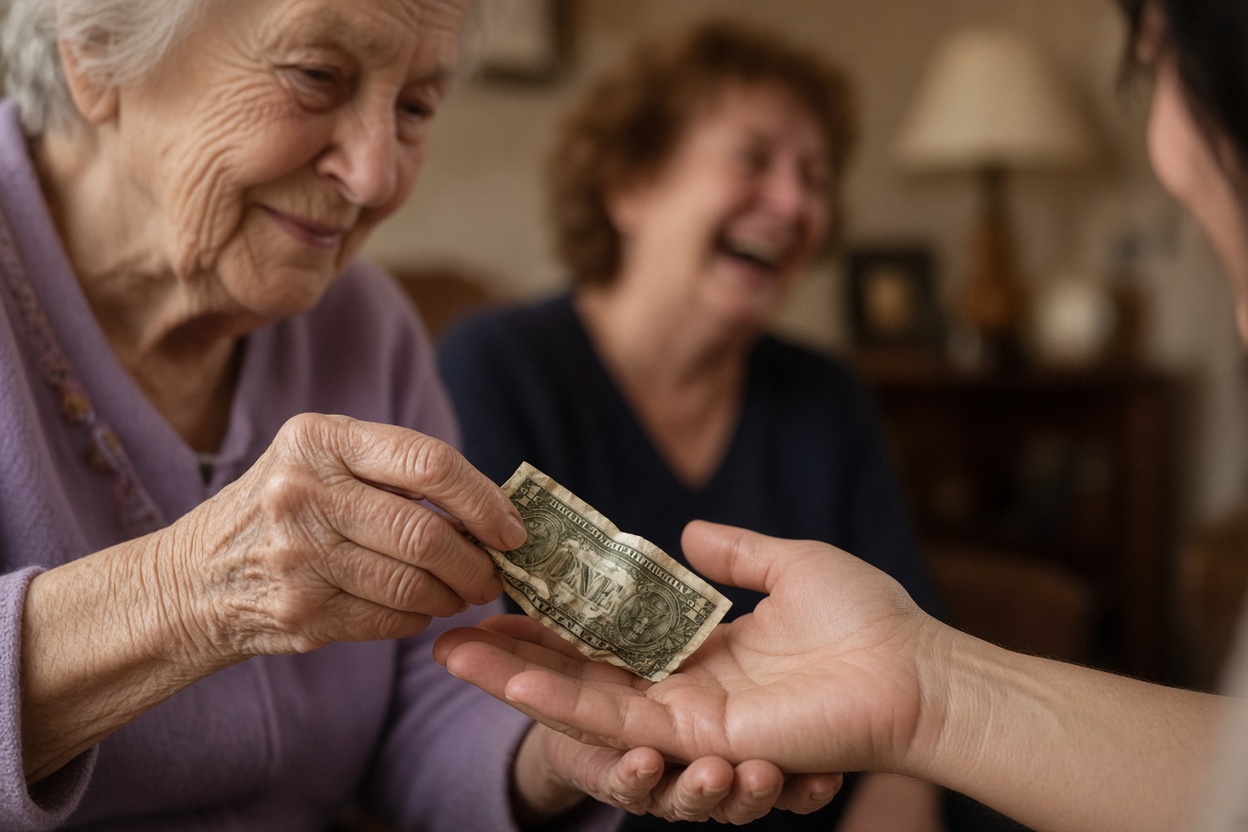
After we hung up, I sat on my bed for a long time. I felt exhausted, relieved, confused, and hopeful all at once. I had imagined meeting my mother many times throughout my childhood, but I had never expected the first real conversation to happen because of an old ten-dollar bill. I called Grandma the following morning and told her that I had spoken to Mom. She listened carefully, then asked whether I was all right. I told her I was still processing everything, but I was glad I had called. Grandma admitted that she had wanted to tell me about the deposits many times. However, she had promised my mother that she would not reveal the arrangement until I was ready. She also wanted me to understand that the money had been saved for my future, not as a condition for accepting anyone back into my life. I asked whether she had been worried that I would become angry when I learned the truth. She said she had worried about many things, but she believed I deserved to know that both of them had been thinking about me. She reminded me that I did not owe my mother an immediate relationship simply because she had contributed money. I could decide how much contact I wanted and when I felt comfortable. I thanked Grandma for protecting my choices. She said that raising me had never been about controlling my future. It had been about making sure I had the opportunity to choose it.
The following Saturday, I agreed to meet my mother at a small diner halfway between our homes. I arrived early and chose a booth near the window. I kept checking the entrance, wondering whether I would recognize her immediately. When she finally walked inside, I knew it was her. She looked older than I remembered, with a few gray strands in her hair and tiredness around her eyes. She wore a simple coat and carried a small handbag. When she saw me, she stopped near the entrance. For a moment, neither of us moved. She looked nervous, almost frightened, and I suddenly realized that she had probably spent years imagining this meeting too. She approached slowly and asked whether she could sit down. I nodded. We ordered coffee and talked about ordinary things at first. She asked about my teaching job, and I told her about the school where I would be working. She asked whether I still enjoyed reading, and I told her I had recently started collecting children’s books for my classroom. She remembered that I had loved picture books when I was little. Eventually, the conversation became quieter. She apologized again and said she did not know whether I wanted a hug. I stood up, crossed the small space between us, and held her tightly. She wrapped her arms around me and began crying. I cried too. We did not pretend that everything was suddenly fixed. We simply held each other and allowed the moment to happen.
After that first meeting, we began seeing each other every Saturday. Sometimes we went to the diner, sometimes we walked through a park, and occasionally we visited a bookstore. I learned more about her recovery and the life she had built. She learned about my college experiences, the friends I had made, and the kind of teacher I hoped to become. I also learned that rebuilding a relationship required patience. There were moments when an old memory made me uncomfortable, and there were questions I was not ready to ask. My mother never demanded that I move faster. She continued showing up when she said she would, and gradually I began trusting that her promises could be believed. She also made an effort to get to know the adult I had become rather than treating me like the little girl she remembered. Grandma was pleased, although she never pressured either of us. She simply watched the relationship grow at its own pace. Two weeks later, my aunt Rochelle visited Grandma’s house. She arrived without the expensive clothes and confident attitude she usually displayed. She looked uncomfortable and asked whether she could speak with Grandma privately. I was in the kitchen when I heard Rochelle apologize for the comment she had made at the restaurant. She admitted that she had spent years feeling jealous of the attention Grandma gave me. Then she explained something that none of us had expected.
