By the time autumn arrived, my classroom was ready. I had arranged the desks in small groups, filled the shelves with children’s books, and placed colorful labels on the storage boxes. The first morning, I stood near the classroom door and greeted each student as they entered. Some children were excited, others were nervous, and a few held tightly to their parents’ hands. I remembered how I had felt on my first day of school and how Grandma had stood outside the classroom until I was comfortable enough to walk inside. I wanted every child in my room to know that they belonged there. During the first week, I introduced the class to a simple rule: everyone was allowed to ask questions, and nobody would be laughed at for not knowing an answer. I told them that learning began with curiosity. When one child struggled to read aloud, I gave him time and listened patiently. I remembered the stories Grandma had told me about being a child who sometimes felt overlooked, and I thought about the little boy who had struggled to speak before someone treated him with kindness. I wanted my classroom to be a place where children felt safe enough to try again. When I came home that afternoon, I told Grandma about my students. She listened carefully, asked their names, and wanted to know which books they enjoyed. She looked happier than I had seen her in years.
The savings account I had opened for Grandma continued growing. Every week, I deposited ten dollars. When I received a little extra money from tutoring or other work, I added more. I did not make a show of it, and I never told her the balance. I wanted her to experience the same quiet security she had given me. Occasionally, she asked whether I was still making the deposits. I always answered yes. She would nod and say that I did not need to overdo it. I reminded her that she had said the same thing to me when I was growing up. We eventually arranged a small trip to visit a town she had always wanted to see. She insisted that we take the bus rather than drive because she enjoyed looking out the window. We spent the day walking slowly through the shops, eating lunch, and visiting a garden. She bought herself a small scarf and did not once ask how much it cost. I considered that a victory. Later, I took her to a restaurant she had never visited because she always assumed places with white tablecloths were too expensive. She looked around in amazement, then laughed when I told her that she was allowed to order whatever she wanted. She chose a simple meal and enjoyed every bite. I realized that giving Grandma financial security was not only about money. It was about helping her feel that she no longer had to deny herself every small pleasure.
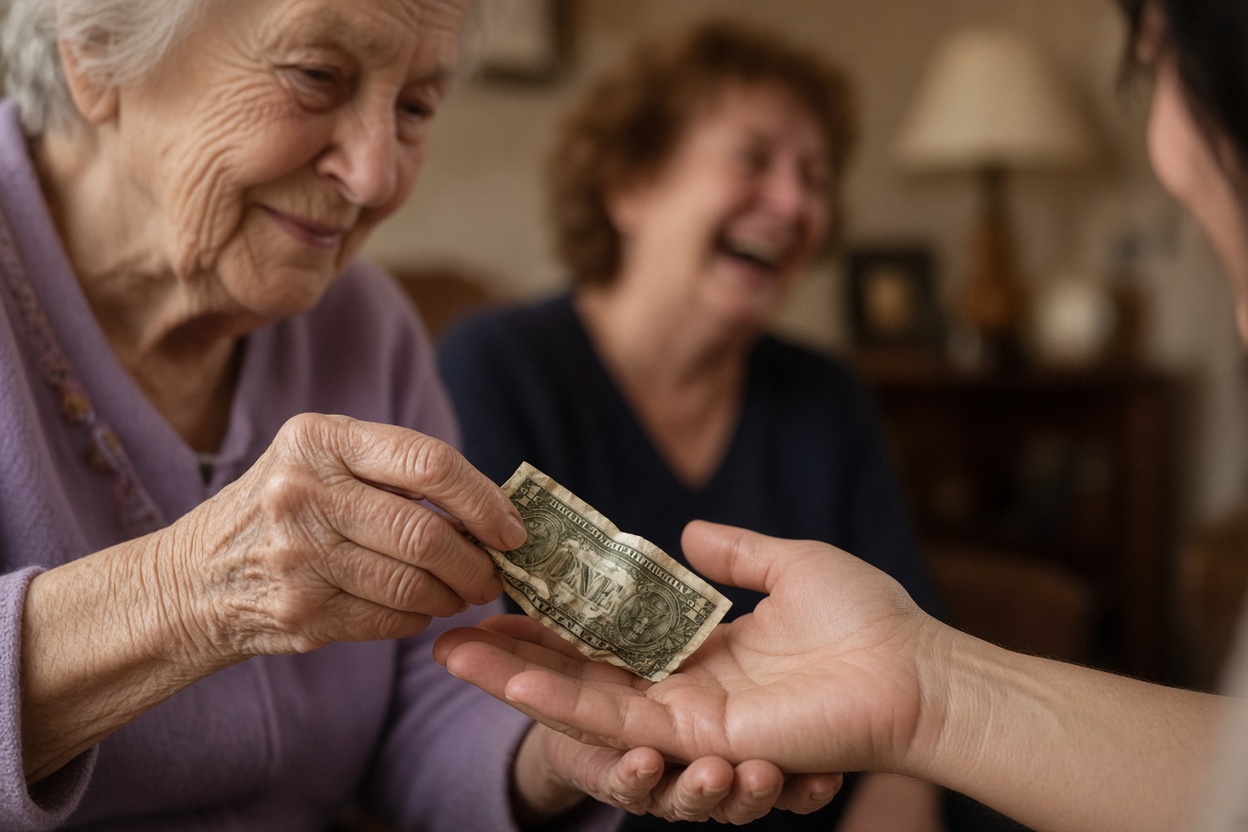
Rochelle also began changing. She visited Grandma more regularly, sometimes bringing groceries and sometimes simply sitting with her to talk. She apologized to me privately for the way she had behaved at the graduation lunch. She admitted that she had judged Grandma’s old purse and small gifts without understanding what they represented. She said she had spent so many years measuring success through money and appearances that she had forgotten the importance of the things that could not be purchased. I accepted her apology, although I told her that the comment had hurt both Grandma and me. She acknowledged that and did not make excuses. Over time, the tension between them eased. One afternoon, I found Rochelle helping Grandma sort through old photographs. They were laughing over pictures of family members from decades earlier. Grandma had placed the ten-dollar bill inside a small frame on a shelf. I asked why she had framed it, and she said she wanted to keep it where she could see it. The bill had become more than a deposit receipt. It represented eighteen years of work, love, and hope. Rochelle looked at it and said that she would never laugh at something like that again. Grandma smiled and told her that the important thing was what she did next. Then she handed Rochelle another photograph and asked her to help identify the people in it.
Sometimes, when I thought about the graduation lunch, I remembered the silence that followed Rochelle’s remark. I remembered Grandma reaching into her worn purse and pulling out a folded ten-dollar bill while everyone else waited to see what she would say. At the time, I had believed the bill was simply a modest gift from someone who could not afford more. I had not understood that it was the key to a story that had been unfolding for eighteen years. The money mattered, of course. It paid off my student loans and gave me the freedom to begin my career without the same financial pressure I had expected. But the true value of the account was what it revealed. Grandma had never stopped believing in my future. Even during the years when she was tired, worried, and struggling to pay her own bills, she had found a way to save something for me. My mother had also been trying to contribute, even when she did not know whether I would ever allow her back into my life. Their choices had not been perfect, and the past could not be rewritten. But the money showed me that love sometimes continues quietly, even when people do not know how to express it directly. It can exist in a weekly deposit, a Sunday phone call, a photograph kept in an album, or a person sitting unseen at the back of a graduation ceremony.
One evening, several months after I started teaching, I sat with Grandma at her kitchen table. Her old brown purse rested beside her chair, although she now carried the new one whenever she went out. The framed ten-dollar bill stood on the shelf, and the photograph from my first day of kindergarten was tucked beside it. I told her that I had made another deposit into her account. She smiled and asked whether the money was safe. I laughed because I finally understood why she had asked that question so many times at the bank. She was not interested in the balance or the interest. She simply wanted to know that the future she had worked so hard to protect was secure. I reached across the table and held her hand. For eighteen years, she had quietly built my future while sacrificing nearly everything for herself. Now it was my turn to make sure she could enjoy the life she had spent so much time putting on hold. People had looked at Ida Brennan and seen an elderly cleaning lady with a broken purse, worn shoes, and a jar of saved coins. They had not understood what she had accomplished. She had given me stability, opportunity, and unconditional love. And from that day forward, I made sure she would never have to worry about taking care of everyone else without someone taking care of her.
