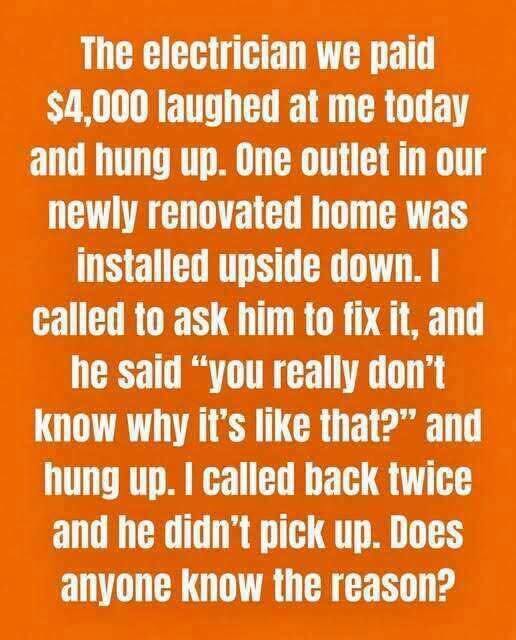
After learning why some electrical outlets are installed upside down, many homeowners naturally begin wondering whether they should change the orientation of the outlets in their own houses. Some people prefer the familiar appearance of a grounding hole facing downward, especially when all the other receptacles in the room follow that arrangement. Others appreciate the possibility that an unusual orientation may identify a switched outlet or reflect a particular safety preference. In most situations, however, there is no reason to change an outlet simply because it looks different. A receptacle’s orientation does not automatically determine whether it is functioning properly or whether its wiring is safe. If the outlet is correctly installed, securely mounted, properly grounded, and compliant with applicable electrical requirements, its unusual appearance may not represent a problem at all. Before considering any modification, homeowners should understand why the outlet was installed that way and whether its current configuration serves a particular purpose.
One reason to avoid unnecessary changes is that an upside-down outlet may be part of a carefully planned electrical arrangement. For example, it could be connected to a wall switch, configured as a split receptacle, or used to identify a circuit that performs a different function from surrounding outlets. If someone changes its orientation without understanding the wiring, the visual identification method may disappear. This could create confusion for future homeowners, maintenance workers, or electricians. Even if the receptacle is not switched, its orientation might reflect the original installation design or a professional preference. A qualified electrician can inspect the outlet and determine whether changing its position would have any practical consequences. If the homeowner simply wants every receptacle to look consistent, the electrician can assess whether the requested modification is appropriate. However, consistency in appearance should never take priority over the correct operation and safety of the electrical installation.
It may be tempting to believe that changing an outlet’s orientation is an extremely simple task. After all, the receptacle is already attached to the wall, and rotating it might appear to require only a few adjustments. However, electrical work should never be treated casually. A wall receptacle can contain energized conductors, and incorrect handling can create a serious risk of electric shock. Improperly connected wiring can also result in overheating, damaged equipment, or fire hazards. Furthermore, the installation may contain multiple conductors or special circuit arrangements that are not immediately visible. Even when a receptacle appears to be switched off, the electrical box may contain connections that remain energized. For these reasons, homeowners without the necessary electrical qualifications should not attempt to modify receptacles themselves. If a change is genuinely necessary, a qualified electrician should inspect the circuit, identify the wiring, and perform the work in accordance with the applicable electrical code.
There are also several signs of electrical trouble that deserve far more attention than outlet orientation. A receptacle that feels unusually warm, has dark marks around its openings, produces buzzing or crackling sounds, or emits a burning smell should be treated seriously. Loose outlets, damaged faceplates, cracked plastic, and plugs that no longer fit securely may also indicate that maintenance or replacement is necessary. Repeatedly tripping circuit breakers can be another indication that something in the electrical system needs investigation. These symptoms should not be ignored simply because the outlet continues to provide electricity. In some situations, damaged connections can produce heat inside the wall, where the problem may remain hidden until the damage becomes more serious. If you notice any of these warning signs, stop using the outlet when safe to do so and arrange for a qualified electrician to inspect it. If there is smoke, fire, or an immediate danger, follow emergency procedures and contact the appropriate emergency services.
The discussion about upside-down outlets also reveals something interesting about the history of residential lighting. Before modern ceiling fixtures became standard in many homes, wall-switch-controlled receptacles provided a practical way to illuminate rooms. A simple lamp connected to a switched outlet allowed someone to turn on the light without walking through darkness. Split receptacles made this arrangement even more convenient by allowing one half of an outlet to control a lamp while the other supplied continuous electricity to another device. Over time, different electricians developed their own methods for identifying these arrangements. Some used reversed receptacle orientation, while others relied on labels, colors, or consistent installation practices. As homes became modernized, many of these original arrangements remained in place. This is why an unusual outlet can sometimes tell a small story about how a property was designed and how its occupants used electricity decades ago.
Ultimately, there is no single explanation for every electrical outlet installed with its grounding opening facing upward. Some electricians choose this orientation because of a safety-related preference. Others use it to identify switched receptacles, special circuits, or split outlets. In other situations, the explanation may be as simple as installer preference or a previous replacement. The most important thing to remember is that an outlet’s direction alone does not prove whether it is safe, unsafe, correctly wired, or controlled by a switch. Proper grounding, secure electrical connections, suitable circuit protection, and regular maintenance are the factors that truly matter. So, the next time you walk into a room and notice a wall outlet that appears to be upside down, take a moment to consider its possible purpose. It might be connected to a convenient lighting arrangement, or it might simply reflect a different installation choice. What looks like a mistake could actually be an intentional feature of the home’s electrical design.
