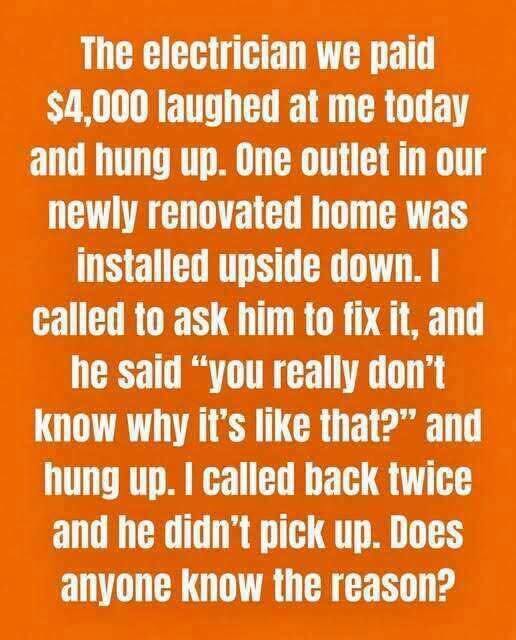
Electrical safety is one of the most frequently discussed reasons for installing receptacles with their grounding holes facing upward. Although most people never think about outlet orientation, electricians and building professionals sometimes debate whether ground-up installation offers an advantage in particular circumstances. The discussion usually focuses on three-prong plugs, which contain two electrical blades and a separate grounding pin. The grounding connection provides an important protective pathway under certain fault conditions. When a plug is inserted into a receptacle, all three connections are positioned in a specific arrangement. If the plug becomes partially disconnected, portions of its metal contacts may become exposed. This situation can create a potential hazard, especially if conductive objects are present nearby. Supporters of ground-up installation argue that changing the orientation may influence how an object interacts with the partially exposed plug. While this argument is worth understanding, it is important not to exaggerate what outlet orientation can accomplish.
Consider a situation in which a three-prong plug is not fully inserted into a wall outlet. Perhaps someone accidentally pulls on a power cord, or the plug becomes loose because the receptacle has worn out. A small space may appear between the plug and the wall. In theory, if a conductive object falls into that space, it could come into contact with exposed metal parts. When the grounding opening faces upward, the grounding pin may occupy a position that changes the possible contact sequence. Some people believe this can reduce the chance of an object bridging the energized blades. However, real-world conditions are not always predictable. The shape of the object, the amount of exposed metal, the position of the plug, and the design of the receptacle all matter. Consequently, ground-up installation should never be described as a guaranteed safety solution. It is better understood as a particular installation preference supported by a safety argument rather than a substitute for recognized electrical protection.
Proper grounding is much more important than the direction in which an outlet is installed. The grounding conductor is designed to provide a low-resistance pathway for fault current under appropriate conditions. If a fault occurs inside a connected appliance, this pathway can help protective equipment operate as intended. Without proper grounding, certain faults may create dangerous conditions for anyone touching the appliance. A receptacle that looks perfectly normal can still contain serious wiring problems if its connections are incorrect or its grounding conductor is missing. Likewise, an upside-down receptacle can be correctly grounded and safely installed. This is why appearance alone cannot establish electrical safety. Homeowners should not assume that a ground-up outlet is automatically safer or that a ground-down outlet is incorrectly wired. The quality of the connections, the condition of the receptacle, and the protective devices installed on the circuit are much more meaningful considerations.
Another important safety feature is GFCI protection. Ground-fault circuit interrupters are designed to detect certain imbalances in electrical current and interrupt power when a potentially dangerous condition occurs. They are particularly important in locations where people may be exposed to moisture, including bathrooms, kitchens, garages, outdoor areas, and other places where local regulations require protection. A GFCI receptacle can often be recognized by its TEST and RESET buttons, although protection can also be provided through other approved devices. The purpose of this protection is different from the purpose of the grounding connection. GFCI devices help reduce the risk of certain electric shock hazards, while grounding provides a protective pathway during electrical faults. Rotating an ordinary receptacle does not give it GFCI functionality. Therefore, someone should never assume that an upside-down outlet provides the same protection as a properly installed GFCI device.
Circuit breakers and other protective equipment also play a critical role in maintaining electrical safety. A circuit breaker is designed to interrupt electrical power when certain overload or short-circuit conditions occur. This helps protect wiring and electrical equipment from excessive current. However, circuit breakers are not designed to prevent every possible electric shock, which is why grounding and additional protective devices remain important. A complete electrical safety system depends on multiple components working together correctly. The receptacle, its wiring, the grounding conductor, the circuit breaker, and any required GFCI or AFCI protection all have specific responsibilities. If one component is missing, damaged, or improperly installed, the overall protection may be compromised. Changing the physical orientation of an outlet does not correct these problems. Homeowners should therefore pay attention to the actual condition of their electrical system rather than focusing exclusively on whether the grounding hole faces upward or downward.
The most practical lesson is that electrical safety should never be judged by appearances alone. If an outlet is installed upside down but works correctly, is properly grounded, and meets applicable installation requirements, its orientation is not automatically a reason for concern. On the other hand, a traditionally oriented outlet may still be dangerous if it has loose connections, damaged wiring, overheating, or inadequate protection. Anyone who notices sparks, burning odors, unusual warmth, crackling sounds, or visible discoloration should stop using the receptacle when it is safe to do so and arrange for professional inspection. Electrical problems can develop behind wall plates, where homeowners cannot easily see them. A qualified electrician can inspect the receptacle, test the wiring, and determine whether additional protection is necessary. In the end, proper installation and maintenance provide far more meaningful protection than the direction of the grounding opening.
