PART 7 — THE COLOR I HAD ALWAYS LOVED
Grant continued his toast by explaining that I had been asked not to wear blue, even though the bride’s mother and aunts were dressed in it. He said I had bought a navy dress, returned it, and chosen pink because I didn’t want to make things difficult. He told the room that I had been seated away from the family table and that the mother-son dance had been removed without his agreement. His voice cracked as he spoke. He looked at Margot, then at Vanessa. “I spent my childhood watching my mother agree with everything because she thought that was what love required,” he said. “I don’t want to spend my marriage doing the same thing.” He looked at me again. “I should have noticed what was happening. I should have asked why you stopped calling. I should have stood beside you. I’m sorry, Mom.” The ballroom was completely silent. I felt tears running down my cheeks, but this time they weren’t tears of embarrassment. My son was finally speaking.
Grant asked the DJ to play “You Are My Sunshine.” When the first notes began, he walked toward me and held out his hand. I stepped onto the dance floor, and he wrapped his arm around me. He was six-foot-one, and I was five-foot-four, so I had to rise onto my toes to rest my head on his shoulder. We danced slowly while two hundred people watched. I remembered singing that song to him when he was a little boy, standing beside his bed with one hand on his forehead. I remembered the years when I believed that keeping the peace was the same as keeping a family together. Grant whispered that he was sorry for the nine months of distance. I told him he didn’t need to carry all the blame. He said he had given Vanessa his passcode, allowed her to answer his phone, and never questioned why I stopped calling. I told him I understood. He held me tighter and promised he would learn to speak up.
Halfway through the song, Vanessa walked onto the dance floor. Her ivory gown swept across the floor, and her mascara was streaked from crying. She stopped a few feet away from us and looked at the navy boutonnière Grant had pinned over my heart. Then she looked at me. “I’m sorry,” she said. Her voice trembled. “I’m so sorry, Joan.” I didn’t know whether to embrace her or step away. I was hurt, and I wasn’t ready to pretend everything was fine. Grant stopped dancing and looked at his wife. Vanessa explained that she had been raised by a mother who controlled nearly every part of her life. Margot decided what she wore, which friends she saw, and how she should behave. Vanessa had learned to agree rather than argue. She admitted that she had repeated the same behavior with Grant. She had controlled his phone, made decisions without him, and excluded me because she thought that was what her mother wanted. She had done to him what Margot had done to her.
The months that followed were not magically perfect. Grant and Vanessa went to couples counseling every week. Grant also began seeing a therapist on his own, and Vanessa did the same. They learned to discuss decisions rather than announce them. They talked about boundaries, family relationships, privacy, and what it meant to share a life without controlling one another. In August, they moved out of Margot’s house and into a little two-bedroom bungalow in Clintonville. It had a porch and a modest kitchen. Vanessa painted the kitchen yellow. Grant told me he had laughed when he saw the color, because it reminded him of the walls in my house. He also changed his phone passcode. He told Vanessa that trust didn’t mean one person had the right to control the other’s conversations. She agreed that they should respect each other’s privacy. Grant returned to calling me every Sunday at five o’clock. Twenty minutes, usually about nothing: the weather, work, and the Browns. Sometimes Vanessa joined the call and told me my pot roast needed more salt. She was right.
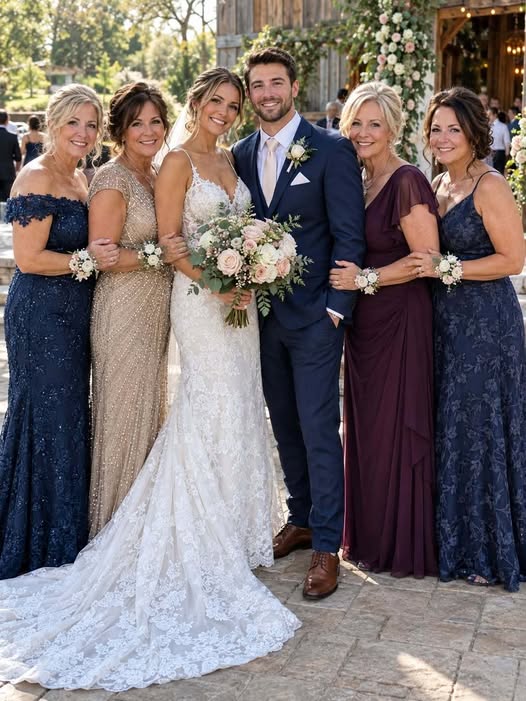
Margot eventually began therapy too. In December, she called me for the first time. She apologized for the dress, the seating arrangements, the dance, and the way she had treated me. She explained that her own mother-in-law had controlled her life for thirty-seven years. She had spent decades angry at a woman who was no longer alive, and she had passed that anger on to me. I listened and asked her a question: “Margot, what color do you actually like?” She was silent for a long time. Then she said green. She had always liked green, but her mother-in-law had told her it made her look pale, so she had never worn it. I told her she should wear it. She asked what color I liked. I told her yellow. Last month, Grant and Vanessa renewed their vows in their backyard, beneath strings of lights. There were only thirty guests, a taco truck, and a friend playing guitar. Vanessa called me beforehand and asked whether I would please wear blue. I went to Nordstrom and bought the navy dress I had returned a year earlier. The saleswoman remembered me and asked what had changed. I smiled and said, “Last year I was asked not to wear blue. This year, I’ve been asked to.” At the ceremony, Margot wore green, Vanessa wore white, and I wore navy. Grant stood between us, laughing with his tie loosened. Someone took a photograph of all of us together. It now sits on my refrigerator in my yellow kitchen. When people ask why I shouted “No” at my son’s wedding, I tell them I wasn’t trying to stop him from loving his wife. I was trying to stop him from becoming someone who swallowed every hurt until it turned into anger. I wanted him to discover that there was a third way between silence and explosion: standing up, taking a breath, and saying one true thing calmly. My son finally did that. And I learned that it is never too late to teach yourself the same lesson.
