Part 4: The Secret Promise Ambrose Made Before Our Divorce
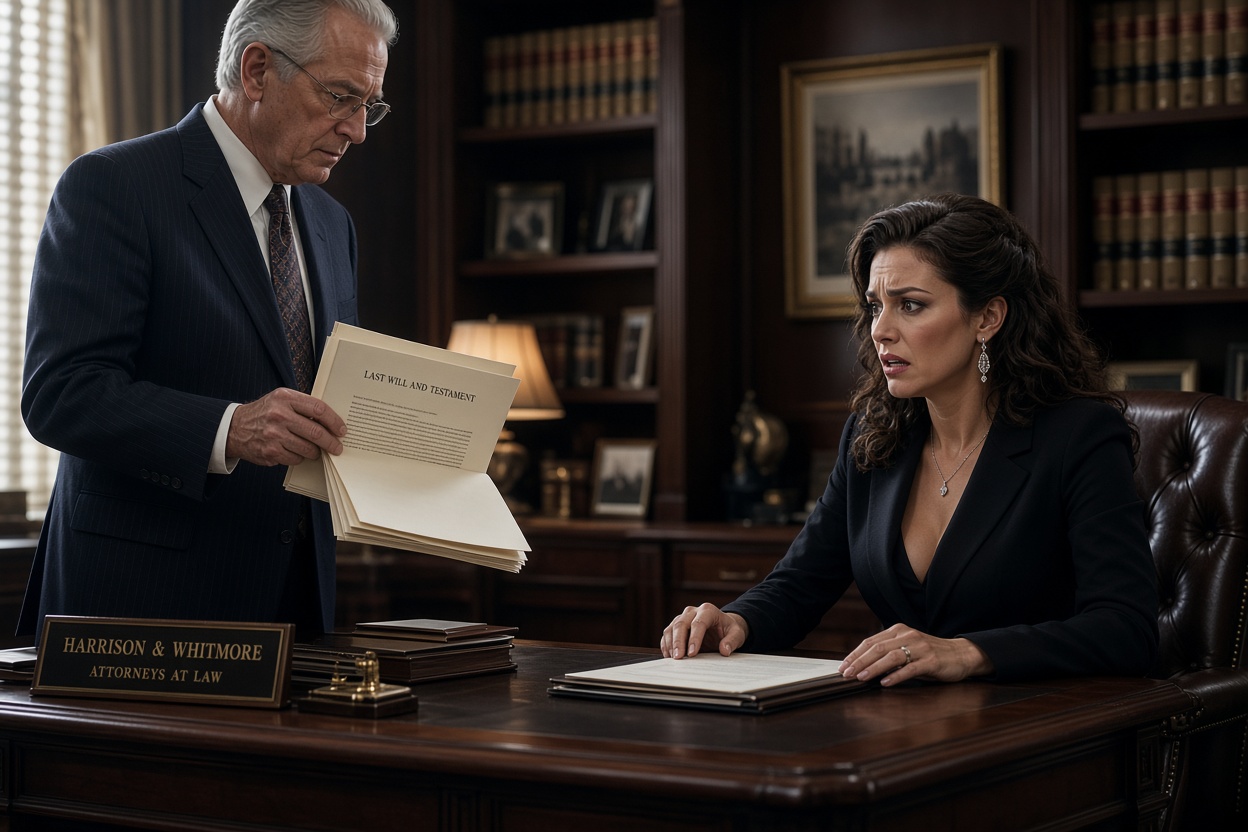
Elaine contacted me several days later and invited me back to the office. She explained that she had located the original financial file and reviewed the instructions Ambrose had provided. When I arrived, she had several folders arranged neatly on her desk. She began by explaining that Ambrose had approached the office during the final months of our marriage because he was concerned about my financial independence. According to the records, he believed that our relationship was deteriorating and that a divorce was becoming increasingly likely. He wanted to establish a way for me to receive financial support without having to depend on him personally after the separation. The arrangement involved scheduled deposits into an account registered in my name. The payments were intended to continue for seventy-two months, creating a substantial reserve that would become available to me after the agreed period. Elaine explained that the precise legal treatment of the account depended on the original agreement and the applicable financial rules. She would not describe it as an unconditional gift until the documentation had been fully reviewed. However, the records clearly showed that Ambrose had intended the money to provide me with financial security. I felt my eyes filling with tears. The man I had believed wanted nothing more to do with me had spent six years arranging payments intended to support my future.
I asked Elaine why Ambrose had not told me about the arrangement before the divorce. She explained that he had expressed concern that direct financial discussions would lead to further arguments and might cause me to reject the arrangement out of anger. He had also believed that I would eventually receive the account information through a formal notification process. However, the records showed that communication had not taken place as clearly as intended. Elaine admitted that she could not yet determine whether the delay resulted from the instructions Ambrose provided, an administrative misunderstanding, or another issue. She wanted to investigate the correspondence between the law office and the bank. I felt frustrated because the explanation still seemed incomplete. If Ambrose wanted to protect me, why had he allowed me to spend six years struggling? He knew where I lived, and he had received at least some information about my circumstances. He could have contacted me directly and explained what he was doing. Elaine listened patiently and acknowledged that the situation raised legitimate questions. She also reminded me that financial arrangements and emotional decisions were not always made for the same reasons. Ambrose might have believed that distance would protect both of us, but that did not mean his decision had been fair or helpful in every respect.
The next part of the file contained information about the source of the deposits. Elaine explained that the payments had originated from funds Ambrose had arranged before the divorce was finalized. The money was not being transferred from an unknown person or an unrelated company. There were records supporting the regular deposits, and the bank had maintained a transaction history for the entire seventy-two-month period. I asked whether the total balance included interest. Elaine said that it appeared to include the principal deposits and any applicable account earnings, but the bank would need to provide the final calculation. The original arrangement had been designed to create a reserve rather than require me to request money every time I faced an expense. Ambrose had apparently wanted me to have something stable that could help with housing, healthcare, and ordinary living costs. I found that difficult to reconcile with the way I had lived. There had been months when I could barely afford groceries, and I had spent years worrying about losing my rented room. The account had existed throughout that entire period. Elaine explained that the funds had been accumulating according to the instructions, but the access conditions had prevented the ordinary account notifications I might have expected. She was now working with the bank to clarify the process for releasing the funds.
Then Elaine showed me a document that made the situation even more personal. It contained a statement Ambrose had written when the arrangement was established. He explained that he did not want me to believe that the money was an attempt to purchase forgiveness or control my future. He described it as a promise to ensure that I would not be left without support simply because our marriage had ended. He acknowledged that our relationship had become unhappy and that both of us had experienced pain. He also wrote that he had not handled the separation well and regretted allowing certain disagreements to become permanent wounds. I stopped reading halfway through because the words brought back memories I had spent years avoiding. I remembered the arguments, the long silences, and the night we finally agreed that our marriage could not continue. I had believed that Ambrose had moved on without looking back. Yet the document suggested that he had carried some responsibility for the way things ended. I did not know whether I could forgive him, and I was not sure whether forgiveness was even necessary. But I began to understand that the story of our divorce might have been more complicated than the version I had repeated to myself for six years.
Elaine recommended that I take the documents to an independent financial adviser and obtain my own legal advice before accepting or moving the money. She explained that a large account balance could have tax, reporting, or other financial consequences depending on the structure and applicable law. She also wanted to ensure that there were no outstanding conditions attached to the account. I agreed because I did not want to make a mistake after discovering such an important asset. On my way home, I stopped at a small café and ordered a cup of tea. I sat near the window, watching people walk through the rain while reading Ambrose’s statement again. For years, I had imagined that he had forgotten me completely. Now I had evidence that he had been thinking about my financial future throughout the separation. I still had many unanswered questions, particularly about why he had not explained the arrangement sooner. But the most painful part was realizing how different my life might have been if I had known about the account. Perhaps I could have found a better apartment, returned to school, or started a small business. Perhaps I would not have spent so many nights worrying about money. I folded the document carefully and placed it inside my bag. The truth was beginning to change the way I remembered my past, but I knew that understanding Ambrose’s intentions would not automatically erase the years I had struggled.
