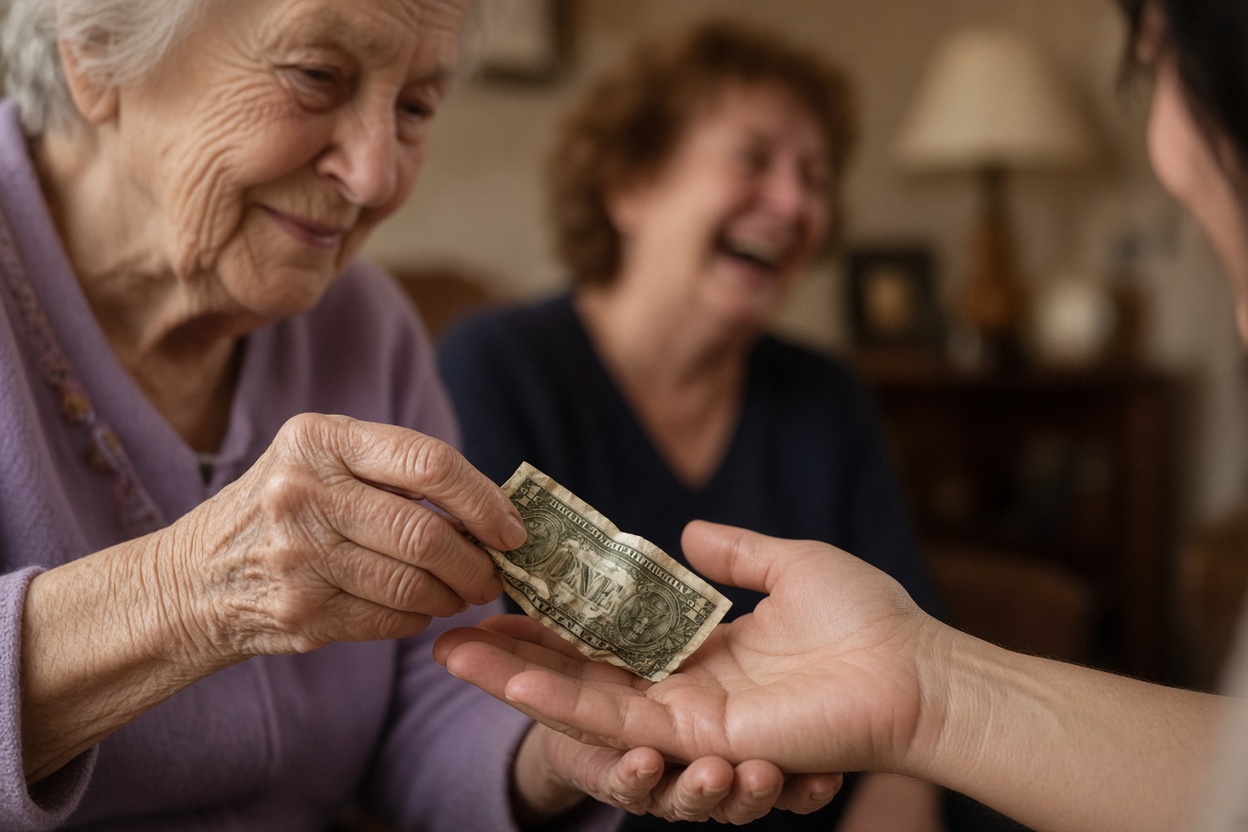
The following morning, I woke earlier than usual. I had barely slept, and my mind kept returning to Grandma’s words. Every week for eighteen years. I tried calculating the deposits, but I quickly realized that the amount could be much larger than I expected. Ten dollars a week did not seem like much, especially when compared with the cost of tuition, textbooks, transportation, and everything else involved in earning a degree. But Grandma had never deposited only ten dollars every single time. Some weeks she had added more, and the account had been earning interest for years. I wondered whether she had saved enough to help with a few textbooks or perhaps pay one semester’s expenses. I also wondered why she had never mentioned it. I had spent years working part-time jobs, applying for scholarships, and taking out student loans. If Grandma had money set aside, why had she allowed me to struggle? Then I remembered how carefully she had taught me to be independent. She never wanted me to believe that someone else would always solve my problems. Perhaps she had planned to reveal the account only when I graduated, when the money could become a gift rather than something I depended on. I put the ten-dollar bill inside my wallet, dressed quickly, and left for the bus stop. Grandma had already made breakfast, but she told me to go before I missed the morning banking hours. She looked nervous, although she tried to hide it. Before I walked out, she reminded me to ask for Mr. Halloway and not to accept an answer from anyone who did not know about the account.
The downtown bank stood in an old stone building that had been there for generations. Its heavy entrance doors opened into a quiet lobby with marble floors, polished wooden counters, and framed photographs showing the building’s history. I had passed it hundreds of times without ever thinking much about it. That morning, however, every detail seemed important. I approached a young teller and explained that I needed to speak with Mr. Halloway about a savings account opened by my grandmother, Ida Brennan. The teller’s expression changed as soon as she heard the name. She glanced toward a nearby office and asked me to wait. A few minutes later, an elderly man wearing a red bow tie appeared in the doorway. His hair was almost completely white, and he walked with a slight limp. He looked at me for several seconds before smiling warmly. “You must be Lucy,” he said. “Ida’s girl.” I felt my eyes fill immediately. There was something comforting about hearing him refer to me that way. He invited me into his office, where several framed photographs stood on the shelves. I noticed that one showed the bank’s staff from many years earlier. Another displayed a group of children standing outside a school. Mr. Halloway asked how Grandma was doing, and I told him she was well, although her knees bothered her. He nodded and said she had never allowed age or discomfort to stop her from keeping a promise.
I handed him the folded ten-dollar bill. He examined the writing on the back and ran his thumb gently over the faded date. For a moment, he said nothing. Then he pressed his lips together and disappeared into the back office. I waited, looking around the room and trying to control my nerves. I heard drawers opening and papers being moved. When Mr. Halloway returned, he was carrying a small blue passbook with worn corners. He placed it on the desk and opened it carefully. The pages contained rows of deposits, dates, and handwritten notes. Some entries were so old that the ink had begun to fade. He turned to the final page and pushed the book toward me. I leaned forward, expecting to see a modest amount. Instead, I saw a balance of $36,418.52. For several seconds, I could not breathe. I read the number again, then a third time. Thirty-six thousand dollars. More than enough to change my financial situation. More than I had ever imagined Grandma could save. I asked whether there had been a mistake. Mr. Halloway shook his head. He explained that the account had been maintained carefully for eighteen years. The balance was accurate, and every deposit had been recorded. He then handed me a sealed envelope with my name written across the front. “Your grandmother asked me to give you this when you came,” he said. I took the envelope, my hands trembling.
I opened the passbook again and began examining the entries more carefully. Most deposits were marked with the same initials or simply recorded as cash deposits. But as I reached the more recent pages, I noticed something unusual. Alongside the weekly deposits were additional monthly entries marked with a single letter: C. The amounts were larger, usually one hundred dollars, and they appeared with remarkable consistency. I pointed to them and asked Mr. Halloway what they meant. He looked at the page and nodded. He explained that Grandma had made the weekly deposits herself, but the monthly entries came from another person. He could not discuss the identity without permission, but he assured me that the person had authorized the deposits and that Grandma had agreed to have them included in the same account. I felt confused. I had assumed that Grandma had built the entire balance by herself. Now I was beginning to suspect that there was another part of the story. Mr. Halloway explained that the original deposits had amounted to approximately fifteen thousand six hundred dollars over eighteen years. With Grandma’s permission, he had periodically moved portions of the money into certificates of deposit so that interest could accumulate. She had never asked him to calculate the growing balance for her. She only wanted to know whether the money was safe. He said that whenever she visited, she asked the same question: “Lucy’s money is still there, isn’t it?” He always assured her that it was.
I sat quietly with the passbook open in front of me. I was overwhelmed by the amount of money, but the thought that Grandma had made those deposits while living on a cleaning income was even more difficult to understand. She had spent years repairing her shoes, keeping old furniture, and refusing to replace things that still technically worked. I remembered her cutting coupons, saving leftovers, and turning the heating down during winter. I had sometimes encouraged her to spend more on herself, but she always said she was comfortable. Now I understood that she had been choosing to save whenever she could. I looked at the envelope again and noticed that it was thicker than an ordinary letter. Mr. Halloway offered me a glass of water and suggested I read it before leaving. I thanked him and carefully opened the paper. The first paragraph explained the weekly deposits. The second explained that Grandma had never wanted me to feel that I owed her anything for raising me. Then I reached a sentence that made me stop. She wrote that the monthly deposits marked with the letter C came from someone I might never expect. I looked up at Mr. Halloway. He nodded gently and told me that the letter would explain everything. I returned to the page and began reading about a visit that had taken place eight years earlier, when I was fifteen years old.
