Rachel didn’t wait for me to finish explaining everything before she grabbed her car keys. She had heard enough to understand that I needed to return to Granville as quickly as possible. I collected my property documents, identification, and the folder containing the divorce decree. Before leaving, I checked the security application one final time. The movers were no longer visible, but several pieces of furniture remained inside the house. Mark’s vehicle had disappeared, and the black SUV was nowhere in sight. I felt an uncomfortable mixture of anger, fear, and disbelief. Only eleven days earlier, I had stood in the empty living room with a set of keys in my hand, imagining the peaceful life I would build there. Now I was returning to a property where my ex-husband had apparently attempted to establish residence without my permission.
During the drive, Rachel repeatedly asked whether I was certain I had never signed an occupancy agreement. I told her I was absolutely certain. She reminded me that Mark had a history of using financial confusion to intimidate me, particularly during the divorce. He had repeatedly claimed that I was misunderstanding the settlement and that I would eventually have to give him more money. I explained that the court had already examined the inheritance issue and ruled in my favor. Rachel shook her head and said she couldn’t understand why he was still trying. I didn’t have an answer. The only thing I knew was that I wasn’t going to surrender the home I had worked so hard to purchase.
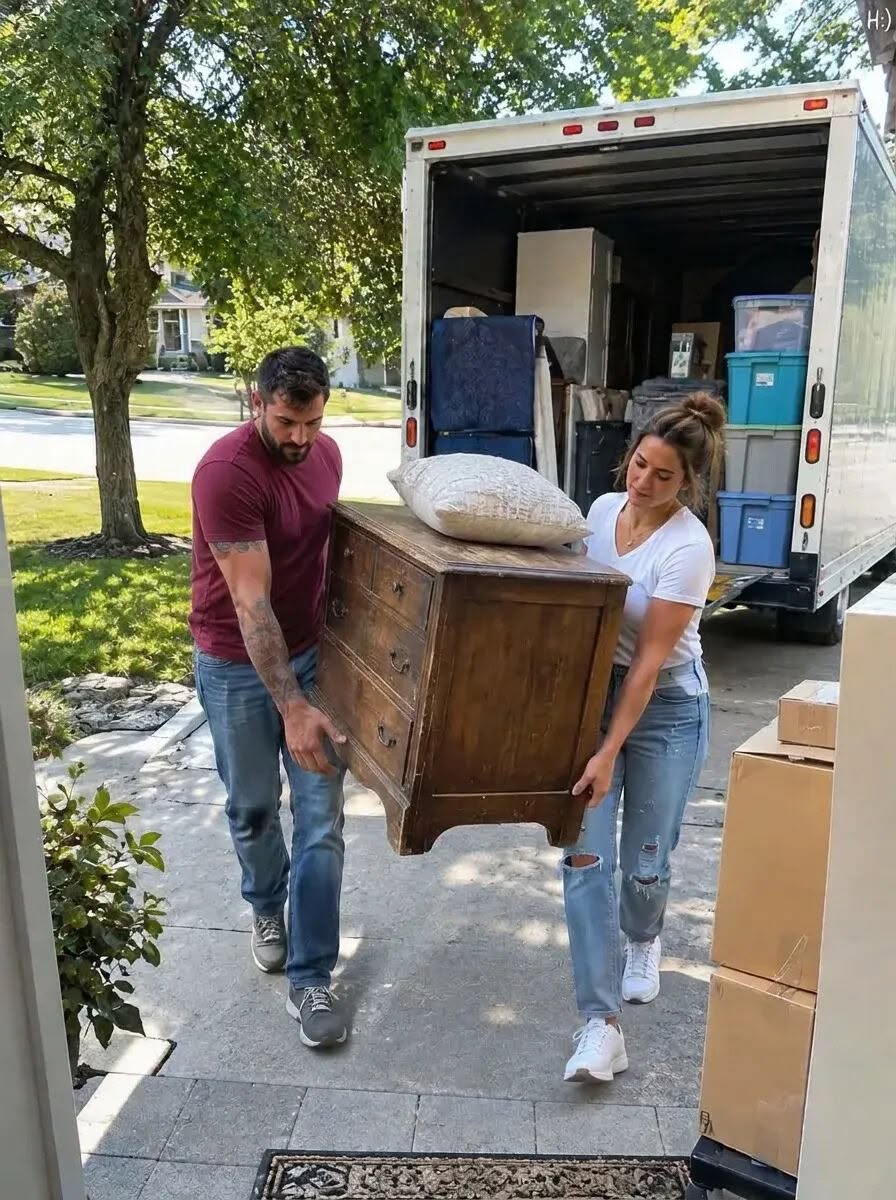
When we arrived, the yellow moving truck and police cruiser were gone, but the house looked completely different from how I had left it. A large leather sofa stood in the living room, facing a television that had been placed against the far wall. Several cardboard boxes were stacked near the kitchen entrance. A wooden dining table occupied the center of the room, and Vanessa’s decorative items were already arranged on the shelves. I walked toward the staircase and stopped when I saw a framed photograph resting on the bedroom dresser. It showed Mark and Vanessa standing together at their wedding, smiling beneath a flower-covered arch. Someone had deliberately placed it in a position where it would be one of the first things I saw upon entering the room. I felt sick. This wasn’t simply an attempt to store furniture in an empty house.
They had brought personal belongings, arranged decorations, and apparently intended to make themselves comfortable. Rachel noticed a small box beside the bed containing several of Vanessa’s cosmetics. She picked it up, looked at me, and immediately placed it back down. Neither of us said anything for several seconds. Then I opened the security application and checked the recent access history. I wanted to know exactly when Mark had entered and whether he had accessed other doors. The system showed the side entrance opening at the time I had watched on camera. There were no signs of forced entry. The evidence was consistent with what Lynn had told me about Greg photographing the keypad.
My first priority was securing the property. Rachel called a locksmith while I contacted Patricia again. The locksmith arrived within an hour, inspected the existing locks, and replaced the hardware on every exterior entrance. I also removed the old keypad system and installed a new one that required a completely different access code. The security company helped me review the user list and disconnect every device that had previously been authorized. I requested a written record of the changes because I wanted documentation showing that I had taken reasonable steps to prevent further unauthorized access. Patricia then arrived with another attorney from her office. She examined the ownership documents, the divorce decree, and the photographs I had taken of the furniture and decorations. Her first question was whether Mark had any legitimate reason to believe he owned part of the property. I explained that he had never contributed to the purchase price and that the deed was registered exclusively under my name. She asked whether the divorce decree contained any clause granting him occupancy rights or an interest in future real estate purchases. I told her it did not. She reviewed the relevant pages and confirmed that nothing in the agreement supported his claim. The property was mine, and the divorce settlement had already resolved the financial disputes between us.
Patricia then reminded me of the dispute over my mother’s inheritance. During the divorce, Mark had attempted to argue that the money had become marital property because I had temporarily transferred it through an account that we had both used. He claimed that once the funds entered a joint account, he became entitled to a share. Patricia had challenged that argument with bank statements, inheritance documents, and a detailed financial timeline. The records showed that the inheritance had been transferred back into my personal account nineteen days later. No portion of the money had been used for household expenses, mortgage payments, or shared purchases.
The court accepted the evidence and ruled that the inheritance remained my separate property. Mark had been particularly angry about that decision. He had repeatedly insisted that he had contributed to the family for decades and therefore deserved a portion of everything I possessed. Patricia explained that his frustration did not create a legal ownership interest in property purchased after the divorce. Even if he believed the financial settlement had been unfair, he could not simply enter my house and establish residence. She also warned that the document he had presented to the officer could become a serious issue if it contained a forged signature or fraudulent notarization.
Before Patricia left, we organized all the available evidence into separate folders. One contained the deed and purchase records. Another contained the divorce decree and inheritance documentation. A third included security footage, photographs of the furniture, the access history, and the locksmith’s invoice. We also preserved the original security recordings rather than relying only on screenshots. Patricia explained that preserving the unedited files could help investigators establish exactly when the people entered, what they carried inside, and how long they remained on the property. She asked me to write down everything I remembered about the day, including the time of the alert and the conversation with Lynn. I included the details about Greg and the black SUV. Then she contacted Officer Yates and informed him that I was prepared to make a formal statement. As the evening approached, I finally sat down in the living room. I looked around at the furniture that didn’t belong to me and felt as though strangers had taken over a place that was supposed to represent my freedom. Rachel sat beside me and quietly reminded me that the house was still mine. The people who had entered could leave. The furniture could be removed. The false document could be investigated. For the first time since receiving the security alert, I allowed myself to believe that I might actually regain control of the situation.
