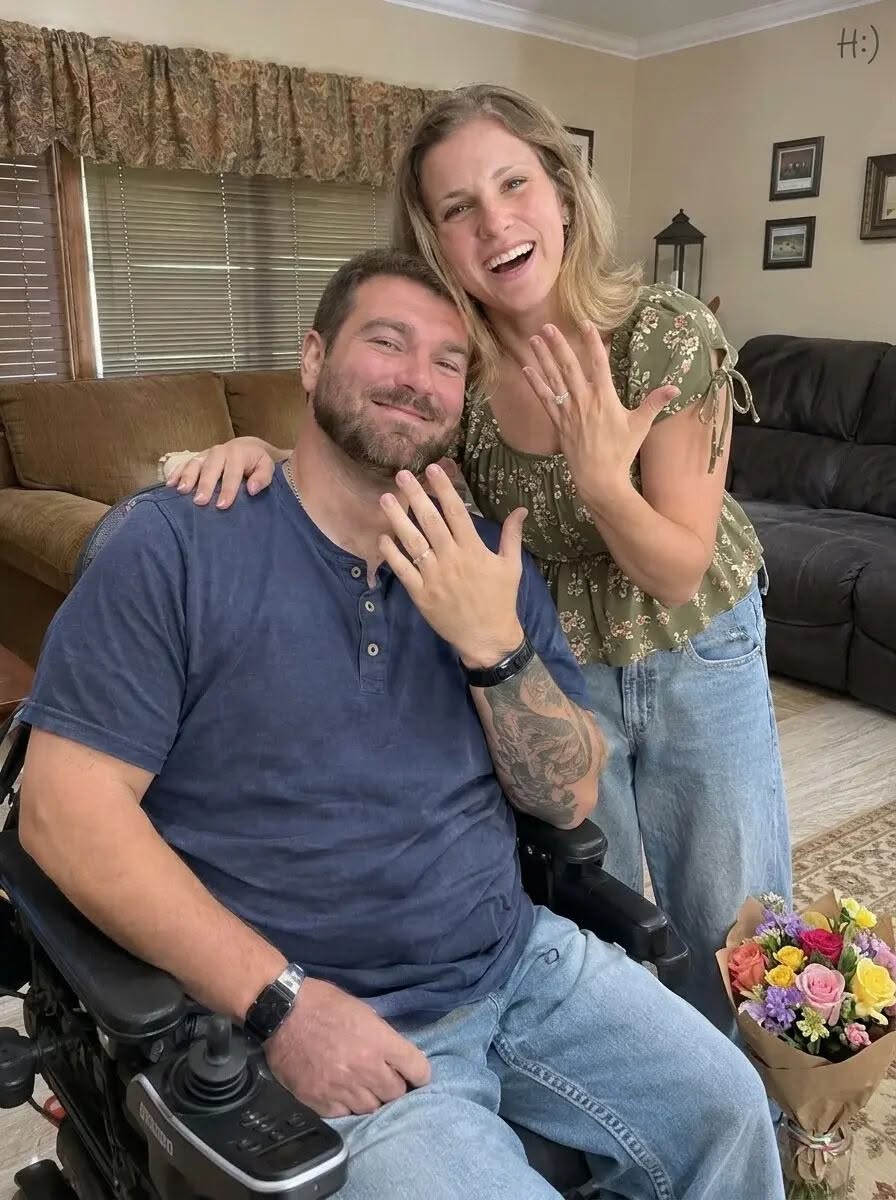
Carl died quietly, with my hand beneath his. There was no dramatic announcement, no sudden movement, and no final speech that could have prepared me for what happened. His breathing simply became slower until it stopped. I stayed beside him, holding his hand long after the nurse confirmed that he was gone. I had spent eleven years volunteering with hospice patients, and I understood the medical reality of death. I knew what to expect and how the final hours could unfold. But knowing those things did not make losing Carl easier. For ten days, I had shared his home, his meals, his jokes, and his quiet moments. I had become his wife, and now I was sitting beside the empty space where he had been. I looked at the chipped blue mug on the table and remembered how carefully he had taught me to prepare his tea. I noticed the Scrabble board still resting on the shelf, with several letters scattered across the table. His books remained exactly where he had left them. Everything looked ordinary, which somehow made his absence feel even more unreal. The nurse gave me time to say goodbye. I thanked Carl for trusting me and whispered that I hoped he was no longer in pain. Then I kissed his forehead and allowed the staff to take care of the arrangements.
Eighteen people attended Carl’s funeral. I had expected a smaller gathering because he had lived alone and rarely spoke about his family. But as the service began, I noticed several people I did not recognize. Some were former students, others appeared to be colleagues, and a few were older people who greeted one another with quiet familiarity. The priest spoke about Carl’s kindness, his love of history, and the way he had treated people with dignity. Several former students shared memories of his classroom. One described him as the first teacher who had ever made him believe he was intelligent. Another remembered how Carl had stayed after school to help students who were struggling at home. I listened, surprised by how much of his life I had never heard about. Near the casket, someone placed a brown paper lunch bag. Another person left a handmade blue birdhouse with a little white door. I could not understand why those particular objects had been chosen. They seemed strangely ordinary beside the flowers and sympathy cards. I asked Dana whether she knew who had brought them. She shook her head. She said perhaps they represented something personal that the students understood. I decided not to ask further. I was still trying to process the fact that Carl had been much more important to many people than I had realized.
After the funeral, I returned to my apartment. I felt exhausted, and the silence seemed heavier than it had before. For several hours, I sat on the couch without turning on the television. I thought about the ten days I had spent with Carl and wondered whether I had truly given him what he wanted. I had promised to hold his hand through his final chapter, and I hoped he had felt less alone. At the same time, I could not escape the feeling that I had only known a small part of him. He had rarely discussed his childhood, his parents, or the years before his diagnosis. I knew he had been a teacher, but I had not understood how many students had depended on him. I knew he loved books, but I did not know why he had guarded one particular paperback so carefully. I also kept remembering his words in the middle of the night: “Just making sure.” I wondered what he had been checking. Perhaps he had been worried that I might leave. Perhaps he had simply been thinking about the time we had left. I was still sitting with those questions when the doorbell rang. A man in a dark suit stood outside holding a sealed envelope. He introduced himself as Elliot Baron, Carl’s attorney. He asked whether he could come inside because he had something important to deliver.
Baron carried a leather briefcase and spoke with the calm manner of someone accustomed to difficult conversations. He told me that Carl had given him specific instructions about the envelope. It was addressed to me and was not to be delivered until after the funeral. Carl had also asked him to explain that the letter contained information I might find surprising. I asked whether there was a problem with the marriage or the legal documents. Baron shook his head. He explained that Carl had made sure his final wishes were recorded properly and that the marriage had been legally completed. There was no dispute about my position as his wife. The envelope, however, contained something personal. Baron said Carl had wanted me to have time to grieve the man I knew before learning something about the person he had been before our friendship began. I looked at the envelope and noticed that my name had been written in Carl’s handwriting. My knees felt weak. I asked whether Carl had been hiding something from me. Baron said that he would not describe it as a secret intended to deceive me. Carl had simply wanted to tell me himself, but his illness had progressed faster than he expected. He had asked Baron to deliver the letter if he could no longer do so. I took the envelope with both hands and sat down.
The first sentence inside the letter made my knees weaken. Carl had written: “Before I became your husband, I was the awkward boy who lived two houses away from you on Silver Oak Street.” I read the sentence again, convinced I had misunderstood. Silver Oak Street was the neighborhood where I had grown up. I remembered the houses, the maple trees, the small corner store, and the children who played outside until their parents called them home. I remembered a quiet boy named Carl who lived with his grandfather, Arthur. He had struggled with a severe stutter and rarely joined the other children. His grandfather repaired bicycles in a small workshop behind their house. Carl sometimes sat outside while Arthur worked, watching the customers come and go. I remembered that some neighborhood children had mocked him because of the way he spoke. I had not thought about him in decades. The man I had married was confident, funny, intelligent, and comfortable with conversation. I had never connected him with the withdrawn child from my old street. I looked up at Baron, who nodded gently. He explained that Carl had lost his parents in a house fire when he was seven years old. His grandfather had raised him, and the years that followed had been difficult. Carl had worked hard to overcome his speech difficulties, but one afternoon when he was thirteen, a small act of kindness had changed the direction of his life. As I read the next paragraph, an old memory began to return.
