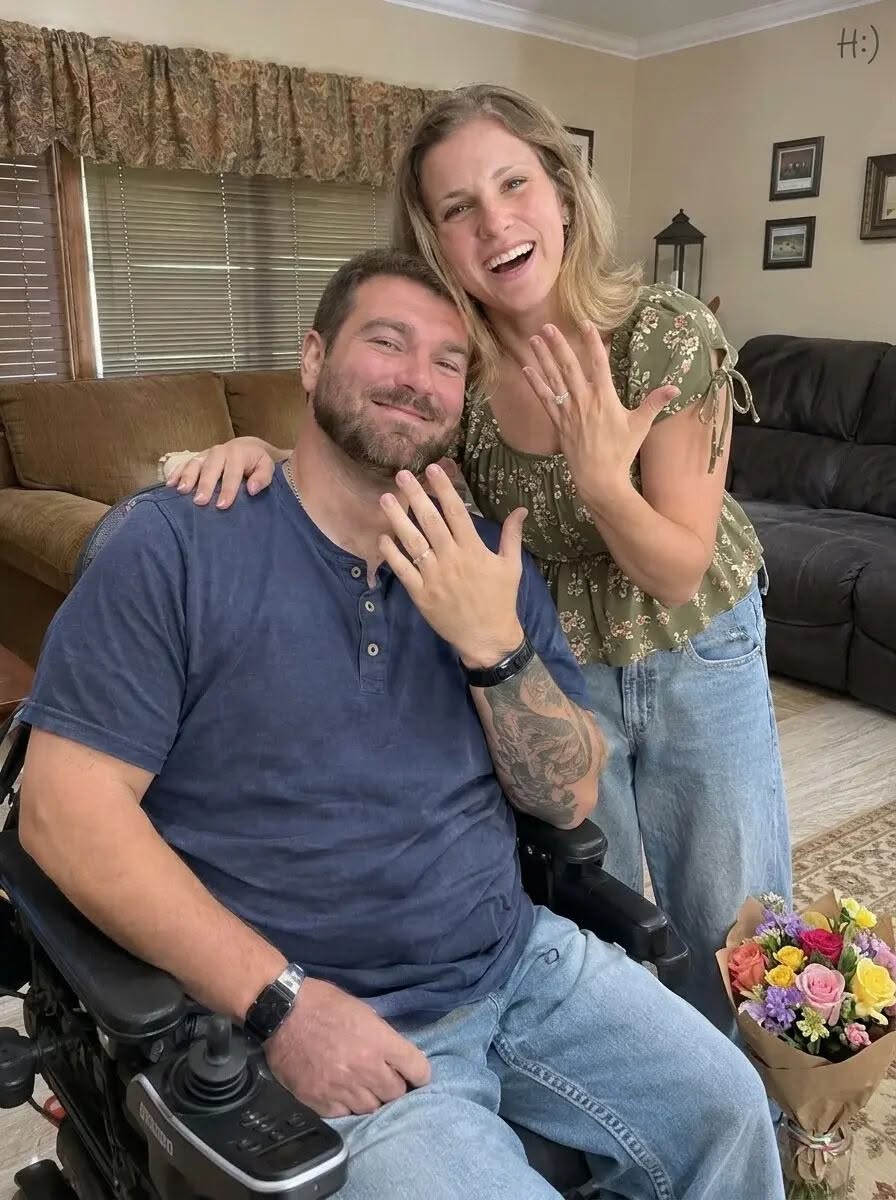
The following afternoon, a priest came to Carl’s house to marry us. Dana arrived shortly beforehand, carrying a small bouquet and a bag containing a few things she thought we might need. The ceremony took place in Carl’s living room, where the books had been moved from the chairs and the Scrabble board had been placed on a shelf. Carl wore his freshly pressed blue shirt, and I wore a simple blue dress. There were no elaborate decorations, no photographer, and no crowd of guests. The priest spoke quietly about commitment, kindness, and the importance of standing beside another person during difficult times. Carl listened closely, occasionally closing his eyes to gather his strength. When it came time to exchange rings, his hands trembled so much that he struggled to place the band on my finger. I gently guided his hand and helped him complete the gesture. Dana stood beside us as our witness, holding a tissue near her face. I could see that she was emotional, although she tried to smile. When the priest pronounced us married, Carl looked at me with an expression I would never forget. It was not the excitement of someone beginning a long future. It was the quiet relief of a man who had finally found someone willing to remain beside him. I leaned down and kissed his forehead. He whispered that I looked beautiful. I told him that he looked handsome too, and for a moment we both laughed.
For the next ten days, I became Carl’s wife in every practical sense. I moved into his house, bringing only a few clothes, toiletries, and personal belongings. My apartment remained available, but I wanted to be close enough to help him without making him feel that he had to ask every time he needed something. Our routine changed slightly. I prepared breakfast when he felt hungry, made tea in his chipped blue mug, and arranged his medication according to the instructions from his medical team. I helped him wash, changed his sheets, and kept track of the times when he seemed more tired than usual. When he had enough energy, he insisted on helping with small tasks. He would sit at the kitchen table and give me instructions about seasoning the soup or arranging the books. Sometimes his suggestions were useful. Other times, he simply enjoyed pretending to be in charge. I learned not to take those moments away from him. He wanted to remain involved in ordinary life for as long as possible. We read books aloud, listened to music, and played Scrabble whenever his hands were steady enough. He won three of our four games. In one match, he used a word that he had spent nearly the entire evening insisting was not valid. When I challenged him, he calmly opened the dictionary and showed me that it was real. I accused him of planning the trick in advance. He smiled and said that winning required strategy.
There were difficult moments too. Carl sometimes woke during the night feeling frightened or confused. His pain increased on certain days, and he became frustrated when his body refused to cooperate with him. I learned when to speak and when to sit quietly beside him. There were mornings when he could barely finish a cup of tea and afternoons when he suddenly felt energetic enough to discuss a book for an hour. I tried not to measure our days by what he could no longer do. Instead, I focused on the things we could still share. We talked about childhood memories, favorite teachers, music, and the places he had hoped to visit. He told me that he had once wanted to travel through Europe by train, stopping in small towns and visiting old libraries. I asked why he had never gone. He shrugged and said that life had become busy, then complicated, and eventually too uncertain. I told him that I hoped he had not spent too much time waiting for the perfect moment to do the things he wanted. Carl considered that for a while. Then he said that perhaps he had spent too much of his life believing there would always be another opportunity. The conversation stayed with me. I began wondering how many people postponed their happiness because they assumed they had endless time.
On my birthday, Carl surprised me with a chocolate cupcake and a single candle. I had not mentioned the date to him, so I was genuinely confused when he presented it after breakfast. He claimed that the teenager who lived next door had purchased it and asked him to keep it hidden until the right moment. I laughed and asked whether he had arranged the entire thing. He denied it, but his expression gave him away. I assumed he had discovered my birthday in the hospice paperwork and decided to make the day special. He sang a few lines of a birthday song, then stopped because it made him cough. I blew out the candle and told him that it was one of the nicest birthdays I had experienced in years. He looked pleased, although he tried to hide it behind a joke about the quality of the frosting. Later, we shared the cupcake while playing a slow game of Scrabble. Carl won again, and I accused him of using his birthday present to distract me. He replied that he had never promised to lose simply because it was my birthday. It was an ordinary afternoon, but it became one of the memories I would hold most closely after he was gone.
A few nights later, I noticed Carl holding a worn paperback against his chest. The book looked old, with a faded cover and pages that had begun to yellow. Whenever I asked about it, he called it his favorite book but refused to let me read it. He said there were some things a person should keep private, even in marriage. I teased him that he was becoming mysterious, but he only smiled. That night, I went to bed after helping him settle into his room. I woke around three in the morning and noticed that the light in the living room was still on. When I walked toward the doorway, I found Carl sitting in his chair, watching me. The paperback rested in his hands. He looked tired, but there was something thoughtful in his expression. I asked whether he was in pain or needed water. He shook his head. “Just making sure,” he whispered. I asked what he meant, but he did not explain. He simply looked at me for another moment and then closed his eyes. I returned to bed, assuming he had been frightened by a dream or worried about his condition. I did not realize that he might have been thinking about something from long before we met again. Two mornings later, while I was holding his hand, Carl took his final breath.
