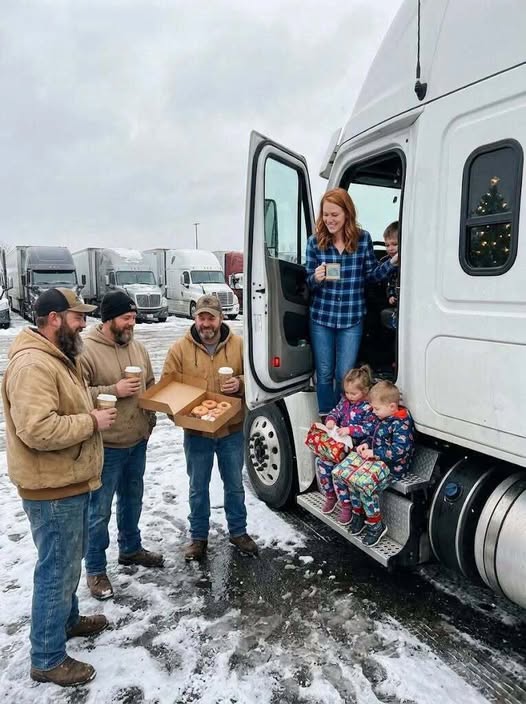
When we finally settled back into our normal routine, I made sure that the children had a proper Christmas celebration at home. We had already exchanged presents in the truck, but I wanted them to experience the traditions we had originally planned. We decorated the house together, baked cookies, watched their favorite Christmas movie, and prepared a special dinner. Nate was finally home, and he helped Wes arrange the presents beneath the tree. Hattie placed the ornaments she had chosen on the lower branches, while Rowan carefully positioned the lights. The children talked about the truck stop gathering throughout the evening. They remembered the donuts, the stuffed animals, the Christmas socks, and the drivers who had gathered around our vehicle. Wes insisted that the five-dollar tree from the truck should remain part of our Christmas decorations. I agreed and placed it beside the larger tree in the living room. It looked small and slightly uneven, but nobody wanted to replace it. It had become a symbol of something more important than the decorations themselves. Whenever I looked at it, I remembered the people who had stopped their own journeys to make three children feel special. I also remembered that even when circumstances were beyond my control, I could still create moments of happiness for my family.
The conversation with Elwood gradually became less tense, although I didn’t pretend that everything had returned to normal. He continued working with Marlene to implement the holiday rotation, and I made sure that all future vacation requests were submitted and confirmed in writing. I also established a personal rule that I would never accept an unexpected change simply because someone expected me to say yes. If the company needed me to adjust my schedule, I would consider the request, but I would first examine whether it was reasonable for my family. I had spent years believing that being a good employee meant making myself available whenever management needed help. I now understood that professionalism included setting boundaries and expecting agreements to be respected. My children needed a mother who could work hard without constantly sacrificing every personal commitment. Nate supported that decision, and we began planning our family schedules together rather than allowing last-minute demands to determine everything. As for Elwood, he slowly began to recognize that his responsibilities as a manager were separate from his feelings as a father. Keaton deserved support, but so did every other employee. Favoring one family member might seem harmless to the person making the decision, but it could have serious consequences for everyone affected.
Keaton also began taking more responsibility for his own situation. He spoke with his father about the special treatment he had received and explained that he didn’t want every difficult period in his life to become an excuse for others to carry his responsibilities. He began working with a counselor and made an effort to rebuild a healthier routine. I was glad to see him doing better, not because I wanted to prove that I had been right, but because I genuinely hoped he would find stability. Losing his mother had been painful for everyone, and I understood that grief didn’t disappear simply because time passed. But I also believed that people could support one another without creating unfair situations. Keaton eventually thanked me for speaking honestly with him. He said the Christmas incident had made him realize how easily a family could become divided when one person’s needs were constantly placed above everyone else’s. I told him that I didn’t want the situation to become something that separated us permanently. I wanted us to understand what had happened and make better decisions in the future. He agreed, and our relationship became more comfortable over time. I still remembered the crossed-out name on the delivery sheet, but I no longer saw Keaton as the person responsible for the entire situation. Elwood had made the decision, and he needed to accept responsibility for it.
The little five-dollar tree eventually became a permanent decoration in our home. We placed it on a shelf near the living room window, where its small branches and inexpensive ornaments could be seen from outside. I kept the original decorations rather than replacing them with something more expensive. There was a tiny red bell, a silver star, and a small wooden reindeer that Wes had insisted on bringing along. The tree wasn’t particularly beautiful by ordinary standards, but it reminded us of the Christmas when nearly thirty strangers came together to help our family. Every year, when we unpacked the larger decorations, the children asked me to bring out the little truck tree too. Rowan liked remembering the conversations he had with the drivers. Hattie remembered the gifts and the woman who had brought her coloring supplies. Wes always told the story about Santa finding our truck through the CB radio. Their memories had gradually become less about the holiday we missed and more about the people who had made it special. I was grateful for that. I didn’t want the children to remember Christmas as a time when their grandfather treated their family unfairly. I wanted them to remember that kindness could appear unexpectedly, even when a day began with disappointment.
Looking back, I still wish Elwood had never changed that assignment. I wish my children had spent Christmas morning in their own home, opening presents beneath the tree we had decorated together. I wish I hadn’t been forced to choose between protecting my job and keeping the plans I had made with my family. But I also know that the experience taught us something important. It showed my children that being treated unfairly doesn’t mean they have to accept that treatment silently. It showed me that I could stand up for my family, even when the person making the decision was someone I had known for years. Most importantly, it showed us that family isn’t defined only by blood or marriage. Sometimes family is found in a truck stop parking lot, among people who hear that three children are having a difficult Christmas and decide to do something about it. Those drivers had their own families waiting for them, their own routes to complete, and their own reasons for being away from home. Yet they stopped because they believed that no child should feel forgotten on Christmas morning. Elwood had handed me a delivery assignment worth $2,800, believing I would simply accept whatever he decided. He never imagined that nearly thirty fellow truckers would turn his unfair decision into a story about generosity, courage, and community. The assignment had taken us away from home, but the people we met on that journey gave us something we would carry for the rest of our lives. Sometimes the greatest Christmas gifts don’t arrive wrapped beneath a tree. Sometimes they arrive in enormous trucks, driven by strangers who refuse to let a family feel alone.
