The most unexpected part of the entire situation happened after we returned home. Keaton contacted me and asked whether he could speak with me privately. I wasn’t sure what to expect. Throughout the years, I had become accustomed to Elwood making excuses for him, and I wondered whether Keaton was going to defend his father’s decision. Instead, he sounded uncomfortable and genuinely upset. He told me that he had heard about the Christmas delivery and wanted to apologize. According to him, he hadn’t known that Elwood had transferred the assignment to me after my vacation had been approved. He had originally been scheduled to complete the Texas delivery, but he had told his father that he wasn’t feeling well enough to work during the holiday period. He had assumed Elwood would find another available driver or arrange a different schedule. He hadn’t known that I had been sent on the trip with three children. When he saw the video of the truckers gathering around our vehicle, he initially thought it was a story about a driver helping another family. Then someone told him the woman in the video was his sister-in-law. He watched the recording again and recognized the tiny tree, the truck, and the children. He said he felt ashamed when he realized what had happened. I listened while he explained that he had never asked his father to take away my vacation. He also said that he hadn’t wanted my children to spend Christmas on the road. I appreciated that he had contacted me rather than pretending the situation wasn’t his concern.
I told Keaton that I understood he had been dealing with personal difficulties. Losing his mother had affected the entire family, and I knew the holiday period could bring back painful memories. I wasn’t angry with him for needing time away from work. Everyone had the right to ask for help when life became difficult. My problem was with the way Elwood had handled the situation. He had decided that Keaton needed protection and had transferred the burden to me without asking whether I could manage it. Keaton listened and admitted that his father had often treated him differently because of what he had been through. He said he sometimes felt uncomfortable being given special treatment, but he hadn’t known how to challenge it without making his father feel that he was rejecting his help. I told him that he didn’t need to feel guilty for having difficulties, but he also needed to understand that other people had responsibilities and struggles of their own. My children had looked forward to Christmas just as much as he had. The fact that they were younger didn’t make their feelings less important. Keaton agreed. He said he wished he had known what was happening because he would have spoken to Elwood before the assignment was transferred. We talked for a while longer, and although the conversation didn’t erase what had happened, it helped me understand that Keaton hadn’t necessarily been part of the decision.
The children were also happy to hear from him. When I told them that Keaton had apologized, Wes immediately asked whether Uncle Keaton had seen the stuffed dog. Hattie wanted to show him the coloring book Denise had given her, and Rowan asked whether he could see the photographs from the truck stop gathering. Keaton eventually visited us and spent the afternoon looking through the pictures. The children showed him the presents they had received from the drivers and explained how everyone had helped decorate the little tree. Wes demonstrated how the stuffed dog could sit beside his toy truck. Hattie showed him the Christmas socks, while Rowan described the different vehicles that had gathered around us. Keaton listened patiently and laughed at their stories. At one point, he became quiet and said he was sorry they had missed the Christmas they had expected. Hattie told him that it had been disappointing at first, but the truckers had made it fun. Wes proudly announced that Santa had found us because Mommy had a CB radio. Everyone laughed. Watching Keaton interact with the children helped ease some of the tension, although I still believed that the company needed to address what had happened formally. A family apology was important, but it wasn’t a substitute for fair workplace procedures.
When the written scheduling proposal was completed, Marlene circulated it among the drivers and management. It established a holiday rotation designed to distribute assignments more fairly. Employees would receive written confirmation of approved vacation dates, and any changes would require direct communication with the affected driver. Managers would also be expected to document the reason for emergency changes and ensure that employees were given an opportunity to discuss practical arrangements before accepting a replacement assignment. The policy included a review process for disputes so that employees wouldn’t have to rely solely on a supervisor’s personal judgment. Elwood initially found the new requirements restrictive, but he eventually agreed that they were necessary. The company had experienced enough criticism over the Christmas incident to understand that informal family arrangements could create serious problems. Several employees told me they appreciated the new system because they had previously worried that personal relationships influenced assignments. I didn’t know whether every problem would disappear, but having a written policy was a meaningful step. It meant that my experience had produced something useful beyond a viral video and an uncomfortable family conversation. I had wanted my vacation respected, and now other drivers would have clearer protections when requesting time off.
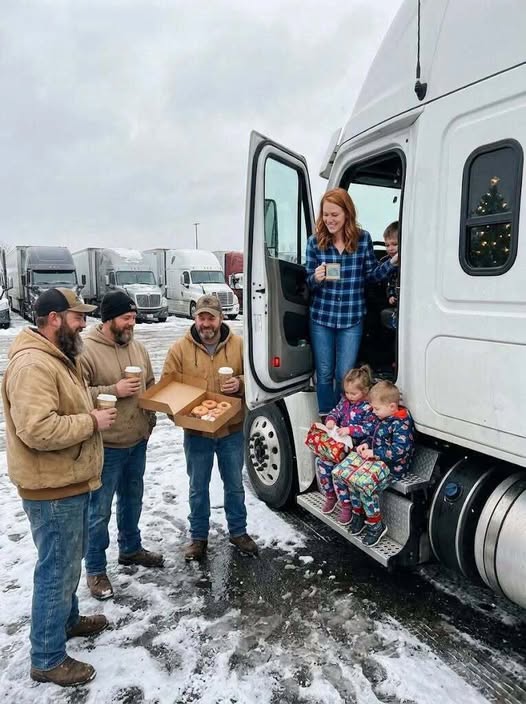
The drivers who had helped us also remained in contact. Odell called occasionally to ask how the children were doing, and Denise sent Hattie a small package of art supplies a few weeks later. Raymond shared another photograph from the Christmas gathering, showing everyone standing beside our truck with the little tree visible through the windshield. Several drivers continued sending messages, saying that they were glad the children had enjoyed the holiday. I thanked them whenever I could, although I never felt that words were enough to express what their kindness had meant. They had turned a difficult situation into a memory my children would carry for years. Rowan, who had initially been disappointed and quiet, began talking about the drivers as though they were old friends. Hattie remembered Denise and her gifts, while Wes continued telling people that Santa had used the radio to find us. Sometimes, when we passed a truck stop, the children would ask whether we might see Odell again. I told them it was possible, and they would immediately look toward the parking area. The experience had changed the way they viewed strangers. They had learned that people they had never met could show genuine kindness without expecting anything in return. I wanted them to remember that lesson much longer than they remembered the disappointment caused by their grandfather’s decision.
