Part 7 — The Note He Finally Answered
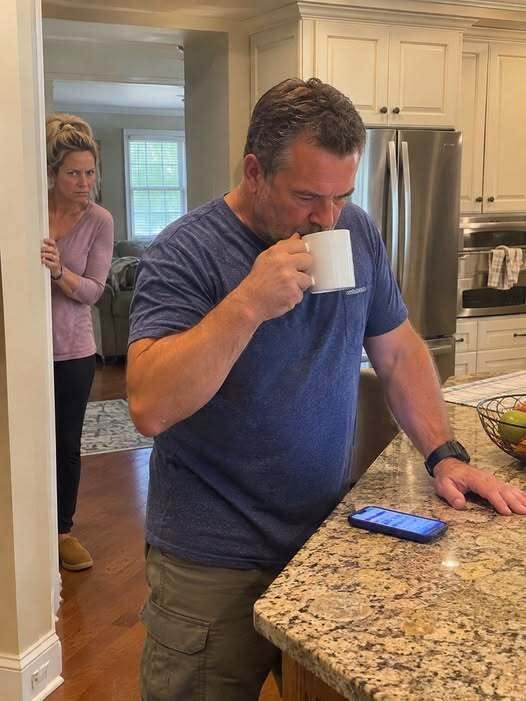
Nearly a year after that morning with the coffee mug, I found Brad sitting at the kitchen table with a sheet of paper in front of him. He had been trying to write something for me. His handwriting was slower than it used to be, and several words had been crossed out. When I approached, he covered the page with his hand. “It’s not ready,” he said. I smiled and asked whether it was a secret. He nodded. I made his coffee and placed it in the white BEST HUSBAND mug. He looked at the faded lettering and chuckled. “Still a ridiculous mug,” he said. I told him it was one of my best purchases. He took a sip, then looked toward the window. The garden was full of spring flowers, and the fence he had repaired the previous year was beginning to lean again. We would have to ask someone to fix it this time. Brad no longer pretended he could do everything himself. That change had taken courage.
A few days later, he gave me the paper. It was folded into thirds, just like the note I had placed beneath his saucer. At the top, he had written my name. Beneath it were several short sentences: “I still love you. I know I forget things. Sometimes I forget what I was saying before I finish the sentence. Sometimes I look at you and know you are important before I can find the right memory. But I know I love you. I don’t want you to spend all your time looking after me. I want you to keep being my wife, not just my helper. Please tell me when you are tired. Please tell me when you need a day for yourself. And please don’t stop laughing at my terrible jokes.” I read it twice. Then I sat beside him and rested my head against his shoulder. “I can do that,” I whispered. He smiled. “Good. Because I have several terrible jokes prepared.” We laughed together, and for that moment the future felt less frightening.
Brad’s condition continued to change, although not in a straight line. Some mornings he was alert and conversational. Other days, he struggled with names, dates, and familiar routines. We continued seeing Dr. Patel and reviewing his care plan. We adjusted the house where necessary and made sure our important documents were organised. We discussed our wishes with the family while Brad could express them clearly. He chose who he wanted involved in decisions and told us what mattered most to him. Those conversations were painful, but they were also valuable. I understood that planning ahead was not giving up. It was a way of protecting his independence and making sure his voice remained part of the decisions that affected him. We also kept doing ordinary things. We watched old films, listened to music, visited the grandchildren, and sat in the garden with coffee. I learned not to measure a good day by how much Brad remembered. Sometimes a good day was simply one in which we enjoyed being together.
One evening, I took the folded note from our anniversary morning out of the kitchen drawer. The paper had softened at the creases. I placed it beside the letter Brad had written for me. The first note had asked him to tell me whether he still loved me. The second had answered in the only way he could. I realised that the hardest part of the previous year had not been learning about his diagnosis. It had been learning how easily fear could make two people withdraw from each other. I had feared betrayal. He had feared becoming a burden. Neither of us had known how to begin the conversation. If I could return to that morning, I would still leave the note beneath the saucer, but I would sit down beside him afterward and ask him to talk. I would tell him that I was frightened, that I needed honesty, and that he did not have to protect me from every difficult truth. I would also tell him that love was not a promise that nothing would change. It was a decision to face change together.
The following morning, I poured his coffee into the white mug again. Brad came downstairs slowly, wearing his favourite blue sweater. He looked at the mug and read the faded words aloud. “Best husband,” he said. “That’s debatable.” I smiled and placed the saucer in front of him. There was no note beneath it this time. I had nothing to ask that he had not already answered. He reached for my hand and said my name. It took him a moment, but he found it. “I love you,” he said. I kissed his forehead and told him I loved him too. Then we sat together while the morning light moved across the kitchen table. I knew there would be more difficult appointments, more forgotten words, and days when neither of us would know what to say. I also knew that I could not control how quickly his memories changed. But I could make sure he never had to face those changes alone. The mug was chipped, the lettering was fading, and the man holding it was no longer quite the same man who had walked downstairs eleven years earlier. Yet he was still Brad. And he was still my husband.
