Part 5 — The Diagnosis Neither of Us Wanted
The call came on a Tuesday morning while I was folding laundry. Dr. Patel’s office asked whether Brad could come in that afternoon to discuss the scan and blood-test results. I knew immediately that the appointment mattered. Brad was in the garden, trying to repair a loose fence panel. When I told him, he put down the screwdriver and stared at me. “They have the results?” he asked. I nodded. He looked toward the house, then at the fence. “I don’t think I can sit in that waiting room again,” he said. I understood. The waiting had become its own kind of suffering. Every telephone call carried the possibility of an answer, and every unanswered question seemed to grow heavier. I told him we could go together and that he did not have to pretend to be brave. He gave a small smile and said, “You always were better at that than me.” I wanted to disagree, but I knew we were both frightened.
Dr. Patel greeted us warmly and invited us to sit. She explained that the blood tests had not revealed an obvious vitamin deficiency, thyroid problem, or other simple cause for the symptoms. The scan showed changes that required careful interpretation, and the cognitive assessment had confirmed difficulties with short-term memory and some aspects of planning and organisation. She told us that the pattern was consistent with an early-stage neurocognitive disorder, and that Alzheimer’s disease was the leading possibility. She was careful to explain that further evaluation and follow-up would be needed before making a definitive diagnosis. Brad stared at the floor. I felt my hands go cold. I had suspected something serious, but hearing the possibility spoken aloud was different from fearing it in private. Dr. Patel explained that the condition could affect people differently and progress at different rates. There were treatments and support options that might help manage symptoms, though none could promise to stop the disease. She gave us time to absorb what she had said.
Brad asked the question I had been afraid to ask. “How long before I can’t remember my wife?” Dr. Patel leaned forward. She said there was no reliable way to predict that from the information available. Some people maintained many abilities for years, while others experienced changes more quickly. She encouraged him to focus on what could be done now: follow-up care, medication discussions, exercise, sleep, social activity, and practical planning. She also recommended that we discuss driving, workplace responsibilities, and legal and financial arrangements while Brad could still participate fully in those decisions. Brad’s jaw tightened when she mentioned driving. He said he had not had an accident and still knew the roads. Dr. Patel acknowledged that, but explained that the episodes of disorientation needed to be taken seriously. She recommended a formal driving assessment and advised him not to drive until the immediate safety concerns had been reviewed. Brad looked at me, and I could see the humiliation in his expression. I reached for his hand. He let me hold it.
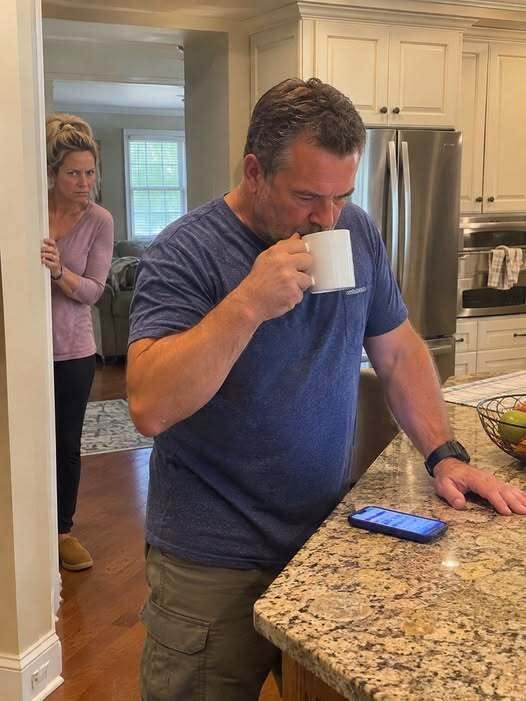
On the way home, he asked me to stop at a small park. We sat on a bench overlooking a pond where children were feeding ducks. Brad watched them for a long time. Finally, he said, “I thought you were going to tell me you wanted a divorce.” I turned toward him. He explained that when he saw the note beneath the coffee cup, he had assumed I had discovered something terrible about him. He had been so frightened of the diagnosis that he imagined I might decide I couldn’t live with what was coming. He had been preparing himself for rejection before I had even asked the question. I told him that I had written the note because I was afraid he no longer loved me, not because I had already decided to leave. He looked at me with tears in his eyes. “I do love you,” he said. “I just haven’t known how to tell you what’s happening.” I leaned against him. We sat there until the afternoon light began to fade.
That night, we told Lauren the doctor’s assessment. She cried, then asked whether she could bring her children over at the weekend. Brad immediately said yes. He wanted to see them, he said, and he wanted them to remember that Grandpa was still Grandpa. We began discussing what the children should be told. We decided to use simple, honest language: Grandpa’s brain was having trouble storing and finding some memories, and the doctors were helping us understand why. We would answer their questions without frightening them with details they did not need. Brad also asked me to help him make a list of the things he wanted to do while he was able. He did not call it a bucket list. He said that phrase sounded like something printed on a novelty mug. Instead, he called it “the things we keep putting off.” At the top were a weekend by the coast, a visit to his brother in Ohio, and a proper family photograph with all the grandchildren. I wrote them down. Then I added one of my own: a dance in the kitchen, just because we could.
