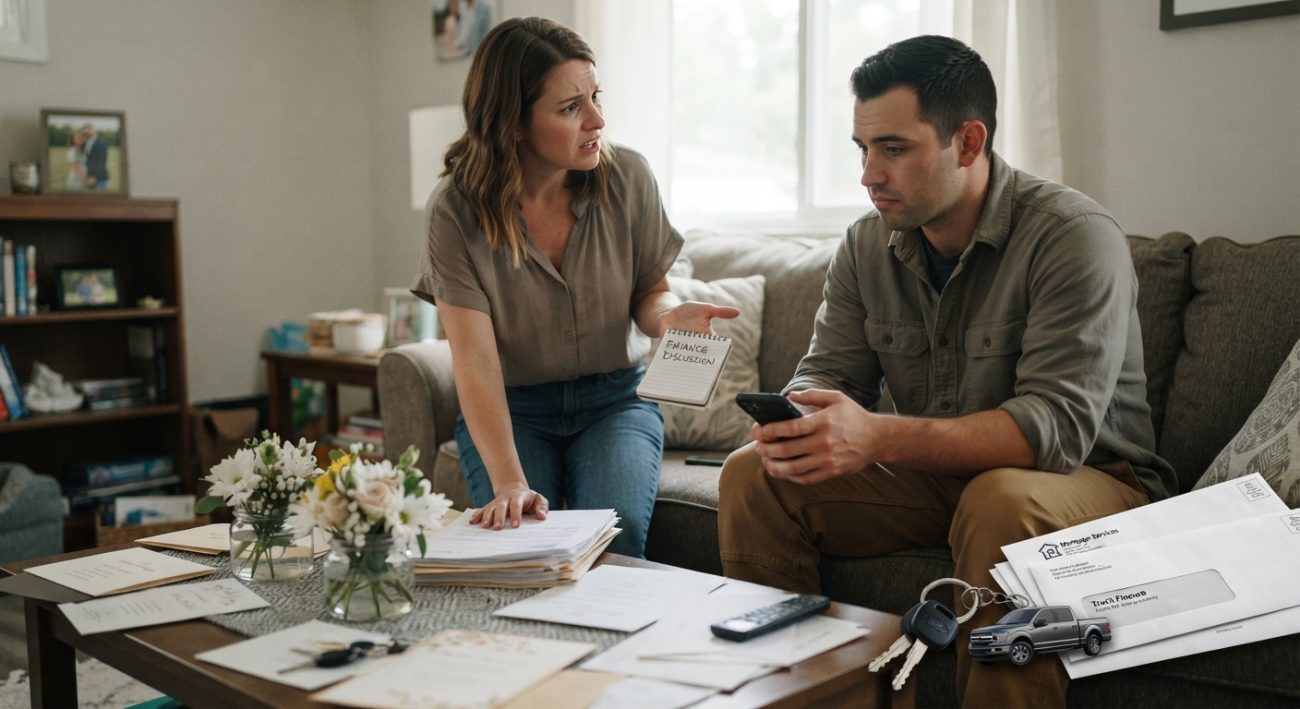
Miss Ottilie was still watching her son. “She isn’t asking you to sign it tonight,” she said. “She’s showing you what your plan sounds like when it’s put on paper.” For the first time that evening, Monte seemed to run out of things to say. His shoulders dropped, and the anger slowly left his face. In its place came something more uncomfortable: the realization that he might have been wrong. His sons sat quietly, no longer cheering him on or looking pleased with the arrangement he had announced at Sunday dinner. I watched Monte study the lease, and I wondered what was going through his mind. Perhaps he was remembering how easily he had told everyone we would live in my house. Perhaps he was thinking about the truck payment and the money he hoped to collect from renting his property. Or perhaps he was finally understanding that I had not been included in any of those calculations. After a long silence, he looked at me and said, “I didn’t mean to make you feel like a guest in your own house.” I didn’t want to hurt him, but I couldn’t pretend that wasn’t exactly how I had felt. “You did,” I told him. “You took down my mama’s painting. Your boys took my husband’s workbench. You never asked me about either one.” I could hear how serious my voice sounded, and I knew there was no point in softening the truth. Those two things represented more than furniture and decoration. The painting connected me to my mother, and the workbench connected me to the man I had spent so many years building a life with. Monte had treated both as inconveniences to be moved aside while he settled into my home. He had not considered that I might feel differently.
He looked down at his hands. “I thought you didn’t care about that old painting,” he said. I almost laughed at the word old, but I held it back. “I care about it. It was my mama’s.” He nodded slowly and said he would put it back. I appreciated that he offered, but I knew the painting was only one part of the problem. “You can,” I said. “But that’s not the whole thing.” He rubbed his forehead and finally admitted that he had become excited about having a plan. The truck was costing him a lot of money, and he had seen an easy way to handle the payments. He could rent out his own house, move into mine, and use the rental income to pay down the truck. He said he hadn’t stopped to ask what I wanted. I listened without interrupting. It was the first time that evening he had explained his thinking without trying to make it sound as though I had already agreed. I understood that money could be a worry. I understood that he wanted to enjoy his new truck without struggling to make the payments. But his financial concerns did not give him the right to make decisions about my home. He had been so focused on the arrangement that benefited him that he had overlooked the person he was supposed to be building a future with. I wanted him to understand that marriage was not a shortcut to getting what he wanted. It was a partnership, and a partnership required both people to have a voice. Monte didn’t make a grand speech or promise that he would never make another mistake. He simply sat there with the lease between us and let his family see him without his usual grin. Somehow, that honesty mattered more than a dramatic apology would have.
After a while, I slid the paper back toward him. “You can tear it up,” I said. “I’m not trying to make you my tenant.” He stared at the lease as if he were deciding whether to believe me. Then he picked it up and tore it straight down the middle. He separated the pieces again, tearing them into smaller scraps until they were small enough to fit in his palm. He placed them beside the red bow on the table. I watched him do it, and I felt some of the tension leave my body. The paper had served its purpose. I had not wanted to collect rent from the man I planned to marry. I wanted him to see the unfairness of assuming that my home could be used to solve his financial problems without my agreement. Miss Ottilie started laughing again, louder this time. One of the wives covered her mouth, and Monte’s oldest boy finally let out the laugh he had been trying to hold back. I laughed too, although my eyes had become wet. There was something almost ridiculous about the sight of a grown man sitting at a restaurant table surrounded by scraps of a lease he had never expected to receive. But beneath the humor was a serious lesson. The wedding was only days away, and we had nearly begun our marriage with an arrangement that one person had made for both of us. Monte stared at the torn pieces and said, “I suppose that settles that.” I looked at him and replied, “It settles the lease. We still have to decide where we’re going to live.” I wanted him to understand that tearing up the paper did not automatically solve everything. We still had to make a real decision, and this time we had to make it together.
Monte looked at me for a long moment. His expression was different now. He wasn’t smiling as though he had everything figured out, and he wasn’t looking around for his sons to agree with him. He seemed to be considering what I had said. Finally, he rubbed his palm against his trousers and asked, “Would you consider living at my place instead? No renting yours out. No renting mine. We could keep both houses.” His voice had lost the certainty it carried when he announced his plan at Sunday dinner. This time, he was asking. It was a small difference in wording, but it meant a great deal to me. He wasn’t telling me where I would live. He was asking whether I would consider an arrangement. I looked at Miss Ottilie. She gave me one small nod, then turned her attention to her tea, leaving the answer to me. Nobody at the table spoke. His sons waited, their wives sat quietly, and Monte watched me with a nervous expression. My first instinct was to say yes immediately. I wanted the discomfort to end. I wanted everyone to relax and return to talking about the wedding. But I caught myself before the word came out. I had spent too many days smiling when I wanted to speak. I wasn’t going to make another important decision simply because I felt uncomfortable saying what I needed. I thought about my bungalow, the fig tree, the porch swing, and the rooms I had painted after my husband’s death. I thought about Monte’s house too. I had been there many times, and there was nothing wrong with it. Perhaps it would be a comfortable place for us to begin our married life. But I needed to know that moving there would not mean surrendering control of my belongings or leaving my own home behind.
“I would consider it,” I finally said. “But I won’t be moving my things into your house while you move mine out of mine. We decide together. And my mama’s painting comes with me.” Monte nodded. “Of course,” he said. “And the workbench. I’ll help bring it back.” His oldest boy looked up from the table. “I can bring it over tomorrow.” His brother immediately offered to help. I looked at both of them and made one thing clear. “It belongs in the garage at my house. I want it back there.” The oldest son nodded. “That’s where it’ll go.” His face had turned red, and he kept his eyes lowered. “I’m sorry, Miss LaDonna.” I looked at him and accepted the apology. “Thank you,” I said. It wasn’t a magic word that erased what had happened, but it was a beginning. I didn’t need everyone at the table to feel ashamed for the rest of the evening. I wanted them to understand that asking first mattered. Monte touched the torn lease with two fingers. “I made this sound awful,” he said. I answered, “You made it sound like I didn’t get a say.” He nodded once. “I did.” I could have left the conversation there, but I wanted to make sure he understood what I expected from our marriage. “If you want to marry me, don’t announce my decisions for me. Ask me. Even when you think you know the answer.” He lifted his eyes and said, “I will.” Miss Ottilie reached across the table and patted his arm. “She shouldn’t have to teach you that at your age.” Monte looked half embarrassed and half amused. “Ma,” he said, and that earned another laugh from the table, even from me. The tightness in my shoulders finally began to ease. Nobody pretended the supper had gone exactly as planned, but at least we were no longer pretending there was no problem.
