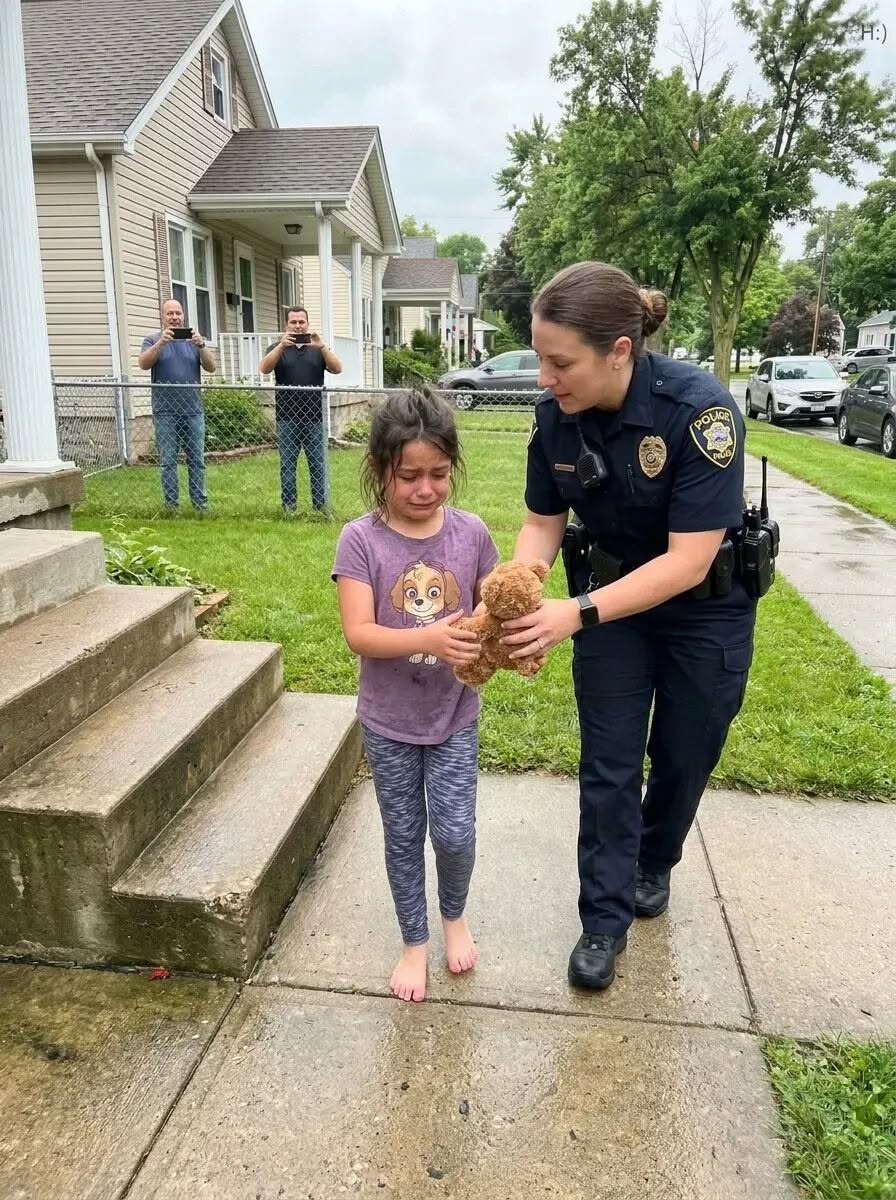
Officer Laura Benson received the dispatch while finishing another call nearby. The information was alarming: a seven-year-old girl had been alone for four days, her father was missing, and she was reporting that she was sick and hungry. Laura immediately activated her lights and drove toward the address. As she approached the house, she noticed that the front porch was dark and the curtains were drawn. A few neighbors had already gathered outside, apparently alerted by the arrival of emergency vehicles. Some stood near their driveways, whispering to one another. One woman was holding her phone up, recording the scene from across the street. Laura parked, stepped out into the damp night, and approached the front door. She knocked gently and announced that she was a police officer. There was no answer at first. She waited and knocked again, this time more softly. After several seconds, the door opened only a few inches. One frightened eye appeared in the gap. “Are you going to be mad at me?” Ashley whispered. Laura immediately crouched down so she would not appear intimidating. She told Ashley that nobody was angry with her and that she had done something very brave by asking for help. Ashley hesitated, then slowly opened the door wider.
The scene inside made Laura’s expression change. Ashley was barefoot on the cold floor, wearing an oversized gray work shirt that clearly belonged to her father. Her hair was tangled, her lips were cracked, and her face looked swollen with exhaustion. She was holding Buddy against her chest with both hands. Laura introduced herself again and asked whether she could come inside. Ashley nodded. The officer carefully closed the door behind her and looked around. The refrigerator was almost empty. A few containers sat on the shelves, but there was very little fresh food. On the kitchen table, Laura noticed a handwritten shopping list. The items were ordinary groceries, followed by the name of Ashley’s prescription medication. Beside it was a reminder about an urgent pediatric kidney appointment. Laura picked up the paper and read it twice. She also noticed a calendar on the wall, filled with medical appointments and reminders. The dishes were washed, the counters were clean, and Ashley’s clothes had been folded neatly on a chair. These details did not match the simple accusation that had already begun spreading among the neighbors. The house did not look like a place where a child had been deliberately abandoned. It looked like a home where someone had been trying desperately to maintain normal life under difficult circumstances.
Laura asked Ashley when she had last eaten. The little girl tried to remember, but her answer was confused. She said she had eaten soup, although she could not explain exactly when. She also admitted that her stomach hurt and that she felt dizzy when she stood up. Laura immediately requested the ambulance again, emphasizing that the child might be seriously dehydrated. She asked whether Ashley had taken her medicine. Ashley shook her head and explained that Daddy had gone to buy it. Laura asked whether Raymond had ever told her he was leaving permanently. Ashley looked shocked by the question. “No,” she replied. “He said thirty minutes. He always comes back.” Her voice became quieter as she explained that she had waited every night and listened for the three knocks. Laura felt a painful tightening in her chest. She had responded to many family emergencies during her career, but there was something particularly heartbreaking about hearing a child describe the exact instructions her missing parent had given her. Ashley was not behaving like a child who believed she had been abandoned. She was behaving like a child who still expected her father to walk through the door at any moment.
Outside, the neighbors continued watching. One man told another that the father should be arrested immediately. The woman recording the scene whispered that she had suspected something was wrong for months. Laura heard enough to understand that people were already forming opinions without knowing the facts. She stepped toward the doorway and asked them to give the medical team room to work. Then she returned to Ashley, who had begun swaying slightly while standing beside the couch. Laura reached out to support her. “Can I carry you for a moment?” she asked. Ashley nodded and held out her arms. The officer lifted her carefully, noticing how little weight the child seemed to have. Ashley’s head rested against Laura’s shoulder. For a moment, she looked as though she might fall asleep. Then her body suddenly went limp. Laura immediately called for the paramedics and laid Ashley gently on the couch while checking her responsiveness. The ambulance crew entered moments later, bringing medical equipment into the living room. One paramedic began assessing Ashley’s breathing and circulation while another prepared a stretcher. Laura picked up Buddy from the wet porch, where Ashley had accidentally dropped him during the commotion, and placed him beside the little girl’s hand.
Before the ambulance left, Laura returned to the kitchen and took the shopping list with her. She wanted to preserve it as possible evidence and also understand where Raymond might have gone. The list included a pharmacy name written in small letters at the bottom. She noticed that the paper had been folded several times, suggesting Raymond had carried it with him before leaving. Laura looked again at the reminder for Ashley’s medical appointment. It was dated for the following morning. The details suggested that Raymond had been aware of how urgent his daughter’s care was. As the paramedics prepared to transport Ashley, Laura stepped outside and faced the neighbors. She held up the list, careful not to reveal private medical details unnecessarily. “This doesn’t look like abandonment,” she said firmly. “This looks like a father who went to the store and didn’t make it home.” The statement silenced several people, although the woman with the phone continued recording. Laura did not argue with them. She had a child to protect and a missing father to find. She climbed into her patrol car, placed the shopping list on the passenger seat, and followed the ambulance toward St. Mary’s Children’s Hospital. Her investigation had begun with a frightened little girl. Now she needed to discover what had happened to the man who had promised to return.
