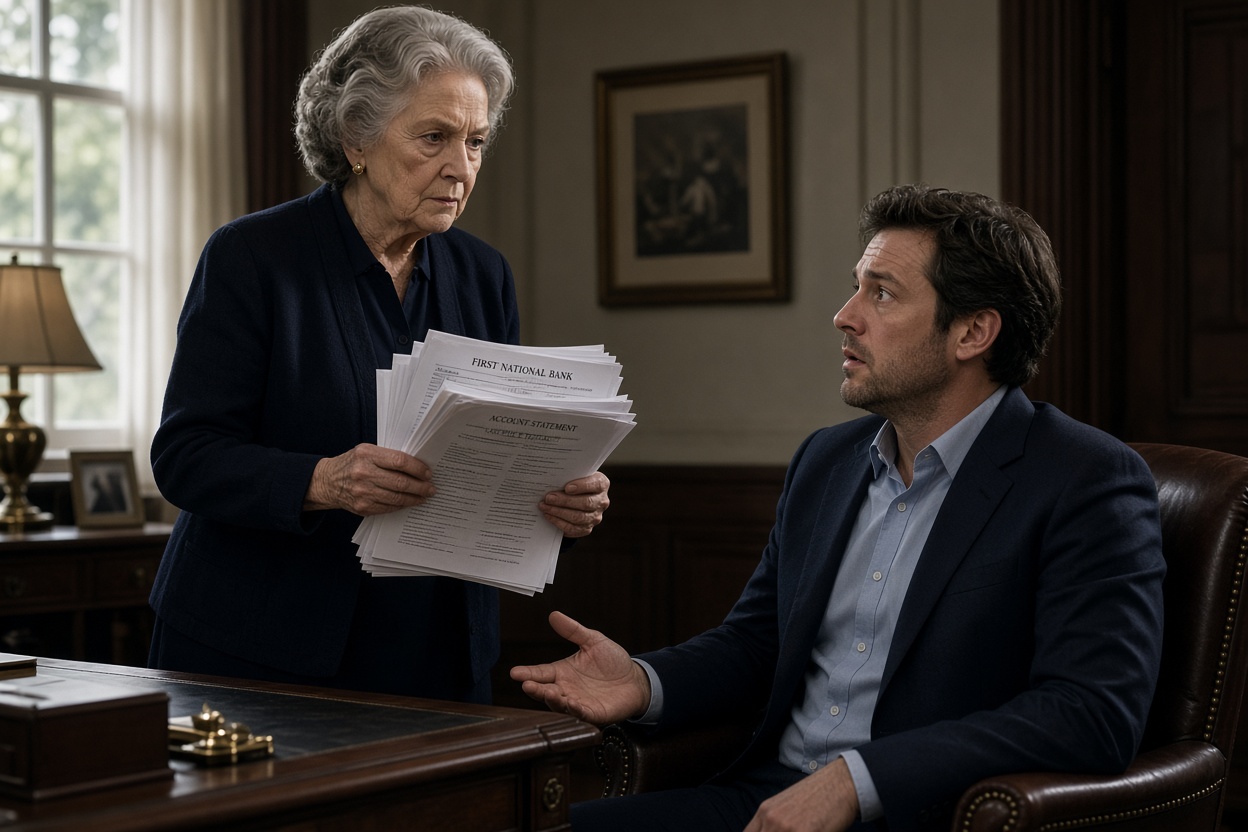
That evening, I sat at the kitchen table with Walter’s photograph beside me. I remembered the years when he would come home exhausted, wash his hands, and sit in that same chair while I brought him dinner. We had argued about small things, laughed about foolish things, and worried about bills when work was slow. But we had always agreed on one thing: what we built together was meant to protect our family, not become an opportunity for someone to take advantage of us. I looked at the bank statements spread across the table and tried to understand how Brian had convinced himself that he was entitled to our money. I also wondered how Emily had managed to sit across from me at Christmas knowing what had happened. She had helped me prepare dinner, asked about my health, and hugged me goodbye.
All the while, she had known that her husband and his mother were using my identity. I did not sleep much that night. Every sound outside made me look toward the window. I checked the locks twice and placed my handbag beside the bedroom door. The next morning, I called the police and confirmed that a report had been opened. I was told that a detective would contact me to arrange an interview. I also made a list of everything that might have been taken or accessed inside my home. I began with my identification documents, then wrote down the dates Emily and Brian had visited. I remembered that Emily had once asked where I kept important paperwork, claiming she wanted to help me organize it. At the time, I had thought it was a thoughtful question. Now I wondered whether she had been looking for something much more specific. I knew I could not allow fear or embarrassment to keep me quiet. I had done nothing wrong, and I had no reason to protect the people who had betrayed me. Walter had worked too hard for me to surrender what remained of his life’s work. I folded the bank statements carefully, placed them inside a folder, and waited for the detective’s call. The money was gone, but I was determined to find out exactly how it had happened, who had helped, and whether there was more to the betrayal than I had discovered. [nextpage]
PART 2
Detective Harris arrived at my house the following afternoon. He was a middle-aged man with a calm voice and a serious expression, the sort of person who seemed to listen carefully before deciding what to say. He introduced himself at the front door, showed me his identification, and asked whether we could speak somewhere private. I invited him into the living room, where Walter’s photograph still stood on the mantelpiece. Detective Harris noticed it and asked whether Walter had been involved in the savings account. I explained that the money had belonged to both of us and that Walter had worked as an electrical contractor for forty years. I told him how we had saved gradually, sometimes putting away only a little each month, until the balance became enough to support us through retirement.
He wrote down the details and asked me to describe the withdrawals. I handed him the bank statements and explained that the three transactions totaled sixty-one thousand dollars. Then I described the security footage and identified Diane as the woman wearing my coat. Detective Harris asked whether I was certain. I told him that I had known Diane for years and had seen her at Christmas only weeks earlier. I also explained that my daughter, Emily, had admitted that Brian arranged the withdrawals and that Diane participated. The detective asked whether Emily had made that admission in writing. I told him that she had confessed during a telephone call, but I had not recorded it. He advised me not to contact anyone involved to argue or threaten them. Instead, he wanted me to preserve messages and let the investigation proceed. I showed him Brian’s text, in which he told me not to make the matter bigger because we were family. Detective Harris read it twice and asked whether Brian had sent anything else. I said no. He placed a copy of the message in his folder and asked me to explain who had access to my house.
I told him that Emily and Brian both had spare keys. I had given Emily a key years earlier because she was my daughter and sometimes needed to check on the house when I traveled. Brian had received one after their marriage, mostly because he helped with small repairs. I had never thought twice about it. They were family, and I believed there was no reason to treat them like strangers. Detective Harris asked whether Diane had ever possessed a key. I said I did not believe so, although she had visited the house several times. He asked whether she had ever been alone inside. I remembered that she had come over with Brian on more than one occasion, and there had been moments when I was in the kitchen while they walked through the hallway or looked around the living room. Nothing had seemed suspicious at the time.
