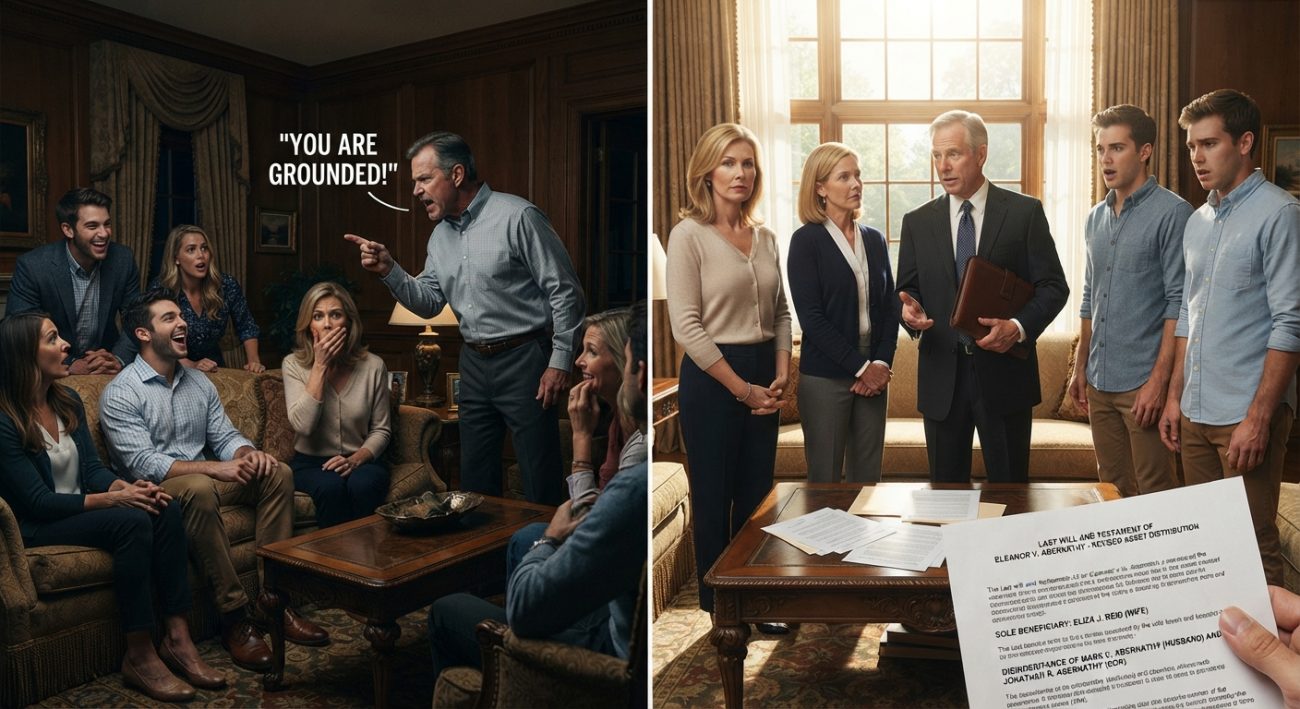
Russell frowned at Leonard’s question. He explained that I had gone upstairs after an argument the previous evening and that the entire situation had been a misunderstanding. He said I had probably needed some time alone and would eventually calm down. He seemed to believe that Leonard had come to discuss the separation agreement and that everything could still be handled quietly. Leonard raised one hand and stopped him. “I’m not talking about last night,” he said. Then he opened the leather folder and removed a document bearing the letterhead of First Meridian Bank. I watched from the hotel room, holding my phone in both hands. Leonard explained that after my call the previous evening, he had begun checking the titles and liens connected to my properties. It was routine before a separation, particularly when large assets and outstanding business loans were involved. At approximately two o’clock that morning, however, he had discovered something that changed everything. Six weeks earlier, a pledge of collateral had been filed with First Meridian Bank. The document used my lake house as security for a four-hundred-thousand-dollar business loan. The borrower was Brett Whitford. Leonard held the paper up so Russell could see it. The property owner listed on the document was Margot Whitford, and the signature appeared to be mine. But it wasn’t. Leonard had seen my signature on thousands of documents throughout the years. He knew exactly how I signed my name, and the signature on the pledge was not authentic.
Russell’s face went white. I watched him grip the edge of the doorframe as Leonard continued explaining what he had found. The loan was connected to the luxury car dealership Brett had announced at dinner. The same dealership for which he had asked me to provide fifty-five thousand dollars. Suddenly, the events of the previous evening made sense. The fifty-five thousand dollars was not the full amount needed to establish the business. It was the down payment required by the bank in addition to the collateral. Brett had apparently already arranged to use my lake house to secure the loan. He only needed me to provide the cash to complete the deal. When I refused, he had deliberately destroyed my grandmother’s glass in front of the entire family. It was no longer simply a question of an immature young man demanding money. Someone had used my identity and attempted to put my property at risk without my knowledge or permission. My lake house was one of the most important places in my life. I had bought the small cedar cottage with the first substantial profits from my physical therapy clinics, eighteen years before meeting Russell. It stood beside the water at the end of a long gravel driveway, surrounded by pine trees. I had spent countless weekends there, especially during difficult periods in my life.
It was where I went when I needed quiet, where I read, thought, and remembered the people who had shaped me. Eleven years earlier, I had scattered my grandmother’s ashes from the end of its dock. Russell’s family had enjoyed visiting the property every summer. I had welcomed them, provided meals, and allowed everyone to use the cottage without charging them a cent. It had never occurred to me that anyone would attempt to use it as collateral for a business loan. Yet someone had signed my name and offered it to a bank. Russell finally spoke. His voice was so quiet that I had to turn up the volume on my phone. “I signed it,” he admitted. “Brett said the bank needed a property. He said it was just a formality. He said the dealership would pay it off in two years and Margot would never even know.” Leonard stared at him. Russell added that he had intended to tell me eventually. Leonard asked him when. Russell had no answer. Leonard closed the folder slightly and explained that forging a spouse’s signature on a property pledge was a serious criminal matter. He told Russell that he was required to inform me of what had happened and that I would undoubtedly want to notify the bank.
Then he reached into the folder and produced three additional envelopes. He explained that these contained the instructions I had given him the previous night. The first was the separation agreement Russell had signed in April. The second was formal notice that the outstanding balance of the loan from the Elisabeth Novak Trust, totaling seven hundred eighty thousand dollars, was now due under the agreement’s separation clause. The third was a thirty-day notice requiring Russell to vacate the house, which was titled solely in my name. Russell stared at the envelopes. “She can’t do this,” he said. Leonard answered calmly that I already had. Then he reminded Russell that he had represented the Whitford family for fifteen years and had even drafted Russell’s father’s will. He told him he had never felt ashamed to stand on that porch until that morning. Leonard turned and walked down the steps toward his car. Russell remained in the doorway holding the envelopes. Brett appeared behind him in the hallway, asking who had come to the door and what was happening. Russell didn’t answer. He simply closed the door.
Ten minutes later, Leonard called me from his car. He asked whether I had seen everything. I told him I had. He apologized for what I had discovered, but I told him there was no reason to apologize. He had found the truth. Without that overnight investigation, I might have remained unaware of the forged pledge for two years, perhaps until the bank attempted to enforce it. Leonard asked what I wanted to do next. I looked through the hotel window at the city waking below me. I thought about the eleven crystal glasses, the one that had been destroyed, and the forty families whose livelihoods depended on Whitford Logistics. Then I told him exactly what I wanted.
