PART 2
I took Kaylee upstairs and brought her into the guest bathroom so she could wash her face and warm her hands under the water. Her fingers were red from the cold, and I could see how exhausted she was. I found clean clothes in the closet and helped her gather what she needed. When she changed, I wrapped her in a thick robe and brought her downstairs. I asked Tara to explain exactly why Kaylee had been sent outside. Tara crossed her arms and said the problem began when forty dollars disappeared from a drawer. According to her, Kaylee had been the only person in the house who could have taken it. Kaylee immediately said that was false. Tara replied that teenagers often denied their mistakes and that she had tried to teach her responsibility. I asked whether she had ever searched Kaylee’s belongings or spoken to me about the accusation. Tara said she did not need my permission to discipline a child in her own home. I reminded her that Kaylee was my daughter and that I had never agreed to any punishment involving the camper. Tara insisted that she had explained the situation during one of our phone calls. I told her she had never mentioned that Kaylee was sleeping outside. She changed the subject and said Kaylee had been difficult for months. I asked what that meant. She listed ordinary teenage behavior: wanting privacy, spending time alone, arguing about chores, and refusing to follow every instruction immediately. I listened until she finished, then asked whether any of those things justified locking a sixteen-year-old outside in freezing weather. She did not answer directly. Rick interrupted and said I was being emotional because I had just arrived after a long drive. I turned toward him and told him he had no authority to decide what happened to my daughter. His expression hardened, and for the first time I understood that he had become far more involved than Tara had admitted.
I asked Kaylee whether she wanted to tell me anything else while everyone was present. She looked nervous, so I told her she could speak freely and that nobody would punish her for telling the truth. She explained that Rick had been staying at the house regularly because his apartment lease had ended. At first, he had only been there a few nights a week, but eventually he began spending most of his time in the living room. He often made comments about Kaylee being spoiled and said she needed to learn how the real world worked. He had taken food from her plate, hidden her school supplies, and laughed when she became upset. Tara always defended him. When Kaylee complained, Tara accused her of being rude and ungrateful. After the forty-dollar accusation, the situation became worse. Rick helped move her belongings into the camper and told her she would stay there until she learned to respect adults. He also made sure the outside latch was secured each night. Kaylee said she had once tried to come back inside because she was shivering, but Rick told her to stop acting helpless. I asked whether he had ever physically hurt her. She shook her head and said he had never hit her, but he had grabbed her arm hard enough to leave marks on one occasion. Tara told her that nobody would believe her if she complained. I asked whether she had photographs of the marks. Kaylee said she had taken pictures with an old tablet before Tara confiscated it. She did not know whether the pictures were still stored on the device. I told her we would look for them later, but we would not risk her safety to retrieve anything. I was beginning to understand that the camper was only one part of a much larger pattern of intimidation.
Tara eventually admitted that she had been discussing a residential program with Rick. She described it as a structured environment where Kaylee could receive counseling, learn discipline, and become more respectful. I asked why she believed Kaylee needed to be sent away. Tara said the girl had become impossible to manage and that she was worried about her future. I asked whether any doctor or counselor had recommended the program. She said no, but insisted that she had researched several facilities. I asked why the monthly cost was nearly ten thousand dollars. Tara said the program offered private accommodation, education, and behavioral support. Then she made a mistake that confirmed Kaylee’s fears. She said that the education trust was intended to support Kaylee’s future, and that using some of it for treatment would be perfectly reasonable. I asked who had given her permission to spend the money. She replied that she was Kaylee’s stepmother and had been managing the household while I was away. I explained that the trust had been established specifically for Kaylee’s education and that Tara had no authority to use it for a residential program. She said she had only been exploring the possibility. Rick then claimed that the paperwork was already being prepared because Kaylee needed professional help. I asked who had arranged the application. Tara refused to answer. I could see Kaylee shrinking into the sofa, her hands gripping the blanket. I moved closer to her and told her she did not have to sign anything. I also told Tara that no residential placement would happen without proper professional assessment, legal authority, and Kaylee’s safety being considered. Tara rolled her eyes and said I was making her look like a villain in front of everyone. I answered that her actions, not my questions, were responsible for how she looked.
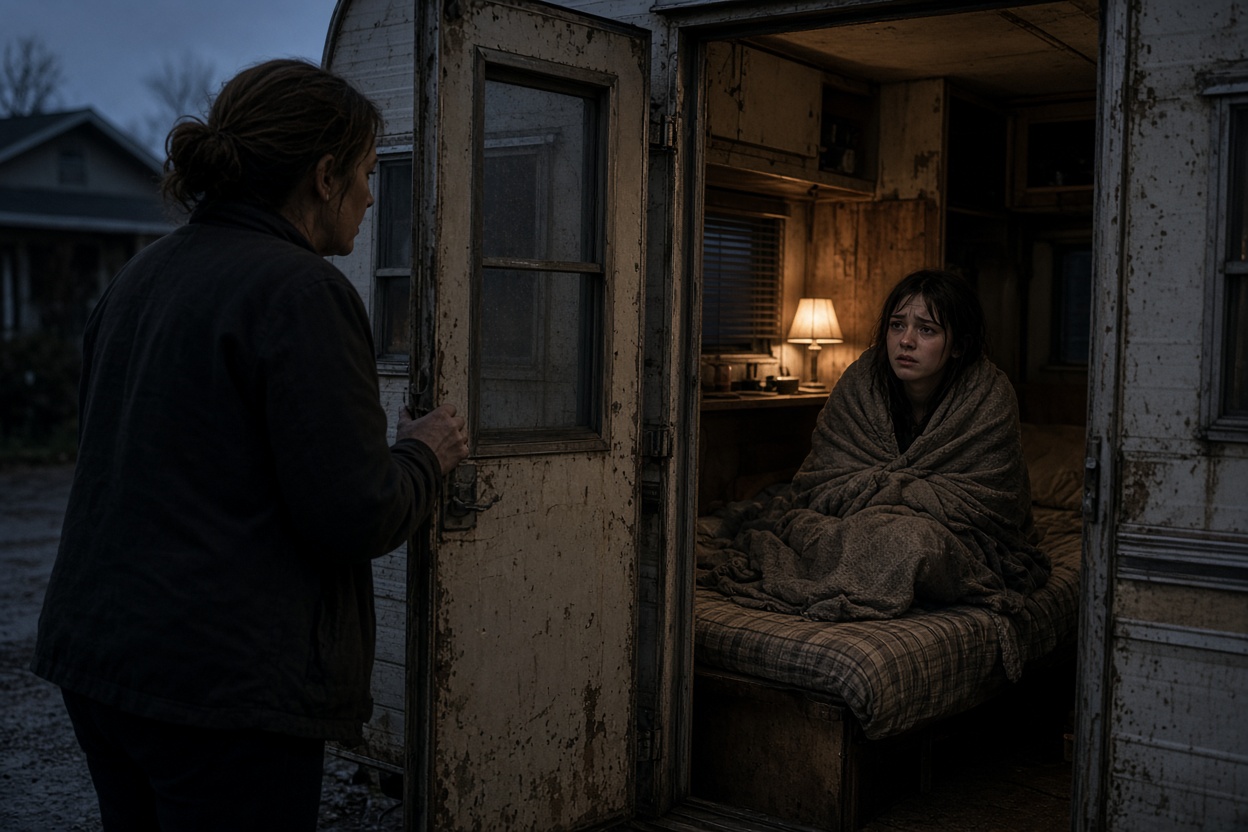
Once Kaylee had eaten something warm, I asked her to show me where she had hidden the recording device. She hesitated because she was afraid Tara might destroy it. I assured her that we would make copies before anyone could interfere. We returned to the camper together, leaving Melissa on the phone with me so there would be another person aware of what we were doing. Kaylee removed the loose panel behind the storage cabinet and reached into the narrow space. She pulled out a small recording device wrapped in a piece of cloth. It was scratched and dusty, but she said it still worked. She explained that she had charged it whenever she could and had saved the recordings on a memory card. She had labeled the files by date because she knew she might need to prove when each conversation occurred. I asked why she had chosen to record for thirty-one nights. She said that at first she only wanted proof that Tara and Rick were talking about sending her away. But as she heard more, she realized the recordings might be the only way to show what was happening. I felt ashamed that my daughter had been forced to become her own investigator. I should have been the person protecting her. Instead, she had spent more than a month hiding evidence in a camper while I drove across the country believing everything was fine. I took the device carefully and promised we would preserve every file. Then I asked Melissa to come over immediately. I wanted another trusted adult present before we listened to anything. [nextpage]
PART 3
Melissa arrived less than an hour later. She had been living nearby and had already suspected something was wrong because Kaylee had stopped answering her messages. Tara had told her that Kaylee was grounded and needed space, so Melissa had not pushed the issue. When she walked through the door and saw Kaylee wrapped in a blanket, her expression changed. She hugged her niece and began crying. Kaylee held on to her for several seconds before stepping back. Melissa looked at me and asked what had happened. I explained what I had found in the camper and what Kaylee had told me about the residential program. Melissa listened without interrupting. When I showed her the recording device, she asked whether the files had been backed up anywhere. Kaylee said the memory card contained the original recordings, but she had not been able to make copies. Melissa suggested that we use her laptop and create several copies before listening. She also recommended contacting my attorney immediately, especially because Tara had mentioned using the education trust. I agreed. We took the device into the study, connected it to the laptop, and carefully copied the files into separate folders. Melissa made one copy on an encrypted drive and another on a secure storage account. I kept the original memory card untouched. Kaylee watched every step, asking us not to delete or rename anything. She had organized the recordings by date, with short notes describing what she remembered hearing. Some files were only a few minutes long, while others lasted more than an hour. Melissa checked that the copies had transferred correctly before we began listening. I sat beside my daughter, feeling nervous about what we were about to hear. I already knew she had suffered, but hearing the voices of the people responsible might make everything painfully real.
The first recording we played was from a night near the beginning of the five-week period. Tara’s voice could be heard clearly. She was speaking to Rick about the forty dollars. Rick laughed and said that nobody would question the accusation because Kaylee was already considered difficult. Then he admitted that he had taken the money himself. He explained that he had needed cash for cigarettes and had taken it from a drawer when nobody was watching. Tara responded that it did not matter because blaming Kaylee had given them a reason to move her outside. I felt my hands tighten around the edge of the desk. The entire punishment had been built on a lie. Kaylee had been telling the truth from the beginning, and the people who accused her knew it. Melissa paused the recording and looked at me. Neither of us spoke for several seconds. Kaylee stared at the laptop screen, her eyes filling with tears. I reached for her hand and told her she had done nothing wrong. We continued listening. In another recording, Tara complained that Kaylee kept asking to call me. Rick suggested taking away any device she could use to contact me. Tara agreed and said that if Kaylee managed to reach me, she would explain that the girl was lying because she wanted attention. Rick laughed and said I would probably believe my wife anyway. The words were almost identical to what Kaylee had told me in the camper. I felt sick realizing how carefully they had planned to isolate her. Another recording captured Tara discussing the letters Kaylee had written. She said she had found one inside a school notebook and had destroyed it before it could be mailed. She also said she had told Kaylee that any further attempt to contact me would result in stricter punishment.
The recordings became more disturbing as we moved through the dates. Rick spoke about the camper as though it were a useful tool for controlling Kaylee. He complained that she was still asking for a heater and said the cold would make her stop arguing. Tara responded that she did not want Kaylee becoming comfortable outside because she might begin treating the arrangement like a normal bedroom. In another conversation, Tara said that the house was more peaceful without Kaylee walking around and asking questions. She mentioned that turning the girl’s bedroom into a home gym had made the space more useful. Rick joked that he was enjoying having the room available because he could store some of his equipment there. Melissa covered her mouth when she heard it. I looked at Kaylee, who was sitting perfectly still. She had heard those conversations alone, night after night, knowing that the people speaking were just a few feet away. I asked whether she wanted to stop. She shook her head and said she wanted us to hear everything. We continued. One recording captured Tara discussing the residential program with Rick. She said the monthly fee was nine thousand eight hundred dollars and that the facility would require a substantial initial payment. Rick asked whether the money could come from Kaylee’s education trust. Tara said she believed it could be arranged if the paperwork described the program as necessary for the girl’s well-being. Rick asked whether I would need to approve the withdrawal. Tara answered that she would handle me after Kaylee signed the admission documents. She said I was rarely home and would probably accept whatever explanation she gave him.
The next recording revealed that Tara planned to use Kaylee’s birthday gathering to pressure her into signing. Tara explained that relatives would be present, and Kaylee would feel embarrassed if she refused in front of everyone. Rick agreed, saying they should make the program sound like a gift and tell her that the family had arranged everything because they loved her. Tara said that once the papers were signed, they could begin accessing the trust funds. She also discussed how to respond if Kaylee became upset. She suggested telling relatives that the girl had behavioral problems and needed professional help. Rick said that people would believe adults rather than a teenager. I stopped the recording and looked at Melissa. We both understood that the birthday gathering was not simply a celebration. It was part of a plan to pressure Kaylee into signing documents that could place her in a facility and give Tara access to her education money. Kaylee whispered that she had heard them discussing it several nights earlier and had been terrified that I would arrive too late. She had not known whether she would be able to refuse the paperwork once everyone was watching. I told her that she would not be signing anything. Melissa reached across the desk and held her other hand. We made a written list of the recordings that seemed most important and noted their dates. We did not alter the originals or edit the audio. We wanted the evidence preserved exactly as Kaylee had recorded it. Melissa then called my attorney and explained that we needed urgent advice about protecting the trust and responding to possible financial abuse.
My attorney, Daniel Brooks, answered the call himself. He had helped me establish Kaylee’s education trust after her mother died, and he knew the account’s terms. I explained that Tara and Rick had discussed using the money for a residential program without my approval. Daniel asked me not to move any funds until he reviewed the trust documents. He said he would contact the financial institution, notify the trustee, and request additional restrictions against unauthorized withdrawals or changes. He also advised me to preserve the recordings and avoid confronting Tara about the specific contents until the evidence had been reviewed. I told him that Tara and Rick were still in the house and that a birthday gathering was underway. He recommended contacting the appropriate authorities because Kaylee was a minor and had described being confined in an unsafe environment. I agreed. Daniel asked whether Kaylee was currently safe. I told him she was with me and Melissa, inside the house. He said he would begin protecting the trust immediately and arrange a meeting the following morning. After the call, Melissa made another set of copies of the files and placed them in a sealed envelope. We wrote down the dates and the device details. I looked at Kaylee and asked whether she was ready to tell the truth in front of the relatives if necessary. She said she was frightened, but she did not want Tara and Rick to keep pretending nothing had happened. I told her she would not have to face them alone. Whatever happened next, I would stand beside her. [nextpage]
PART 4
The birthday gathering was supposed to begin at eight, but by then the atmosphere inside the house had changed completely. Tara had tried to restore the appearance of a normal celebration. She had placed a cake on the dining table, arranged balloons near the living room, and told the relatives that Kaylee was feeling tired after a difficult week. Rick had put music on again and was speaking loudly about football as though nothing unusual had happened. I watched them from the kitchen while Melissa stayed beside Kaylee. My daughter had changed into a clean sweater and jeans. Her hair was brushed, and the color had begun returning to her cheeks. But every time Tara walked past, Kaylee’s shoulders tightened. I wanted to send everyone home and deal with the matter privately, but Daniel advised me that the recordings should be handled carefully and that the authorities needed to be contacted. I had already called the local sheriff’s office and explained that my daughter had been kept in a freezing camper under circumstances that required immediate attention. A deputy was on the way. I also told the relatives that there was something important they needed to understand before anyone celebrated. Tara immediately objected, saying I was embarrassing Kaylee. I replied that the only person who should be embarrassed was the person responsible for what had happened. Rick stepped toward me and said I should stop making accusations. I told him to sit down. For once, he did not laugh. Melissa placed the laptop on the dining table and connected it to the television. She explained that the recordings were original files taken from a device Kaylee had hidden in the camper. Tara’s face changed when she saw the memory card beside the computer.
I began by explaining that I had driven from Atlanta expecting to surprise my daughter on her birthday. Instead, I had found her locked inside a camper with no working heater. I described the thin blankets, the outside latch, and the five weeks she had spent sleeping there. Some relatives looked toward Tara, expecting her to explain. She said Kaylee had been punished for stealing money and that the arrangement was temporary. I asked whether anyone had been told that the camper door could only be locked from outside. Nobody answered. I then asked whether anyone had been told that the heater had been unplugged. Tara said she had not realized it was that cold. Kaylee quietly corrected her, saying Tara had unplugged it herself. Tara told her to stop lying. I raised my hand and told her not to interrupt. Then I explained the missing phone, the intercepted letters, and the plan to send Kaylee to a residential program. I asked Tara whether she intended to use the education trust to pay the monthly fees. She said she had only been researching options. I told her we had recordings of conversations that suggested otherwise. Rick laughed nervously and said the recordings could be edited. Melissa responded that we had preserved the original files, created copies, and kept the dates exactly as Kaylee had recorded them. She explained that the device had not been altered and that the files were available for investigators to examine. Tara tried to take the laptop, but Melissa moved it away. I told Tara that nobody was going to touch the evidence.
We played the first recording. Rick’s voice filled the room as he admitted taking the forty dollars. He said nobody would question the punishment because Kaylee was already being described as difficult. Tara’s voice followed, agreeing that blaming Kaylee had given them an excuse to move her into the camper. The room became completely silent. One of my cousins slowly turned toward Rick and asked whether he had really stolen the money himself. Rick stood up and said the recording was being taken out of context. Melissa paused the audio and reminded everyone that the original file was preserved with its date and full length. I asked Rick to explain why he had admitted taking the money. He said he had been joking. I asked whether he had also been joking when he discussed keeping the heater unplugged. We played another recording. Tara’s voice could be heard saying that the cold made Kaylee easier to control and that she did not want the girl becoming comfortable in the camper. A woman near the doorway began crying. Another relative covered her mouth. Tara looked around the room and insisted that Kaylee had been difficult and disrespectful. She said she had been trying to maintain order in the household while I was away working. I told her that discipline did not involve deliberately exposing a child to freezing temperatures or preventing her from contacting her father. Tara replied that she was the only adult who had been present every day. I answered that being present did not give her permission to mistreat my daughter. Kaylee sat beside Melissa, holding her hand. She did not look away from Tara.
We played the recordings about the residential program next. The voices discussed the monthly cost, the education trust, and the birthday paperwork. When Tara’s voice said that Kaylee would feel too embarrassed to refuse in front of relatives, several people turned toward her in disbelief. Rick tried to interrupt again, claiming the audio had been edited to make them sound worse. Melissa opened the folder containing the original recordings and showed the file dates and lengths. She explained that the recordings had been copied without changing the original memory card. I told everyone that my attorney had already been contacted and that the trust was being protected against unauthorized withdrawals. Tara suddenly became angry. She said the trust was meant for Kaylee’s future and that she was only trying to make decisions that would help the girl. I asked how placing Kaylee in a program she did not need would help her future. Tara said she needed professional supervision. Kaylee finally spoke. She said she had never been given a chance to explain herself and that nobody had asked whether she wanted to attend the program. Tara told her she was being dramatic. I looked at my daughter and asked whether she wanted to say anything else. Kaylee said she wanted to go back to her own bedroom and never sleep in the camper again. Her voice was quiet, but everyone heard her. I told her that she would. Then I turned toward Tara and Rick and said they had no permission to remain in the house.
Tara tried to argue that she lived there and could not be ordered out by me in front of guests. I reminded her that the house was mine and that I had already contacted the authorities. Rick stepped forward and told me I would regret humiliating him. Melissa immediately moved between him and Kaylee. I told Rick to leave before the deputy arrived. He looked around the room, perhaps expecting someone to support him, but nobody did. Tara began crying and saying that I was destroying my marriage over a misunderstanding. I told her that the recordings were not a misunderstanding, the camper was not a misunderstanding, and the stolen money was not a misunderstanding. I asked her to collect only her personal belongings and leave the rest untouched. She refused at first, but when the doorbell rang, she stepped back. Two deputies entered and asked everyone to remain calm. I explained that my sixteen-year-old daughter had been sleeping in a camper with an outside latch and an unplugged heater for five weeks. I showed them the camper, the device, and the original files. One deputy asked Kaylee whether she felt safe speaking privately. She nodded, and the deputy arranged to interview her away from Tara and Rick. The other deputy began documenting the scene. [nextpage]
PART 5
The deputies treated the situation seriously from the moment they entered the backyard. One of them photographed the camper from several angles, including the outside latch that could be secured without someone inside being able to open it. Another photographed the disconnected heater and the electrical outlet. They also took pictures of the narrow mattress, the thin blankets, and the limited space where Kaylee had been sleeping. The deputy asked me how long I believed she had been kept there. I told him Kaylee had said five weeks, and I showed him the calendar notes she had made while recording the conversations. He asked whether she had been able to enter the house whenever she wanted. I explained that the door had been secured from outside and that Tara and Rick controlled when she could come inside. The deputy wrote everything down. Kaylee was interviewed privately in the living room while Melissa remained nearby but outside the immediate conversation. I could hear only occasional questions. When the interview ended, Kaylee came back looking exhausted but relieved. She told me the deputy had listened without interrupting and had asked her to explain the events in her own words. He had also asked about the threats, the missing phone, and the letters she believed Tara had destroyed. Kaylee said she felt strange telling a stranger everything, but she was glad someone had finally listened. I hugged her and told her she had done exactly what she needed to do. The deputies explained that the recordings would need to be preserved properly and that investigators would determine what further action was appropriate. They also advised me to keep Tara and Rick away from Kaylee while the matter was being reviewed.
Tara and Rick were not allowed to return to the camper or approach Kaylee during the investigation that evening. The deputies asked them to remain separate while they collected initial statements. Tara insisted that she had been acting as a parent and that the camper was simply a temporary punishment. When asked about the outside latch, she said it was there for security. The deputy asked why it could only be locked from outside. Tara did not provide a convincing explanation. When asked about the heater, she said Kaylee could have asked for more blankets. I watched the deputy write down her response. Rick claimed that he had not been serious when he admitted taking the forty dollars. The deputy asked whether he had actually taken it. Rick changed his answer and said he could not remember. The recordings were preserved, and the officers noted the device’s condition and location. Melissa gave them copies of the files while keeping the original memory card secure. They also received the dates and notes Kaylee had written. Before leaving, the deputies explained that the investigation would continue and that we should contact them immediately if Tara or Rick attempted to approach Kaylee. I thanked them and asked whether Kaylee could remain in the house safely. They said that immediate safety arrangements would be addressed through the appropriate process. After they left, I made sure every door was locked. I moved Kaylee’s belongings into the guest bedroom for the night and placed a chair near the door so she would feel secure. She asked whether Tara might come back. I told her that I would not let her face anyone alone.
The following morning, I met with Daniel Brooks, my attorney. Melissa came with me, and Kaylee stayed with a trusted family friend while we discussed the legal situation. Daniel had already contacted the institution holding the education trust. He explained that the trust documents included restrictions on how the money could be used and that Tara could not simply redirect it to a residential facility. He had requested that no withdrawals, transfers, or changes be processed without the required authorization and verification. He also recommended a formal review of anyone who had access to trust information. I asked whether Tara could have attempted to sign paperwork on Kaylee’s behalf. Daniel said he would investigate whether any applications had already been submitted and would notify the relevant institutions that the family was disputing any unauthorized placement or financial arrangement. We also discussed the recordings. Daniel advised that we should preserve the original files, maintain copies in secure locations, and avoid posting them publicly. He explained that the authorities would determine how the recordings could be used in the investigation. I told him I wanted to make sure Kaylee’s education money remained protected for college or another future opportunity she chose. He said that was the purpose of the trust and that he would take steps to defend it. He also recommended that I begin documenting every expense related to Kaylee’s immediate care and any costs caused by the situation. I agreed. For the first time since arriving in Amarillo, I felt that we were moving from shock toward a practical plan.
When I returned home, Kaylee was sitting at the kitchen table with Melissa. She had been given her phone back after the deputies finished documenting it, although several accounts needed to be secured. She was scrolling through old messages and trying to find the letters she had written to me. She said she had saved some drafts on an online account before Tara took the device. We checked together and found two unsent messages. One was written shortly after she had been moved into the camper. It said she was cold and did not understand why Tara hated her. The second was written several days later and simply asked me to come home. I read both messages and felt tears running down my face. I had been in other states, worrying about delivery schedules and fuel costs, while my daughter was begging me to return. I had no idea. Kaylee apologized for not finding another way to reach me. I told her she never needed to apologize for being unable to escape a situation controlled by adults. She had tried to contact me, and the people responsible had blocked her. I was the adult who needed to make sure she could reach me. I asked whether she wanted to speak with a counselor. She said she might, but she did not want to be sent away. I explained that counseling was different from the residential program Tara had threatened. It would be someone she could talk to while living safely at home. Kaylee thought about it and agreed to meet with a professional who worked with teenagers. I promised that she would be involved in every decision about her care.
That evening, I began the process of changing the household arrangements. Tara was no longer permitted to manage Kaylee’s schedule, phone, school communication, or personal belongings. I changed the passwords on the family accounts and contacted the school to explain that only I or another person I formally authorized could collect information about Kaylee. I also asked the school to notify me if anyone attempted to change her enrollment or request her records. Daniel helped prepare the necessary legal notices. Rick was told not to contact Kaylee or enter the property. I arranged for the locks to be changed again because Tara had keys, and I wanted to make certain that nobody could come inside without permission. Kaylee watched as the locksmith replaced the front and back door hardware. She said it felt strange to see so many changes happening because of her. I told her none of it was her fault. The changes were happening because adults had failed to protect her, and I was correcting that failure. Before bedtime, she asked whether she could sleep in her old bedroom once we cleaned it. I looked toward the hallway and promised that we would restore it. She said she missed the pale-yellow walls and the photographs of her mother beside the desk. I told her we would bring everything back, and this time nobody would take her space away. [nextpage]
PART 6
The weeks that followed were difficult, but they were also the first weeks in a long time when Kaylee could live without constantly watching for Tara’s reaction. Daniel filed the necessary paperwork to protect the education trust and began preparing for a protective order. The authorities continued reviewing the recordings and interviewing the people involved. Tara lost access to the home while the legal process moved forward, and Rick was formally instructed to stay away from Kaylee. I began divorce proceedings after realizing that the marriage could not continue under the circumstances. Tara sent several messages claiming that I had misunderstood her intentions and that she had only been trying to help Kaylee. I did not respond directly. Daniel advised me to keep all communication documented and to avoid emotional arguments that could complicate the legal process. The recordings remained preserved, and the deputies had copies of the original files. Kaylee attended her first counseling appointment with a professional who specialized in working with teenagers who had experienced family conflict and mistreatment. I drove her there and waited outside until she finished. When she came out, she said it had been difficult to talk about everything, but the counselor had listened and had not blamed her. I told her that was exactly how it should be. She did not need to convince someone that she deserved safety. She deserved it simply because she was a child. We agreed that she would continue attending sessions at a pace that felt comfortable. I also made sure she had a phone that Tara could not access and that she knew how to contact me at any time, no matter where I was.
The financial investigation revealed that Tara and Rick had discussed the education trust in more detail than I initially knew. They had looked into the residential program’s fees and had requested information about payment arrangements. The program had not received the trust money, but there had been conversations about how the funds might be accessed. Daniel obtained confirmation that no authorized withdrawal had taken place. He also arranged additional safeguards so that future requests would require verification from the proper trustee and would be reviewed independently. I was relieved that Kaylee’s three hundred and ten thousand dollars remained intact. That money represented the future her mother and I had wanted her to have. It was meant to help her attend college, pursue training, or choose another path without being burdened by unnecessary debt. It was never intended to pay for a facility selected by people who had mistreated her. When I explained the legal protections to Kaylee, she seemed relieved but also embarrassed. She said she felt guilty that so much trouble had happened because of her. I told her that the trouble had happened because Tara and Rick made choices that harmed her. Protecting her trust was my responsibility, not a burden she needed to carry. I also explained that she would have a voice in decisions about her future. When the time came to use the money, we would discuss it together and make sure it supported her goals. She smiled slightly and said she wanted to visit colleges someday. I told her we could start looking whenever she felt ready.
One of the hardest decisions I made was changing my trucking assignment. My previous route paid more, but it required long trips across several states and kept me away from home for days at a time. I had chosen it because the extra income helped us cover expenses and build savings. After everything that had happened, I realized that the money meant very little if I was never present when my daughter needed me. I spoke with my dispatcher and requested a lower-paying local route that would allow me to return home every evening. The change meant giving up some bonuses and adjusting our budget, but I decided it was worth it. My supervisor asked whether I was sure because the long-distance routes were more profitable. I told him I was sure. I had spent years measuring my success by the number of miles I drove and the money I brought home. Now I needed to measure it differently. When I told Kaylee about the change, she looked surprised. She asked whether I was giving up too much for her. I explained that I was not giving up my life; I was changing how I lived it. I wanted to be home for dinner, school events, appointments, and ordinary evenings when she might simply want to talk. She said she did not want me to lose money because of what had happened. I told her that no paycheck could replace the time we had lost. We would manage with less, and we would manage together.
Restoring Kaylee’s bedroom became our first project. When I opened the door, I found the room almost unrecognizable. The treadmill stood where her bed had been, a weight bench occupied the corner, and several storage boxes were stacked along the wall. Tara had removed the pale-yellow curtains and replaced them with plain blinds. Kaylee stood in the doorway for a long time without speaking. I asked whether she wanted to help me clear everything out or whether she preferred to let Melissa and me handle it. She said she wanted to be involved. We moved the equipment into the garage and carefully packed the items that belonged to Tara. I did not want Kaylee to feel that she had to erase every memory of what happened, but I wanted her bedroom to feel like hers again. We washed the walls, replaced the damaged curtains, and bought a new bed and desk. Kaylee chose a soft yellow comforter and a small bookshelf. We found the old photographs of her mother in a storage box and placed them beside the desk. She wanted one picture from when she was a baby and another from a family trip near the ocean. I helped her hang them at eye level. When the room was finished, she sat on the bed and looked around. She said it felt familiar again. I told her it had always been her room, regardless of what Tara had done with it. She touched the wall and smiled. It was a small moment, but it felt like an important beginning.
As the legal proceedings continued, I learned that rebuilding trust would take longer than changing locks or restoring a bedroom. Kaylee sometimes woke during the night after dreaming she was back in the camper. She became anxious whenever someone knocked unexpectedly. She also struggled when adults raised their voices, even if the conversation had nothing to do with her. Her counselor helped her understand that those reactions were understandable after what she had experienced. I learned to listen without trying to solve every feeling immediately. Sometimes she needed reassurance. Other times she simply wanted me to sit beside her while she talked. I also had to confront my own guilt. I kept thinking about every phone call I had made when Tara told me Kaylee was busy or grounded. I wondered why I had not recognized the warning signs. Melissa reminded me that Tara had deliberately hidden what was happening and controlled Kaylee’s ability to communicate. I could not change the past, but I could make different choices now. I began calling Kaylee during my work breaks, not to check on her like a supervisor, but to ask how her day was going. I attended school meetings and learned the names of her teachers. We started having dinner together most evenings. Sometimes we talked about serious things, and sometimes we argued about music or what movie to watch. Those ordinary conversations mattered more than I had expected. They reminded both of us that life could become normal again. [nextpage]
PART 7
By the time Kaylee’s seventeenth birthday arrived, the house felt different in ways that had nothing to do with furniture or decorations. The locks were secure, the legal proceedings were moving forward, and Tara no longer had access to our home or Kaylee’s personal life. Rick had been kept away from her, and the authorities continued handling the evidence from the recordings. The education trust remained protected, and Daniel kept me informed about every development. I had settled into my new trucking route, which paid less but allowed me to return home every evening. At first, I worried about the reduced income, but we adjusted our spending and found that we could live comfortably without the extra money. More importantly, I was present. I could take Kaylee to school when she needed a ride, attend her appointments, and be home when she walked through the door. On her seventeenth birthday, Melissa helped decorate the living room. We invited a few relatives and some of Kaylee’s friends. There was no pressure to make the celebration look perfect. We ordered food, put music on, and placed a simple cake on the table. Kaylee wore a dress she had chosen herself and spent most of the evening laughing with her friends. Every so often, I caught myself watching her from across the room. I was not checking whether she looked frightened or uncomfortable. I was simply happy to see her enjoying herself. The girl who had once sat shivering beneath thin blankets in a locked camper was now surrounded by people who cared about her. That did not erase what had happened, but it showed us how much could change when she was finally safe.
After the guests had eaten, Kaylee asked me to come upstairs. She wanted to show me something she had bought with money she had saved from small jobs and birthday gifts. On her bedside table sat a little lamp with a pale shade and a simple wooden base. It was not expensive or particularly unusual, but she had chosen it carefully. She said she wanted something that reminded her of the nights in the camper when she had been afraid and believed nobody would ever find out what was happening. She explained that she used to imagine a light coming through the door, someone opening it, and someone finally listening to her. The lamp represented that moment when I had arrived and found her. I sat on the edge of the bed and looked at it. She said she knew the recording device had helped prove the truth, but she wished she had never needed to hide it in the first place. I told her she should never have been put in that position. She had been forced to gather evidence because the adults around her had refused to believe her. I wished I could take those five weeks away from her, but I knew I could not. I could only make sure that the rest of her life was not defined by them. She asked whether I was angry that she had recorded Tara and Rick. I told her I was grateful she had found a way to protect herself, and I was sorry she had felt she had no other choice. Then I asked whether she wanted the lamp turned on. She smiled and switched it on. A soft light filled the corner of the room, illuminating the photographs of her mother beside the desk. Kaylee leaned against my shoulder, and for a few minutes neither of us said anything.
Later that evening, Melissa joined us in the kitchen. We talked about how different the house felt compared with the night I had arrived from Atlanta. Melissa reminded me that I had been carrying a birthday cake when I first noticed the camper. I remembered setting it on the porch and walking toward the backyard without knowing what I would find. I thought about how easily I could have gone straight inside, greeted Tara, and waited for Kaylee to come downstairs. If I had done that, I might never have discovered where she was sleeping. I might have believed the same explanations Tara had given me for months. The thought frightened me. I had been working hard because I believed providing financially was the most important way to care for my daughter. I had sent money home, paid bills, and trusted the person who was supposed to help raise her. But I had not been present enough to notice that something was terribly wrong. Melissa told me I could not spend the rest of my life punishing myself for what Tara had deliberately hidden. I knew she was right, but guilt does not disappear simply because someone tells you to let it go. I promised myself that I would remember the lesson without allowing it to destroy the years ahead. I would ask questions, listen carefully, and never assume that a child is fine simply because an adult says so. Kaylee deserved to know that she could tell me anything, even if the truth was uncomfortable. She deserved a home where she did not have to hide a recording device to be believed.
As the birthday gathering came to an end, Kaylee helped clear the table. Her friends hugged her goodbye, and Melissa collected the remaining food containers. I walked outside for a moment and looked toward the backyard. The camper was still there, but it was no longer a place where my daughter slept. We had removed the mattress and blankets, and I planned to sell it once the investigation no longer required it. I stood beside it and remembered the night I had opened the door. I could still see Kaylee’s pale face, her trembling hands, and the fear in her eyes. I remembered how she had grabbed my sleeve and begged me to listen before confronting anyone. She had been terrified, but she had also been determined to make sure the truth survived. That courage had helped protect her. I went back inside and found her sitting on the sofa with her new lamp’s box beside her. She looked up and thanked me for coming home. I told her I would always come home when she needed me. She said she knew I had to work, but she liked knowing I would be there in the evening. I told her that I was learning to make my work fit around our lives instead of making our lives fit around my work. She smiled and said that sounded fair. We sat together until the house was quiet. I did not need to make a speech or promise that nothing bad would ever happen again. I only needed to keep showing up, keep listening, and make sure she never felt alone when she needed help.
Before going to bed, I stood in the doorway of Kaylee’s restored bedroom. Her pale-yellow walls looked warm beneath the bedside lamp. Her mother’s photographs were arranged beside her desk, her books were back on the shelves, and the new curtains moved gently in the evening breeze. Kaylee was already under the covers, reading a book she had chosen from the library. I told her goodnight, and she asked whether I would be home for breakfast. I said I would. She smiled, turned another page, and settled into her pillow. I closed the door most of the way, leaving it slightly open because she liked knowing I was nearby. Then I walked downstairs and looked at the family photograph on the mantel. Kaylee’s mother had died when our daughter was younger, and I had spent years trying to make sure she never felt that loss too deeply. I now understood that love was not only about keeping a roof over a child’s head or saving money for a future. It was also about noticing when something was wrong, listening when a child was frightened, and being willing to change your life when they needed you. I had driven nineteen hours from Atlanta thinking I was bringing my daughter a birthday surprise. Instead, I discovered how badly she needed me to come home. The camper, the locked door, the unplugged heater, and the hidden recordings would always be part of our history, but they would not decide our future. Kaylee had her bedroom back, her education trust was protected, and she had people around her who believed her. I had learned that earning money and providing financially could never replace being present when my daughter needed me most. Being a good father meant showing up, listening, and making sure she never had to fight alone to be believed or protected. [nextpage]
