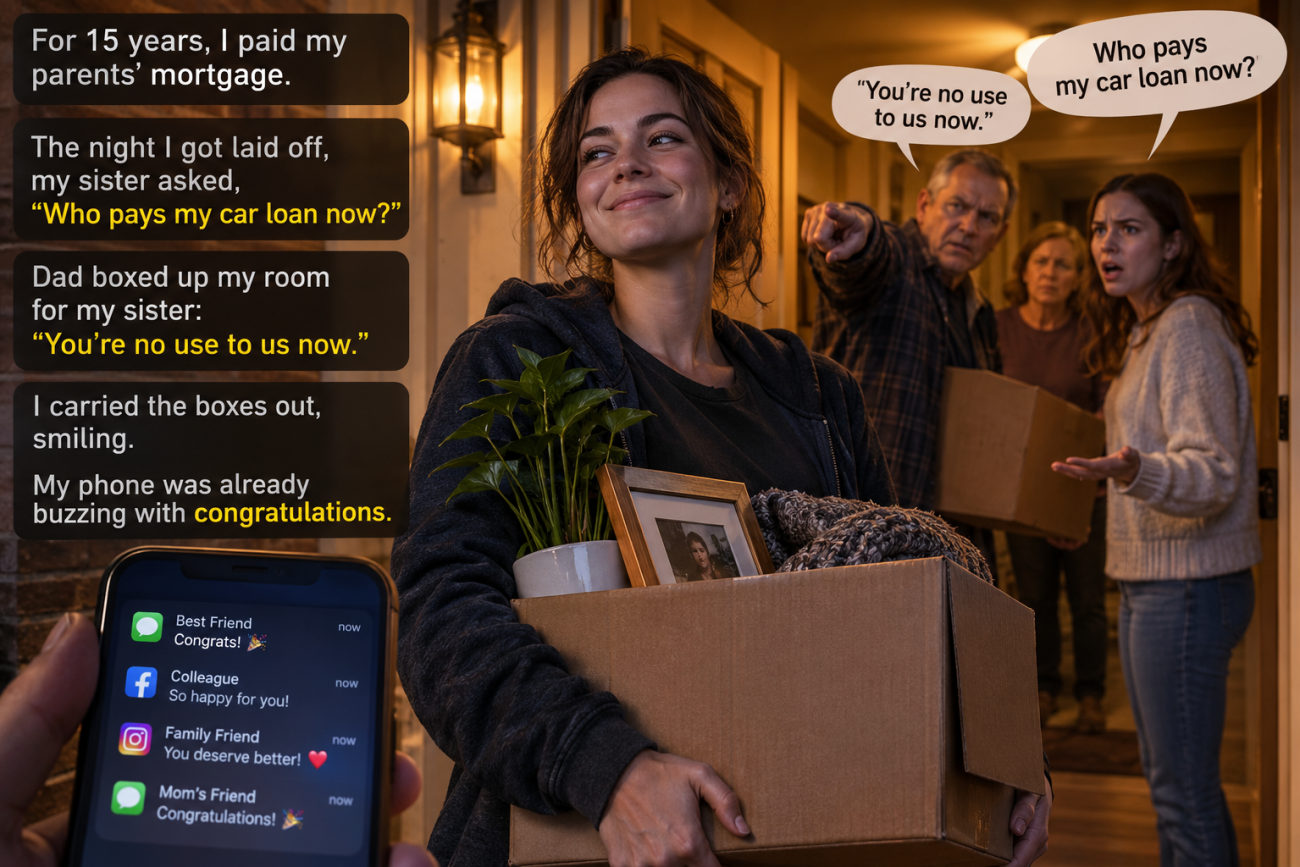
I sat in my car in the driveway for several minutes after loading the final boxes. Through the window, I could see Dad carrying another carton downstairs. He placed it near the others, returned inside, and continued working without looking toward me. I watched him for a moment, wondering whether he remembered the years when I had helped him believe the house would never be lost. When his factory closed fifteen years earlier, he had sat at the kitchen table with a mortgage letter in his hands, terrified that everything he had worked for was disappearing. I had been seventeen then, still attending Hilliard Davidson High School, and I had offered him my entire monthly paycheck from Kroger. I remembered the tears in his eyes when he accepted the money. “If you weren’t helping, sweetheart, we’d lose everything,” he had told me. Back then, those words had meant something. I believed I was saving my family. I never imagined that one day he would look at me and say I was no longer useful.
My phone vibrated again. It was Aunt Joanne. Her message read, “Claire, your dad always made it sound like you helped out with a few bills. I saw the total in that notebook. Was that really more than $215,000?” I stared at the screen. Joanne had apparently discovered the green accounting notebook I had kept for fifteen years. Every payment, every additional contribution, and every emergency expense had been recorded carefully. I answered with one word: “Yes.” Three minutes later, another message arrived. She explained that she had confronted Dad in front of Elaine and Ryan. When she questioned him about the amount, he became furious and ordered her to leave his house. Joanne attached a photograph of herself sitting in her car, with my parents’ illuminated windows visible in the background. She had left without her coat. I knew how unusual that was. In thirty-two years, I had rarely seen anyone walk away from Dad before he finished speaking.
I placed the phone on the passenger seat and started the engine. I didn’t know where I would sleep that night, but I knew I couldn’t return to the house. My former supervisor, Margaret Caldwell, had once told me that I could call her if I ever needed help. She had retired from the bank the previous spring and lived in a narrow brick duplex in Grandview Heights. I drove there, carrying my belongings in the back of my car. Margaret opened the door wearing reading glasses, faded jeans, and an oversized Ohio State sweatshirt. She looked at my face, then at the boxes, and immediately understood that something serious had happened. “Have you eaten?” she asked. I almost laughed. “Birthday cake was technically available.” She gave me a disappointed look. “That wasn’t my question.” I admitted that I had eaten a couple of eggs earlier. She stepped aside and invited me in.
Her spare room contained a small futon, a dresser, and a window overlooking the neighboring garage. It wasn’t much, but it was the first place that day where I didn’t feel unwanted. Margaret prepared tea while my phone continued vibrating against the kitchen table. Messages arrived from relatives, acquaintances, and people who had somehow heard about the situation. Some expressed sympathy.
Others asked whether the rumors about the money were true. I didn’t answer most of them. Margaret noticed my shaking hands and gently asked whether I wanted to talk. I told her I wasn’t ready. She nodded and said we didn’t have to discuss anything until I felt comfortable. That simple response nearly made me cry. For years, I had been surrounded by people who expected me to solve their problems. Margaret was the first person that evening who asked what I needed.
