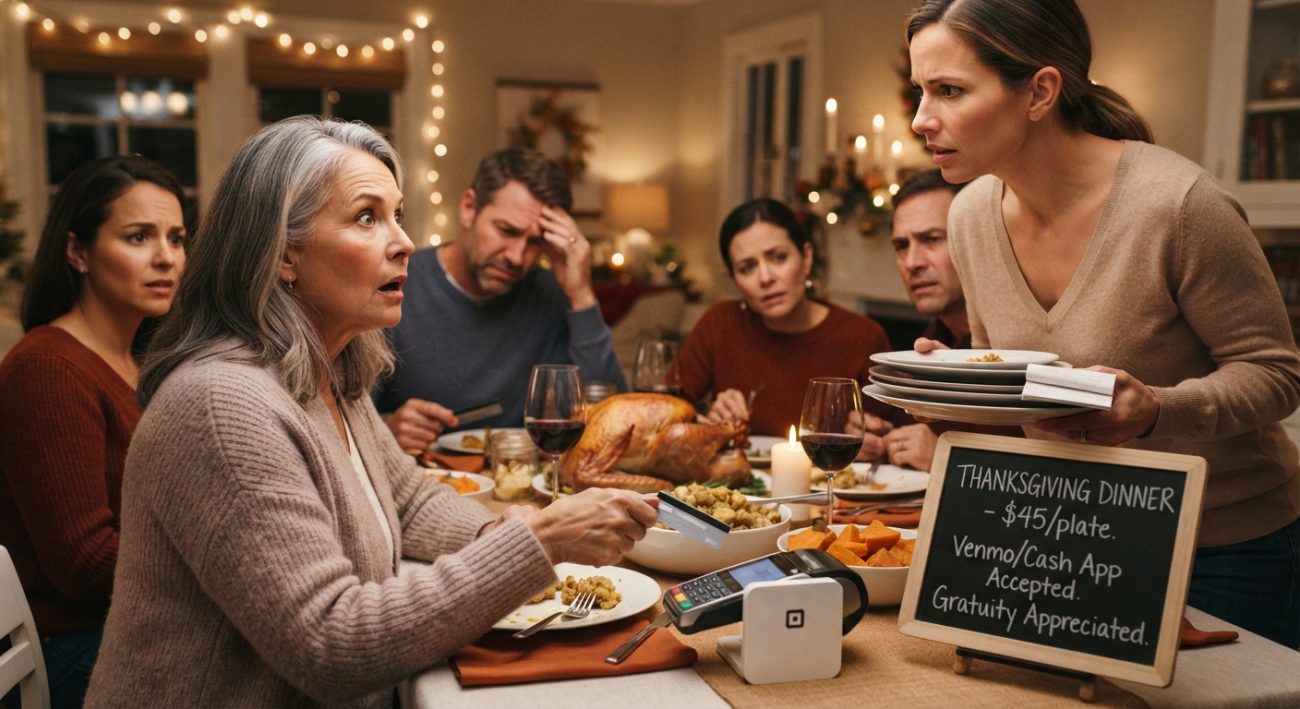
The rest of Thanksgiving dinner passed in a way that felt almost unreal. Everyone continued talking, but I found myself listening from a distance, as though I were sitting at another table entirely. Ron made a joke about the turkey being especially good, and Debbie complimented Brittany on how beautifully she had arranged the dining room. Brittany smiled and accepted the praise. Nobody mentioned the card again. Nobody asked whether I was comfortable paying forty-five dollars after bringing so much food myself. I looked at Kyle several times, hoping he might find a moment to speak privately or at least acknowledge that the situation was uncomfortable. But he remained silent. He ate his dinner, answered questions when someone addressed him, and acted as though nothing unusual had happened. That silence hurt more than Brittany’s demand. I wasn’t expecting him to argue with his wife in front of everyone, but I had hoped he would recognize how unfair the situation was. I had been his mother long before Brittany entered his life. I had spent years preparing meals, supporting him, and helping him whenever he needed something. Yet that afternoon, I felt like an unwanted guest who had been allowed to sit at the table only after agreeing to pay. I finished my food slowly, complimented the grandchildren on their drawings, and helped carry a few dishes into the kitchen. I didn’t want to leave abruptly and make the children wonder why Grandma was upset. I smiled when they asked whether I would come again for Christmas. I told them I would see them soon, even though I had no idea what that would look like.
When everyone began settling into the living room, I took out my purse and counted forty-five dollars. I placed the cash on the counter beside Brittany’s little stack of notes. She noticed and thanked me without looking particularly surprised. I asked whether she could give me a receipt. For the first time that afternoon, she looked directly at me. Her expression suggested that the request was unnecessary, perhaps even a little amusing. But I repeated it politely. I wanted a receipt for the payment, just as I would have expected one from any business. Brittany said she could write one if I really wanted it. I told her that would be fine. She took a small piece of paper, wrote the amount, and handed it to me. I folded it carefully and put it into my purse. I didn’t explain why I wanted it. I didn’t tell her what I was thinking or ask why Ron and Debbie had been exempt from the same charge. I simply thanked her and began gathering my belongings. Kyle finally approached me near the doorway. He asked whether I was leaving already, and I told him I was tired and needed to get home. He nodded, then stepped aside to let me pass. I hugged my grandchildren goodbye and promised to call them later. As I walked to my car, I felt a sadness I couldn’t quite describe. It wasn’t the forty-five dollars. I could afford that amount. It was the realization that something I had considered an act of love had apparently become an obligation that others felt entitled to measure and charge me for.
The drive home was quiet. I kept both hands on the steering wheel and watched the familiar streets pass by. I thought about the years I had spent making Thanksgiving special for Kyle. I remembered the tiny kitchen where I had prepared meals when he was young, the school lunches I packed, and the evenings when he came home hungry after sports practice. I had never kept a record of those things or expected him to repay me. They were simply part of being his mother. But as I drove, another memory came back to me. For the past five years, I had been paying the family phone bill. It had started innocently enough. Kyle had called me one month and explained that he was dealing with several unexpected expenses. He asked whether I could help cover the phone bill temporarily. I agreed because I had the money and didn’t want him worrying. Later, he mentioned that adding Brittany’s line would make the plan cheaper overall. Then Ron and Debbie were added because they wanted to reduce their monthly costs. Before long, the account included several adults, and I was paying the entire amount. At the time, I didn’t complain. I thought I was helping my son and making things easier for everyone. I also carried Kyle’s truck insurance, which he had asked me to cover during a difficult financial period. He had promised to take over the payments when things improved, but somehow the arrangement continued. I realized that I had never sat down and calculated exactly how much those expenses were costing me each month.
When I arrived home, I placed my purse on the kitchen counter and took out the small receipt Brittany had given me. I looked at the handwritten forty-five dollars and felt an unexpected sense of clarity. If everybody was now responsible for paying their fair share, then perhaps it was time to examine what fair share really meant. I went to the drawer where I kept household paperwork and began searching for the phone bills. I found several statements from the past year, followed by older documents that I had saved for tax and account purposes. The numbers were there in black and white. The phone bill had been averaging around two hundred dollars a month, sometimes a little more depending on usage and fees. The truck insurance added another amount. Together, the expenses I had been covering came to approximately three hundred and ten dollars every month. I sat down and used a calculator. Three hundred and ten dollars multiplied by twelve months was three thousand seven hundred and twenty dollars a year. Over five years, the total was more than eighteen thousand dollars. I checked the calculations again because I couldn’t believe how much the arrangement had cost me. I had never demanded payment or sent anyone an invoice. I had simply continued paying because I believed I was helping family. But now I was being charged forty-five dollars for a Thanksgiving meal, while I had quietly paid thousands of dollars toward the expenses of people who hadn’t even been asked to contribute a dish. I put the calculator down and stared at the bills. For the first time, I wondered whether anyone had ever appreciated what I was doing.
