PART 2
The next incident happened in July, and it bothered Frank more than anything Denise had taken from the garage. One afternoon, I went outside to water my tomato plants, turned on the faucet, and discovered that almost no water was coming through the hose. I checked the connection and followed the pipe with my eyes. A bright blue hose had been attached to our outdoor faucet. It ran along the side of our house, crossed our lawn, continued across Denise’s grass, slipped beneath her fence, and ended inside her swimming pool. I could hear water flowing into it. Denise was using our water to fill her pool. When I told Frank, he jumped out of his chair so quickly that I worried about his knee. “She’s filling her pool with our water?” he asked. I tried to make the situation sound smaller than it was. Perhaps she was only topping it off, I suggested. Frank reminded me that we paid the water bill. He was already heading toward the back door, ready to confront her, but I told him I would handle it. I walked outside, turned off the faucet, disconnected the blue hose, and carefully coiled it up on Denise’s side of the property line. I even made sure it was neatly arranged so she would not trip over it. That was what I considered handling the situation. I never spoke to her. The following morning, the hose was gone, and Denise never mentioned it.
In August, she crossed another line. My mother’s roses grew beneath the front windows of our house. They were pink climbing roses that I had planted in 1991, the summer my mother died. I had taken cuttings from her garden, rooted them in old coffee cans on the windowsill, and eventually planted them outside. Frank built the trellis for me, and every year I cared for those roses as though they were part of my family. One afternoon, while folding towels in the living room, I looked through the window and saw Denise standing in my flower bed with a pair of kitchen shears. She was cutting the roses. I rushed outside with a bath towel still hanging over my arm. I intended to tell her to put the shears down and get out of my garden. But before I could finish saying her name, she smiled and asked whether I knew what variety they were. She wanted to take a few samples so she could plant the same flowers at her house. Somehow, I began explaining which colors were available, how climbing roses needed a trellis, and why they preferred morning sunlight. She thanked me and walked away carrying three flowers that had belonged to my mother’s garden. I returned inside and finished folding the towels. I folded each one twice, trying to understand why I had once again allowed someone to take something important to me without saying what I really thought.
The problem with our garbage cans began in September. Frank and I usually produced only one or two bags of household trash each week, so our two large cans were rarely full before Wednesday’s collection. Then, suddenly, they began filling up on Mondays and Tuesdays. I found large black contractor bags inside them, bags I knew did not belong to us. At first, I blamed the wind or neighborhood children. Frank looked at me over his glasses when I suggested that explanation, but he did not argue. Eventually, I caught Denise carrying two enormous bags down her driveway. She walked straight toward our cans, placed one bag inside, and was lifting the second when I reached her. “Denise,” I said, “please use your own trash cans.” She looked at me as if I had asked her to do something unreasonable. She explained that her cans were always full while ours were practically empty. She asked how much trash two retired people could possibly produce and why I was being difficult. I suggested she contact the city and request another container. She rolled her eyes and dropped the second bag into my can. “Pfft. And pay extra for one? No, thanks.” Then she accused me of being stingy. She said she had only put a couple of bags in my garbage cans and walked away.
I stood beside the mailbox holding a seed catalog, an electric bill, and a birthday card from my sister. The word stingy kept repeating in my mind. I had spent most of my life helping people. I was the woman who brought casseroles when someone was sick, who kept extra birthday cards in a drawer, and who offered winter clothes to neighbors who needed them. I had even given Ellen my good coat one year when her furnace broke and she had to wait weeks for a replacement part. Yet Denise had managed to make me feel guilty for asking her not to fill my garbage cans. She continued doing it. I caught her twice more in October and several times in November. Sometimes she waved at me afterward, and I waved back. I kept expecting her to remember our conversation and stop. I did not want to repeat myself because I thought a polite request should be enough. Frank finally confronted me about it one evening when he saw me carrying a kitchen garbage bag out the back door. I explained that the front cans were full again, so I was using the smaller container near the garden. He put down his crossword pencil and asked whether I was seriously carrying our trash around the house because I did not want to speak to Denise. I said it was easier than having another argument. He reminded me of something my mother used to tell me: “Don’t make a fuss, Ruthie. Don’t make a scene. Don’t make the neighbors talk.” Frank said my mother had meant well, but she had been gone thirty-three years, and I was still obeying that old advice even when it made my own life harder. I told him I would handle it. He quietly replied that this was exactly what worried him.
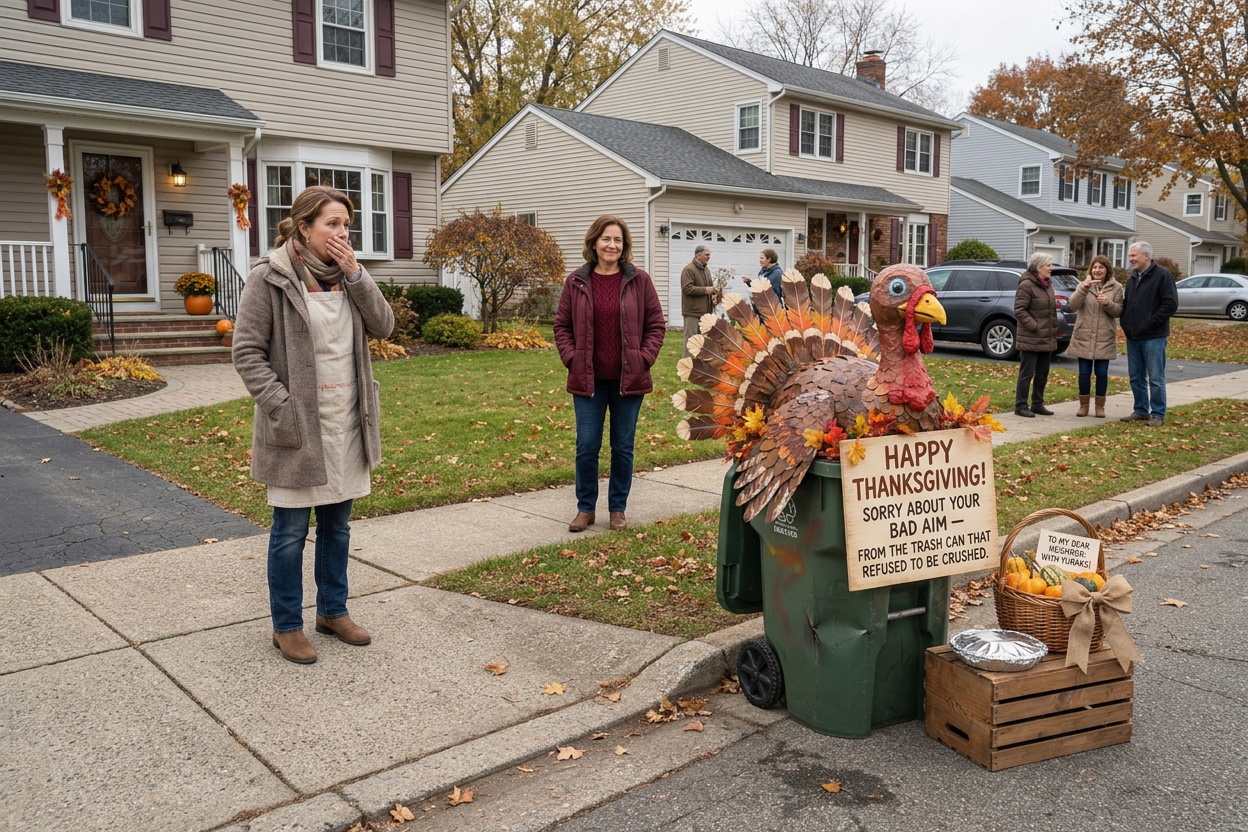
By Thanksgiving morning, I had become so accustomed to avoiding conflict that I was willing to carry garbage through the backyard rather than ask my neighbor to respect a simple boundary. Then I found the melted can. Frank came outside after I called him, wearing his brown sweater and slippers. He examined the damage without speaking. The side of the container was still warm, and the ashes inside were not completely cold. He told me that if the can had been beside the garage, the fire might have spread to the house. He fetched the garden hose and sprayed the ashes until the steam disappeared. We waited until the container was cool enough to move. I asked Frank whether he wanted to come with me to Denise’s house. He offered, but I insisted on going alone. I thought I could finally tell her what she had done and ask her to replace the can. I tipped it almost sideways and dragged it up her front walk, struggling with the melted wheel. From inside her house, I could hear a football game, laughter, and people talking over one another. Denise had a house full of Thanksgiving guests. When she opened the door, she was holding a glass of wine and wearing a dish towel over her shoulder. I stood there with the ruined container leaning against my hip, ready to have the conversation I should have had months earlier.
