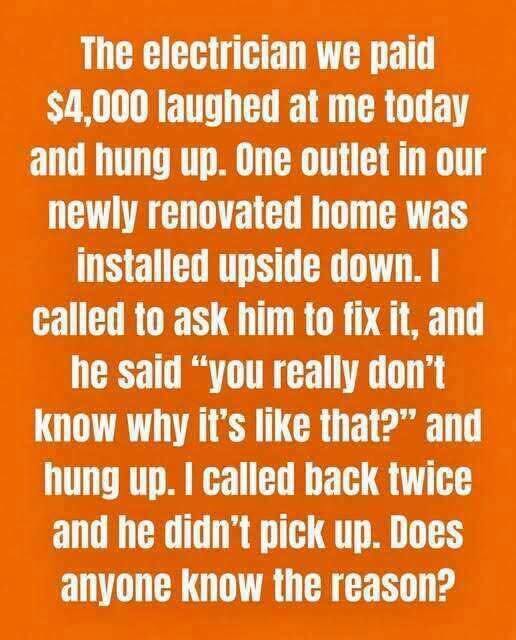
Have you ever walked into a room, looked at a wall outlet, and noticed that one of them appears to be installed upside down? Most people are accustomed to seeing electrical outlets with the two narrow vertical openings positioned above the round grounding hole. However, in some homes, offices, and commercial buildings, you may discover an outlet where the grounding opening faces upward instead. At first glance, this unusual arrangement might make you think that an electrician made a mistake during installation. After all, if every other outlet in the room follows the same direction, why would someone deliberately turn one around? Surprisingly, there are several practical explanations for this arrangement, and some electricians intentionally install receptacles this way. It can be connected to safety preferences, special electrical circuits, switched outlets, or simply the installer’s personal preference. Understanding these possibilities helps explain why something that looks like an installation mistake may actually have a purpose.
One of the most interesting explanations involves the way electrical outlets are used in older homes. Many houses built decades ago were designed differently from modern properties. Today, homeowners commonly expect bedrooms, living rooms, kitchens, and other spaces to have permanent ceiling lights controlled by wall switches. However, older houses did not always include ceiling fixtures in every room. Instead, homeowners often depended on table lamps and floor lamps to illuminate their living spaces. This created a practical problem because someone entering a dark room had to walk toward a lamp before being able to turn on the light. To make everyday life more convenient, electricians developed arrangements in which a wall switch controlled an electrical receptacle. By plugging a lamp into that outlet, residents could operate the lamp from the doorway without touching the lamp itself. This simple arrangement became especially useful in bedrooms and living rooms where ceiling lighting was unavailable.
Another interesting feature of these installations is that some electrical receptacles are divided into two independently controlled sections. These are commonly known as split receptacles or split-wired receptacles. A standard duplex outlet has two places where electrical devices can be plugged in, and in certain installations, an electrician can configure the upper and lower portions to operate differently. For example, one half can receive electricity through a wall switch, while the other half remains continuously powered. This allows homeowners to control a lamp without interrupting the electricity supplied to other equipment. Imagine a living room where a floor lamp is connected to the switched half while a phone charger, digital clock, or another small device uses the continuously powered half. When someone turns off the wall switch before going to bed, the lamp switches off, but the other connected device can continue receiving electricity. This arrangement provides flexibility without requiring additional wall switches or separate outlets.
Some electricians use the upside-down orientation as a visual identification method. When most outlets in a room are installed with their grounding openings facing downward, a receptacle facing the opposite direction immediately attracts attention. This difference can remind homeowners, maintenance workers, or future electricians that the outlet may have a special function. For example, an upside-down receptacle might be associated with a switched circuit, a dedicated electrical supply, or another installation arrangement that differs from the surrounding outlets. However, it is important to understand that this practice is not universal. There is no guarantee that an upside-down outlet is controlled by a wall switch, and an ordinary-looking outlet might also contain a switched connection. Different electricians use different identification methods, including labels, colors, circuit diagrams, and installation conventions. Therefore, the orientation should be treated as a possible clue rather than proof of how the outlet operates.
The next time you notice an electrical outlet with its grounding hole facing upward, remember that its unusual appearance does not automatically mean something is wrong. It might have been installed intentionally to identify a switched receptacle, accommodate a particular electrical arrangement, or follow the electrician’s preferred installation method. In older homes, it could even reflect the original lighting design of the property. What makes this detail interesting is that a small difference in appearance can reveal something about how a home was designed and how people used electricity in the past. Nevertheless, homeowners should never assume that an outlet is safe simply because it looks properly installed. Correct wiring, grounding, secure connections, and suitable circuit protection are much more important than physical orientation. If you are curious about an unusual outlet, a qualified electrician can determine its actual purpose. Sometimes, the smallest details in a house have the most interesting explanations.
