Part 3 — The Test Results
The appointment took place on Thursday morning. Brad drove us to the clinic, but he barely spoke during the journey. He kept both hands on the steering wheel and watched the road as though it required every bit of concentration he had. I wanted to fill the silence with reassurance, but I knew that empty promises would not help. At the reception desk, he gave his name and date of birth without difficulty. Then, when the receptionist asked him to confirm his address, he hesitated. He looked at me. I supplied the house number, and he nodded as though I had reminded him of something he had nearly forgotten. The receptionist smiled politely and directed us to the waiting area. Brad sat with his knees apart, hands clasped, staring at a television mounted in the corner. I took his hand. He squeezed it once, then released it. I wondered whether he was embarrassed to need my help or simply afraid of what the doctor might say. Perhaps it was both.
The neurologist, Dr. Patel, was a calm woman with silver-framed glasses and a habit of listening without interrupting. She asked Brad about his symptoms, when they had started, and whether they had become more frequent. She asked about his sleep, his diet, his medication, his alcohol use, and his family history. Brad answered most questions himself, although he struggled to remember the exact month when the first incident occurred. I filled in a few details from my notebook. Dr. Patel asked permission to look at it, then read through the dates and descriptions. She did not appear alarmed, but she took the notes seriously. She explained that memory problems could have many causes, including sleep disorders, depression, medication effects, vitamin deficiencies, thyroid problems, and neurological conditions. She said that no diagnosis should be made from a few forgotten names or missed appointments. More testing was needed. I felt a little relief, though I knew that uncertainty was not the same as good news.
Brad completed several assessments. The doctor asked him to remember a short list of words, draw a clock, follow instructions, and repeat a sequence of numbers. At first, he handled the tasks easily. Then he became frustrated when he couldn’t recall all the words. He tried to joke that the test was unfair because nobody remembered lists without writing them down. Dr. Patel smiled but did not let him avoid the exercise. I watched his expression change as he struggled. The man who had once remembered every detail of our wedding reception could not retrieve a handful of ordinary words after a short delay. He looked toward me, and I saw shame in his eyes. I wanted to tell him that a test could not measure everything he was. It could not measure his kindness, his humour, the years he had worked to support our family, or the way he still reached for my hand when he thought I was asleep. But I remained quiet until the assessment was over.
Afterward, Dr. Patel explained that the results suggested some difficulty with short-term memory and certain thinking skills, but they were not enough to establish a cause. She ordered blood tests, a brain scan, and further cognitive assessment. She also recommended that Brad review his medication with his regular doctor and make sure he was sleeping properly. She explained that some causes of memory problems were treatable, while others required longer-term management. She avoided making promises. I appreciated that. We needed honesty more than comfort. Brad asked directly whether he might have dementia. Dr. Patel said it was one possibility among several, but it would be irresponsible to assume that before the investigations were complete. She encouraged him to continue working if he felt safe and capable, while making sensible arrangements to reduce the pressure he was under. On the drive home, neither of us spoke for several minutes. Then Brad said, “I hate that you had to write everything down.” I told him I was glad I had.
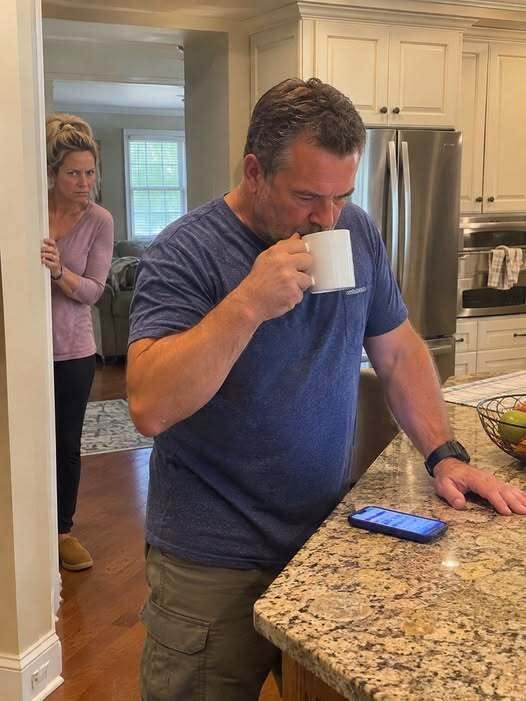
That night, I made his favourite dinner and put the white mug in front of him. The words BEST HUSBAND were beginning to fade from years of washing, but I had never replaced it. Brad looked at the mug and gave a small, sad smile. “I don’t feel much like the best husband lately,” he said. I sat opposite him. “You don’t have to earn that mug every morning,” I replied. “It’s just a mug.” He looked at me, and for a moment I thought he might cry. Then he told me something he had not mentioned at the appointment. He had been forgetting not only conversations, but sometimes the order of familiar tasks. Once, he had stood in the garage holding a screwdriver and forgotten what he had gone there to repair. Another time, he had driven past the turning for our house and continued several streets before recognising where he was. He had been frightened to tell me because he worried I would take his car keys away. I listened carefully. Then I told him that we would discuss driving with the doctor, because safety mattered more than pride. He nodded. It was the first time he had allowed me to say that without becoming defensive.
